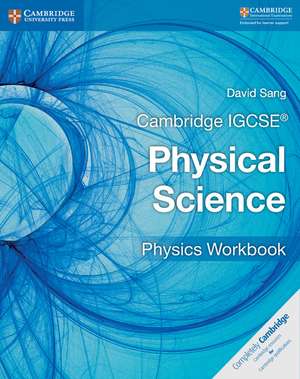
Cambridge IGCSE Physical Science Physics Workbook
Autor David Sangen Limba Engleză Paperback – 16 feb 2017 – vârsta până la 16 ani
Preț: 120.41 lei
Puncte Express: 181
Carte disponibilă
Livrare economică 02-16 noiembrie
Livrare prin curier în România Termenul estimat este afișat lângă disponibilitate.
Transport gratuit de la 400.00 lei Plată online sau ramburs, în funcție de opțiunile comenzii.
Retur gratuit în 14 zile Comandă securizată și suport în română.
Specificații
ISBN-13: 9781316633526
ISBN-10: 1316633527
Pagini: 178
Dimensiuni: 217 x 277 x 12 mm
Greutate: 0.48 kg
Editura: Cambridge University Press
Locul publicării:Cambridge, United Kingdom
ISBN-10: 1316633527
Pagini: 178
Dimensiuni: 217 x 277 x 12 mm
Greutate: 0.48 kg
Editura: Cambridge University Press
Locul publicării:Cambridge, United Kingdom
V-ar putea interesa
-
 Cambridge O Level PhysicsDavid Sang-14%Preț: 207.04 lei240.22 lei
 -
 Cambridge Checkpoint Science Workbook 9Mary Jones-10%Preț: 80.64 lei90.04 lei
Cuprins
Introduction; How to use this book; P1. Making measurements; P1.1 The SI system of units; P1.2 Paper measurements; P1.3 Density data; P1.4 Testing your body clock; P2. Describing motion; P2.1 Measuring speed; P2.2 Speed calculations; P2.3 More speed calculations; P2.4 Distance–time graphs; P2.5 Acceleration; P2.6 Velocity–time graphs; P3. Forces and motion; P3.1 Identifying forces; P3.2 The effects of forces; P3.3 Combining forces; P3.4 Force, mass and acceleration; P3.5 Mass and weight; P3.6 Falling; P4. Turning effects of forces; P4.1 Turning effect of a force; P4.2 Calculating moments; P4.3 Stability and centre of mass; P4.4 Make a mobile; P5. Forces and matter; P5.1 Stretching a spring; P5.2 Stretching rubber; P5.3 Pressure; P6. Energy transformations and energy transfers; P6.1 Recognising forms of energy; P6.2 Energy efficiency; P6.3 Energy calculations; P7. Energy resources; P7.1 Renewables and non-renewables; P7.2 Wind energy; P7.3 Energy from the Sun; P8. Work and power; P8.1 Forces doing work, transferring energy; P8.2 Calculating work done; P8.3 Measuring work done; P8.4 Power; P9. The kinetic model of matter; P9.1 Changes of state; P9.2 The kinetic model of matter; P9.3 Understanding gases; P10. Thermal properties of matter; P10.1 Calibrating a thermometer; P10.2 Demonstrating thermal expansion; P10.3 Thermal expansion; P11. Thermal (heat) energy transfers; P11.1 Conductors of heat; P11.2 Convection currents; P11.3 Radiation; P11.4 Losing heat; P12. Sound; P12.1 Sound on the move; P12.2 Sound as a wave; P13. Light; P13.1 On reflection; P13.2 Refraction of light; P13.3 The changing speed of light; P13.4 A perfect mirror; P13.5 Image in a lens; P14. Properties of waves; P14.1 Describing waves; P14.2 The speed of waves; P14.3 Wave phenomena; P15. Spectra; P15.1 Electromagnetic waves; P15.2 Using electromagnetic radiation; P16. Magnetism; P16.1 Attraction and repulsion; P16.2 Make a magnet; P16.3 Magnetic fields; P17. Static electricity; P17.1 Attraction and repulsion; P17.2 Moving charges; P17.3 Static at home; P18. Electrical quantities; P18.1 Current in a circuit; P18.2 Current and charge; P18.3 Electrical resistance; P18.4 Electrical energy and power; P19. Electric circuits; P19.1 Circuit components and their symbols; P19.2 Resistor combinations; P19.3 More resistor combinations; P19.4 Electrical safety; P20. Electromagnetism; P20.1 Using electromagnetism; P20.2 Electricity generation; P20.3 Transformers; P21. The nuclear atom; P21.1 The structure of the atom; P21.1 Isotopes; P22. Radioactivity; P22.1 The nature of radiation; P22.2 Radioactive decay equations; P22.3 Radioactive decay; Answers.
Descriere
Cambridge IGCSE® Physical Science resources tailored to the 0652 syllabus for first examination in 2019, and all components of the series are endorsed by Cambridge International Examinations.