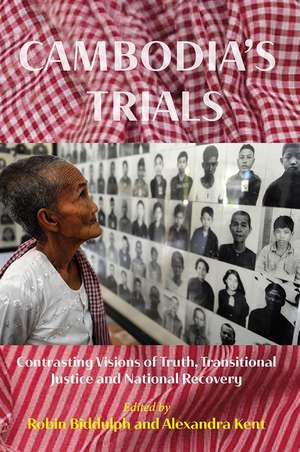
Cambodia's Trials: Contrasting Visions of Truth, Transitional Justice and National Recovery
Editat de Robin Biddulph, Alexandra Kenten Limba Engleză Paperback – 29 dec 2023
More than four decades have passed since the end of Khmer Rouge rule in Cambodia in 1979. Even so, the country is still coming to terms with the destruction wrought in the decade when the Khmer Rouge won and held power and, thereafter, during their guerrilla resistance to the new regime in Phnom Penh until 1998. The Khmer Rouge Tribunal (or Extraordinary Chambers in the Court of Cambodia, ECCC), established in 2006 to bring the Khmer Rouge leadership to justice, has long been the focus of scholarly attention in Cambodia’s recovery. In many ways a product of the 1990s, a time when liberal democracy appeared to be on the rise both in Cambodia and internationally, the ECCC was imagined as a ‘Transitional Justice’ initiative – while delivering justice it should also ease the transition to liberal democracy. This compelling study argues that approach is dated. The political circumstances in which the ECCC was born have changed profoundly, both globally and locally. No longer can Cambodia’s current situation be analysed solely in terms of transitional justice narratives or the work of the ECCC. Other ways in which Cambodians have come to terms with their past, and built new lives, must also be considered. Decentring the ECCC in the scholarly narrative of Cambodia’s recovery, the volume’s authors offer fascinating new insights into the Khmer Rouge period and more recent years of social, cultural and political change in Cambodia.
Preț: 259.14 lei
Puncte Express: 389
Carte indisponibilă temporar
Doresc să fiu notificat când acest titlu va fi disponibil:
Se trimite...
Specificații
ISBN-13: 9788776943318
ISBN-10: 8776943313
Pagini: 400
Ilustrații: 10 halftones, 1 map
Dimensiuni: 152 x 229 x 23 mm
Greutate: 0.48 kg
Editura: Nus Press Pte Ltd
Colecția NIAS Press
ISBN-10: 8776943313
Pagini: 400
Ilustrații: 10 halftones, 1 map
Dimensiuni: 152 x 229 x 23 mm
Greutate: 0.48 kg
Editura: Nus Press Pte Ltd
Colecția NIAS Press
Cuprins
Preface
Contributors
Introduction: Beyond Transitional Justice: Cambodians’ Continuing Struggles for Truth in a Troubled World
Section 1: Context
1. ‘Egregious Dysfunctions’: Transitional Justice in Cambodia’s Limited Access Order
2. Khmers Rouges and Khmer Rights
3. The Rhetoric and Language of Justice at the ECCC
4. Narratives of Complex Political Victims: Constructing Victimhood and Negotiating ‘Khmer Rouge’ Identity in Post-Conflict Cambodia
Section 2: Interactions
5. Upholding the Right to Effective Legal Representation in Cambodia: Lessons Learned from the Extraordinary Chambers in the Courts of Cambodia
6. The Extraordinary Chambers in the Courts of Cambodia: Failed Justice or Catalyst for Transformation?
7. Outsourcing Outreach: “Counter-Translation” of Outreach Activities at the Extraordinary Chambers in the Courts of Cambodia
8. Violent Ruptures, Collective Memory and the Temporal Borders of the ECCC in a Cambodian Village
Section 3: Beyond
9. Ecocide in the Shadow of Transitional Justice: Genocidal Priming and the March of Modernity
10. Beyond Transition: Local Experiences of Change in the Forty Years Since the Fall of Democratic Kampuchea
11. The Dead, Haunting, and Reordering Cambodian Society After the Khmer Rouge
12. From Khmer Rouge Soldier to Guardian Spirit: Memorialization, Transformation, and Reunification
Colour Illustrations
Index
Contributors
Introduction: Beyond Transitional Justice: Cambodians’ Continuing Struggles for Truth in a Troubled World
Section 1: Context
1. ‘Egregious Dysfunctions’: Transitional Justice in Cambodia’s Limited Access Order
2. Khmers Rouges and Khmer Rights
3. The Rhetoric and Language of Justice at the ECCC
4. Narratives of Complex Political Victims: Constructing Victimhood and Negotiating ‘Khmer Rouge’ Identity in Post-Conflict Cambodia
Section 2: Interactions
5. Upholding the Right to Effective Legal Representation in Cambodia: Lessons Learned from the Extraordinary Chambers in the Courts of Cambodia
6. The Extraordinary Chambers in the Courts of Cambodia: Failed Justice or Catalyst for Transformation?
7. Outsourcing Outreach: “Counter-Translation” of Outreach Activities at the Extraordinary Chambers in the Courts of Cambodia
8. Violent Ruptures, Collective Memory and the Temporal Borders of the ECCC in a Cambodian Village
Section 3: Beyond
9. Ecocide in the Shadow of Transitional Justice: Genocidal Priming and the March of Modernity
10. Beyond Transition: Local Experiences of Change in the Forty Years Since the Fall of Democratic Kampuchea
11. The Dead, Haunting, and Reordering Cambodian Society After the Khmer Rouge
12. From Khmer Rouge Soldier to Guardian Spirit: Memorialization, Transformation, and Reunification
Colour Illustrations
Index
Recenzii
“Cambodia's Trials renews the literature devoted to the ECCC (in particular on the hybrid formula of the institution, on the trials, etc.) by bringing together seasoned researchers who are exploring little-explored terrain, and by putting them into dialogue… The strength of this assemblage is finally to make heard voices too often neglected, those of Cambodians in rural areas, and to give access to a complex Cambodian reality.”
“Cambodia's Trials emerges as a pivotal text in the discourse on transitional justice, particularly in the context of Southeast Asia's tumultuous history…. [it] is an essential read for scholars, policymakers and practitioners engaged in transitional justice, Southeast Asian studies and human rights. Its comprehensive analysis, critical insights and forward-looking perspectives significantly contribute to understanding the complexities of reconciling with a troubled past. It not only enriches the academic discourse on transitional justice but also serves as a guide for future efforts to address historical injustices in Cambodia and beyond.”