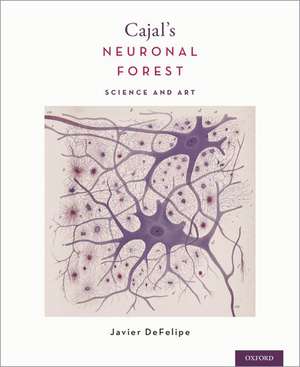
Cajal's Neuronal Forest: Science and Art
Autor Javier DeFelipeen Limba Engleză Hardback – 21 dec 2017
Cajal's Neuronal Forest: Science and Art continues the tradition set forth by its sister volume Cajal's Butterflies of the Soul (OUP, 2009). This new collection contains hundreds of beautiful rarely-seen-before figures produced throughout the nineteenth century and the beginning of the twentieth century by famed father-of-modern-neuroscience Santiago Ramón y Cajal (1852-1934) and his contemporaries. Cajal was captivated by the beautifulshapes of the cells of the nervous system. He and his fellow scientists saw neurons as trees and glial cells as bushes. Given their high density and arrangement, neurons and glial resembled a thick forest, a seemingly impenetrable terrain of interacting cells mediating cognition and behavior. In unraveling the mysteries of thebrain, these researchers encountered an almost infinite number of cellular forms with an extraordinary beauty, which they could not help but put pen to paper, allowing them to discover a new artistic world- the neuronal forest- that gave free rein not only to their imagination, but to a new way of viewing the brain as well. This book has been divided into two parts. The first focuses on the scientific atmosphere in Cajal's times, on the history of the neuron, and the anatomical challenge posed in studying neuronal connections. It also delves into the artistic skills of Cajal and other important pioneers in neuroscience and how the neuronal forests have served as an unlimited source of artistic inspiration. The second consists of 275 original drawings by Cajal. All were published over the course of his scientificcareer and cover virtually all of his research fields of interest, including the spinal cord, the optic lobe and retina, cerebral cortex, and many other regions of the brain. Cajal's Neuronal Forest: Science and Art is a testament to the natural beauty found in science. Despite the common misconception that the drawings of Cajal and other scientists of the time are pieces of art, these drawings are in fact copies of histological preparations and contributed greatly to the discoveries made in the field of neuroscience. This book is a gem in any library, whether serving as a medical history or a gallery of stunning sketches.
Preț: 724.71 lei
Preț vechi: 1042.30 lei
-30%
Carte tipărită la comandă
Livrare economică 27 noiembrie-08 decembrie
Specificații
ISBN-10: 0190842830
Pagini: 512
Dimensiuni: 229 x 282 x 31 mm
Greutate: 2.06 kg
Editura: Oxford University Press
Colecția OUP USA
Locul publicării:New York, United States
V-ar putea interesa
-
 Cajal and de Castro's Neurohistological MethodsMiguel A. Merchán-26%Preț: 619.07 lei837.96 lei
 -
 Cajal's Degeneration and Regeneration of the Nervous SystemSantiago Ramon y. Cajal-32%Preț: 1534.16 lei2272.60 lei
 -
 The Pleasure Center: Trust Your Animal InstinctsMorten L. Kringelbach-20%Preț: 260.78 lei326.13 lei
 -
 -27%Preț: 498.76 lei685.91 lei
 -
 -33%Preț: 692.60 lei1032.91 lei
 -
 Imaging the Aging BrainWilliam Jagust-32%Preț: 1091.63 lei1615.51 lei
 -
 Fiber Pathways of the BrainJeremy Schmahmann-32%Preț: 1010.02 lei1475.00 lei
 -
 Creating Modern Neuroscience: The Revolutionary 1950sGordon M Shepherd MD, DPhil-32%Preț: 528.62 lei782.99 lei
 -
 Cajal's Butterflies of the Soul: Science and ArtJavier DeFelipe-32%Preț: 903.11 lei1327.40 lei
 -
 -18%Preț: 307.49 lei373.13 lei
 -
 The Brain as a Tool: A Neuroscientist's AccountRay Guillery-28%Preț: 494.63 lei688.91 lei
 -
 Introduction to Neuroimaging AnalysisMark Jenkinson-17%Preț: 328.68 lei396.88 lei
 -
 The Brain, Emotion, and DepressionEdmund T. RollsPreț: 344.21 lei
 -
 Inside Psychology: A science over 50 yearsPat Rabbitt-30%Preț: 498.21 lei712.02 lei
 -
 The neurophysiological foundations of mental and motor imageryAymeric Guillot-32%Preț: 809.30 lei1198.52 lei
 -
 -25%Preț: 1215.58 lei1627.24 lei
 -
 -30%Preț: 388.44 lei551.80 lei
 -
 Preț: 295.22 lei
 -
 The Neuroscience of AdolescenceAdriana GalvánPreț: 284.97 lei
 -
 The Beautiful BrainLarry Swanson-18%Preț: 245.33 lei297.56 lei
 -
 -5%Preț: 2113.52 lei2224.75 lei
 -
 The 3-Dimensional Atlas of the Marmoset BrainAtsushi Iriki-18%Preț: 1282.18 lei1563.63 lei
 -
 The 3D Stereotaxic Brain Atlas of the DeguNoriko Kumazawa-Manita-15%Preț: 666.39 lei783.99 lei
 -
 COMPEN VIVO MONIT REAL-TIME (V2)Wilson George S-18%Preț: 1042.62 lei1271.49 lei
Recenzii
All neuroscientists can find illustrations of their preferred part of the brain in this book.
In a treasure trove of Cajal's drawings, the author traces the discovery of the types and connectivity of neurons, the deduction that bulbous spine endings provide the elements for the transmission of nerve impulses, and schema of direction of current flow in different brain regions. Cajal's Neuronal Forest is a remarkable resource for anyone interested in Cajal's scientific genius, his artistry and the origins of the Neuron Theory.
Javier DeFelipe has assembled a special volume dedicated to Cajal's lifetime contributions to the field of Neuroscience. This collection of Cajal's full-size, hand-made drawings provides higher resolution images than those found in his Textura or Histologie volumes.
Everyone interested in how the brain works should own and display a copy of this spectacular book.
Notă biografică
Javier DeFelipe is a Research Professor at the Instituto Cajal (CSIC), Madrid, Spain. His main area of expertise lies in the microanatomy of the cerebral cortex. The frequent citation of his work in the scientific literature reflects the variety and excellence of his numerous contributions. Prof. DeFelipe is also fascinated by the link between the study of the brain and art and has been involved in organizing and curating numerous exhibitions around the world. Hehas written several articles, chapters and books on both this subject and the influence of Santiago Ramón y Cajal in modern neuroscience.
Cuprins
- Table of Contents
- Foreword Ramon Areces Foundation
- Foreword Spanish Foundation to Science and Technology
- Foreword Tatiana Perez De Guzman El Bueno Foundation
- Foreword by Pasko Rakic
- Preface
- Part I: Introduction
- Introductory Remarks
- A Note on Microphotography and Illustrations of Histological Preparations
- The Anatomical Challenge of the Study of Neuronal Connections
- Section A: The Scientific Atmosphere in Cajal's Times
- The Discovery of the Reazione Nera: Commencing the Detailed Study of the Structure of the Nervous System
- The Discovery of the Golgi Method by Cajal and the Influence of Maestre De San Juan and Simarro
- Drawing as a Tool to Illustrate Microscopic Images
- Differences in the Interpretation of the Microscopic World
- Neuron Doctrine versus the Reticular Theory
- The Reticular Theory and Precursors of the Neuron Theory
- Golgi, Cajal and the Nobel Prize Lectures in 1906
- The Law of Dynamic Polarization of Nerve Cells
- Introduction of the Term "Neuron" and the Renascence of Reticularism
- Confirmation of the Free Ending of the Nervous Processes: The Discovery
- of the Synaptic Cleft
- Neoreticularism and the Neuron Doctrine in the Present Day
- Dendritic Spines: True Anatomical Structures versus Artifact
- Dendritic Spines and the Methylene Blue Method
- Other Interpretations of the Dendritic Spines
- Dendritic Spines and Cajal's 'Final Lesson'
- Confirmation that Dendritic Spines are Postsynaptic Structures
- Combination of the Golgi Method and Electron Microscopy
- Dendritic Spines: Their Features and Role as a Key Component in Microcircuits
- Section B: The Golden Era for Artistic Creativity in Neuroscience
- Artistic Skills and Emotions of Cajal and Other Early Neuroanatomists
- Verification of the Drawings of Cajal and Other Scientists
- The Neuronal Forest as a Source of Artistic Inspiration
- Summary, Final Considerations and Concluding Remarks
- Notes
- Bibliography
- Part II: Gallery of Cajal's Drawings
- Section A: Spinal Cord
- Section B: Medulla Oblongata
- Section C: Cerebellum and Deep Cerebellar Nuclei
- Section D: Midbrain and Thalamus
- Section E: Optic Lobe of Lower Vertebrates
- Section F: Retina of Vertebrates
- Section G: Cerebral Cortex and Olfactory Apparatus
- Section H: Degeneration and Regeneration of the Nervous System
- Section I: Retina and Optic Centers of Cephalopods
- Section J: Insect Brain: Visual System
- Section K: Supplementary Figures
- Author Index