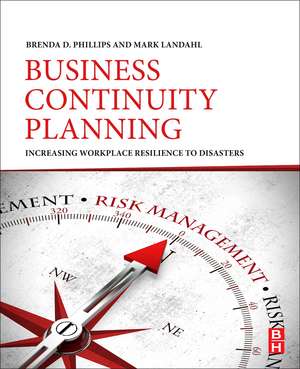
Business Continuity Planning: Increasing Workplace Resilience to Disasters
Autor Brenda D. Phillips, Mark Landahlen Limba Engleză Paperback – 26 noi 2020
Observăm că, deși informațiile despre reziliența organizațională sunt abundente, literatura academică a dus lipsă de un instrument care să traducă terminologia complexă în pași executabili pentru entități de orice dimensiune. Business Continuity Planning vine să completeze această lacună, oferind un cadru metodologic riguros, dar accesibil, menit să elimine barierele de planificare ce blochează adesea progresul managerilor de risc. Considerăm că volumul semnat de Brenda D. Phillips și Mark Landahl reprezintă o evoluție firească în opera autorului principal. Dacă în Introduction to Emergency Management and Disaster Science accentul era pus pe fundamentele teoretice ale disciplinei, iar în Disaster Recovery pe managementul post-eveniment, lucrarea de față se concentrează strict pe mecanismele de menținere a viabilității comerciale în timpul crizelor, inclusiv în contextul recent al pandemiei.
Structura cărții urmărește o progresie logică: începe cu analiza provocărilor și a tipologiilor de dezastre (de la tsunami la atacuri cibernetice), continuând cu formarea echipelor și implicarea părților interesate. Credem că elementul distinctiv este caracterul său de „antrenor” de planificare, capitolul dedicat stabilirii contextului și captării atenției decidenților fiind crucial pentru implementarea unei culturi a continuității. Descoperim aici un echilibru între rigoarea academică și utilitatea practică, susținut de exemple din dezastre recente.
Ca alternativă la Disaster Recovery, Crisis Response, and Business Continuity de Jamie Watters pentru cursurile de planificare strategică, acest volum aduce avantajul unei metodologii bazate pe dovezi (evidence-based) și a unor resurse gata de utilizat, precum șabloanele de lucru, care facilitează trecerea imediată de la teorie la execuție, indiferent de scara afacerii.
Preț: 405.24 lei
Preț vechi: 663.98 lei
-39%
Carte tipărită la comandă
Livrare economică 19 noiembrie-03 decembrie
Specificații
ISBN-10: 0128138440
Pagini: 194
Dimensiuni: 191 x 235 mm
Greutate: 0.35 kg
Editura: ELSEVIER SCIENCE
V-ar putea interesa
-
 Introduction to International Disaster ManagementDamon P. Coppola-25%Preț: 600.91 lei801.21 lei
 -
 What's Stopping You?Timothy ArmooPreț: 122.61 lei
 -
 WreckersSimon ParkPreț: 188.88 lei
 -
 How to Survive a CrisisDavid Omand-25%Preț: 63.90 lei85.20 lei
 -
 Resilience: Why Things Bounce BackAndrew Zolli-7%Preț: 73.88 lei79.56 lei
 -
 Preț: 448.54 lei
 -
 Preț: 238.15 lei
 -
 -19%Preț: 582.58 lei719.24 lei
 -
 Preț: 124.30 lei
 -
 The New Nature of BusinessAndre HoffmannPreț: 116.02 lei
 -
 -26%Preț: 106.06 lei143.86 lei
 -
 -31%Preț: 129.90 lei188.70 lei
 -
 Disrupt EverythingJames PattersonPreț: 122.07 lei
 -
 Preț: 135.23 lei
 -
 InevitableMike ColiasPreț: 195.49 lei
 -
 LifehouseAdam GreenfieldPreț: 92.16 lei
 -
 Business Start Up and Future PlanningGordon Clarke-19%Preț: 63.07 lei77.88 lei
 -
 -20%Preț: 277.69 lei347.11 lei
 -
 LET It HappenMau Espinosa-11%Preț: 83.92 lei93.89 lei
Public țintă
Primary: Emergency Managers, Business Continuity Planners, and Risk Managers.Secondary: Emergency Management education/degree programs.
De ce să citești această carte
Recomandăm această carte managerilor de urgență și profesioniștilor din risk management care au nevoie de un parcurs clar pentru securizarea activității. Cititorul câștigă acces la proceduri standardizate și instrumente practice (checklists) care transformă un proces birocratic greoi într-o strategie de reziliență activă. Este un suport esențial pentru programele de studii superioare, oferind o perspectivă actualizată asupra amenințărilor contemporane, inclusiv riscurile biologice și tehnologice.
Cuprins
Chapter One. The Challenges of Business Continuity Planning
Introduction
What Most Businesses Do (Not Do) in a Disaster
Hazards that Become (Business) Disasters
- Natural Hazards
- Tsunamis and Cascading Events
- Hurricanes and Cyclones
- Floods
- Earthquakes
- Volcanos
- Tornadoes
- Hazardous Materials
- Technological Disruptions
- Terrorism and Active Attackers
- Pandemics
Types of Disaster Planning
- Mitigation Planning
- Preparedness and Planning
- Response Planning
- Recovery and Business Continuity Planning
The Benefits of Business Continuity Planning (BCP)
- Mission fulfillment
- The financial bottom line
- Loss containment
- Customer bases
- Human resources
- Diversity in the business community
Essential Principles for BC Planning
- Involvement and inclusion
- Planning is a process
- Evidence-based planning
- A culture of continuity
Upcoming Chapters
Chapter Two. Setting the Stage
The Challenges of Business Continuity Planning
- Getting people’s attention
- Securing a commitment from the CEO
- Lack of knowledge or understanding
- Educating and involving people on planning as a process
The Effects of Disasters on Businesses
- Direct impacts
- Indirect impacts
- Downtime
- Displacement
- Impacts on employees
- Impacts on customers
- Businesses that fail
Essential Actions for Starting the Planning Process
- Get a team together
- Establish a timeline
- Kick off the BCP effort
- Build and maintain momentum
Chapter Three. Pre-planning Steps to Launch BCP
Introduction
Hazard Identification
- Sources of hazard information
- How to write up a hazard identification
Risk Assessment
- Understanding probabilities and historic trends
- Crafting Scenarios
Loss Estimation
- Kinds of losses to estimate
- Broader community impacts
Business impact analysis
Determining Acceptable Losses
Mitigating Losses
Essential Actions
Chapter Four. Parts of a Business Continuity Plan
Scenarios and Decision-Making
- Pandemic
- Technology Disruptions
- Natural Disasters
Critical Functions
- Prioritizing Critical Functions
- Work Teams
Assets and Workarounds
Essential Partnerships
Essential Actions to Take
Chapter Five. Managing Disruptions
Introduction
Infrastructure Disruptions
- Anticipating Disruptions
- Utilities
- Communication and Information Technology
- Transportation arteries and supply chains
Downtime Management
- How utilities get back on
- The role of critical function work teams
Displacement Management
- Site displacement
- Functional displacement
- Population displacement
Restoring Critical Functions
Essential Actions
Chapter Six. Managing Human Resources
Introduction
Case Examples
- Terrorism
- Natural Disaster
- Pandemic
The Critical Role of Human Resources Management
- Business Continuity Planning for Human Resource Management
- Preparing Employees for Disruptions
What Employees May Experience
- Personal Impacts
- Professional Impacts
What Employers May Experience
- Coping with Employee Impacts
- Coping with Immediate Business Impacts
Navigating Recovery
- Transitioning from Response to Recovery
- The 2004 Tsunami
- The 1989 Loma Prieta Earthquake
- Recognizing and Rewarding Employees
Essential Actions
Chapter 7. Strengthening and Testing your Business Continuity Plan
Introduction
Training on the BCP
- Why you need to know the plan
- Teachable moments
- Training options
- What to train on
Creating scenarios
· Exercises
- Tabletop
- Full scale
- Field
Virtual/Simulations
· Creating a culture of preparedness
Essential Actions
Chapter 8. Becoming More Resilient
Introduction
- Disaster losses and future predictions
Resilience
- The Sendai Framework
Mitigation
- The purpose of mitigation
- Becoming a champion for mitigation
The Recovery Process
- Employee support
- Flexibility
- Sustainability
Essential Actions
Appendix 1. Emergency Response Planning Basics 2. Mitigation Planning Basics 3. Essential Tools and Resources for BCP (worksheets, checklists, etc.)
Descriere
Terrorism, natural disasters, or hazardous materials threaten the viability for all types of businesses. With an eye toward business scale, scope, and diversity, Business Continuity Planning: Increasing Workplace Resilience to Disasters, addresses a range of potential businesses from home-based to large corporations in the face of these threats, including the worldwide COVID-19 pandemic. Information on business continuity planning is easy to find but can be difficult to work through. Terminology, required content, and planning barriers often prevent progress. This volume solves such problems by guiding readers, step-by-step, through such actions as identifying hazards and assessing risks, writing critical functions, forming teams, and encouraging stakeholder participation. In essence, this volume serves as a business continuity planning coach for people new to the process or seeking to strengthen and deepen their ongoing efforts. By engaging stakeholders in a business continuity planning process, businesses can protect employees, customers, and their financial stability. Coupled with examples from recent disasters, planners will be able to inspire and involve stakeholders in creating a more resilient workplace. Designed for both educators and practitioners, Business Continuity Planning: Increasing Workplace Resilience to Disasters walks users through how to understand and execute the essential steps of business continuity planning.
- Presents evidence-based best practices coupled with standard operating procedures for business continuity planning in a stepwise, user-oriented manner
- Includes numerous examples and case studies bringing the ideas and procedures to life
- Provides user-friendly materials and resources, such as templated worksheets, checklists, and procedures with clear instructions, making the volume engaging and immediately operational