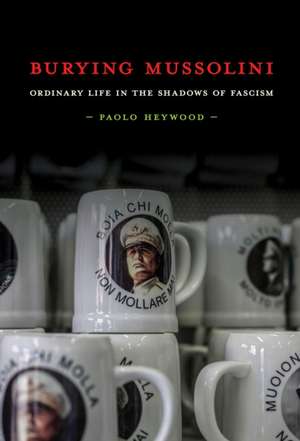
Burying Mussolini
Autor Paolo Heywooden Limba Engleză Paperback – 15 dec 2024
As politicians, commentators, and social scientists seek to understand what lies behind new forms of political authoritarianism, and whether and how they resemble movements once thought consigned to the past, Burying Mussolini narrates how people in Predappio cope with the dark heritage of their home by carefully crafting a sense of 'ordinariness' that is itself inflected by ghosts of their fascist past.
Preț: 210.54 lei
Puncte Express: 316
Carte disponibilă
Livrare economică 17 noiembrie-01 decembrie
Livrare express 03-07 noiembrie pentru 24.90 lei
Livrare prin curier în România Termenul estimat este afișat lângă disponibilitate.
Transport gratuit de la 400.00 lei Plată online sau ramburs, în funcție de opțiunile comenzii.
Retur gratuit în 14 zile Comandă securizată și suport în română.
Specificații
ISBN-13: 9781501778285
ISBN-10: 1501778285
Pagini: 204
Dimensiuni: 148 x 225 x 13 mm
Greutate: 0.32 kg
Editura: Cornell University Press
ISBN-10: 1501778285
Pagini: 204
Dimensiuni: 148 x 225 x 13 mm
Greutate: 0.32 kg
Editura: Cornell University Press
Notă biografică
Paolo Heywood is Associate Professor of anthropology at Durham University. He is the author of After Difference, editor of New Anthropologies of Italy, and the co-editor of Beyond Description.
Cuprins
Introduction: The Fascist Parenthesis
1. Fascism and the Social Life of"Ordinary Life"
2. Ordinary Exemplars and the Moralization of the Everyday
3. The "Carnival of Mussolini" and How to Pretend It Isn't Happening
4. Everyday Space and Walking in the Fascist City
5. Ordinary Skepticism and Fascist Family Resemblances
6. Recycling the Past and the"Museum of Fascism"
Conclusion: Anthropology after Fascism
1. Fascism and the Social Life of"Ordinary Life"
2. Ordinary Exemplars and the Moralization of the Everyday
3. The "Carnival of Mussolini" and How to Pretend It Isn't Happening
4. Everyday Space and Walking in the Fascist City
5. Ordinary Skepticism and Fascist Family Resemblances
6. Recycling the Past and the"Museum of Fascism"
Conclusion: Anthropology after Fascism