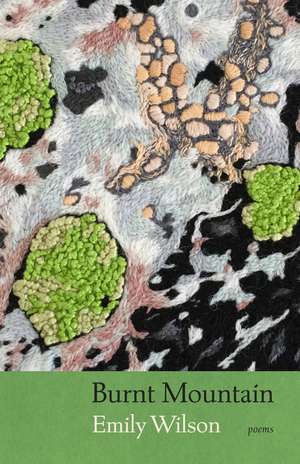
Burnt Mountain: Kuhl House Poets
Autor Emily Wilsonen Limba Engleză Paperback – 21 oct 2025
Din seria Kuhl House Poets
-
 Preț: 107.64 lei
 -
 Preț: 100.63 lei
 -
 Preț: 107.84 lei
 -
 Preț: 108.17 lei
 -
 Preț: 116.33 lei
 -
 Preț: 149.77 lei
 -
 Preț: 115.27 lei
 -
 Preț: 116.18 lei
 -
 Preț: 116.89 lei
 -
 Preț: 115.62 lei
 -
 Preț: 115.90 lei
 -
 Preț: 133.10 lei
 -
 Preț: 132.22 lei
 -
 Preț: 132.27 lei
 -
 Preț: 131.99 lei
 -
 Preț: 140.35 lei
 -
 Preț: 140.46 lei
 -
 Preț: 140.18 lei
 -
 Preț: 132.56 lei
 -
 Preț: 131.99 lei
 -
 Preț: 140.96 lei
 -
 Preț: 148.65 lei
 -
 Preț: 148.65 lei
 -
 Preț: 141.58 lei
 -
 Preț: 148.44 lei
Preț: 96.08 lei
Nou
Puncte Express: 144
Preț estimativ în valută:
17.01€ • 19.84$ • 14.73£
17.01€ • 19.84$ • 14.73£
Carte disponibilă
Livrare economică 05-19 februarie
Preluare comenzi: 021 569.72.76
Specificații
ISBN-13: 9781685970307
ISBN-10: 1685970303
Pagini: 80
Dimensiuni: 140 x 216 x 8 mm
Greutate: 0.11 kg
Editura: University of Iowa Press
Seria Kuhl House Poets
ISBN-10: 1685970303
Pagini: 80
Dimensiuni: 140 x 216 x 8 mm
Greutate: 0.11 kg
Editura: University of Iowa Press
Seria Kuhl House Poets
Recenzii
“Poetry is rarely so alive as it is in Burnt Mountain’s sublime refusal to relegate landscape to object or backdrop. Here, Emily Wilson documents encounters with fern, trail, rock, and woods in untamed rhythms that current ‘Fust-purple glowering green / helleborine’ directly into the reader’s body-mind. With enthralling awareness of ‘the die-cut spiky lichen- / crush and ash,’ this book continues the remarkable ecological vision that Wilson has cultivated across her body of work, redefining what it means for no mountain or weed or flower or human to ever stand alone.”—Karla Kelsey, author, Transcendental Factory: For Mina Loy
“What a pleasure and privilege it has been for the past quarter-century to witness the dramatic encounters of Emily Wilson’s mind with nature via her singularly exquisite poems. This ‘dark-empaneled’ nature is always adulterated with culture, it is the compromised, damaged nature we know— but Wilson has invented new lenses that bring it closer than it’s ever been before, while simultaneously honoring its essential strangeness. With her terse yet lush lyrics enacting incantatory scenes that glitter with thrilling arrangements of language, Wilson captures emotions, states, and transformations that no other poet can.”—Donna Stonecipher, author, The Ruins of Nostalgia
“There is a thrilling and exacting astringency to Emily Wilson’s new poems, a form of attention that stitches together the ‘spare, sparred and / tender’ things that become perceptible once the space around them is cleared. Promising no pinnacle at which to arrive, Burnt Mountain offers instead a panoply of journeys ‘gullying through the somewhat seen.’ It stands in the bristling between silence and a lavishly threshed-out language, incandescent with the ‘glossy flanges’ of ferns, the ‘sun the chill / blazons in.’ These surpassingly beautiful poems let us feel—even savor—the condition of our own vertiginous precarity.”—Mary Szybist, author, Incarnadine, and winner of the 2013 National Book Award for Poetry
“What a pleasure and privilege it has been for the past quarter-century to witness the dramatic encounters of Emily Wilson’s mind with nature via her singularly exquisite poems. This ‘dark-empaneled’ nature is always adulterated with culture, it is the compromised, damaged nature we know— but Wilson has invented new lenses that bring it closer than it’s ever been before, while simultaneously honoring its essential strangeness. With her terse yet lush lyrics enacting incantatory scenes that glitter with thrilling arrangements of language, Wilson captures emotions, states, and transformations that no other poet can.”—Donna Stonecipher, author, The Ruins of Nostalgia
“There is a thrilling and exacting astringency to Emily Wilson’s new poems, a form of attention that stitches together the ‘spare, sparred and / tender’ things that become perceptible once the space around them is cleared. Promising no pinnacle at which to arrive, Burnt Mountain offers instead a panoply of journeys ‘gullying through the somewhat seen.’ It stands in the bristling between silence and a lavishly threshed-out language, incandescent with the ‘glossy flanges’ of ferns, the ‘sun the chill / blazons in.’ These surpassingly beautiful poems let us feel—even savor—the condition of our own vertiginous precarity.”—Mary Szybist, author, Incarnadine, and winner of the 2013 National Book Award for Poetry
Notă biografică
Emily Wilson is author of The Great Medieval Yellows, Micrographia (Iowa, 2008), and The Keep (Iowa, 2001). A visual artist as well as a writer, Wilson lives in Iowa City, Iowa, and western Maine.
Descriere
Since her first collection, The Keep, Emily Wilson has forged a singular voice in American poetry, one that traces and complicates the dynamic relationships between language and the natural, aesthetics and science, material forms and inwardness. Burnt Mountain is set on the rugged slopes of an inauspicious mountain, densely wooded, long ago scoured by fire, and marked by generations of human presence. Above all, these poems encounter the flickering, flowing matrices of being—“that far-forged interior / Outlandish green and flaming cause unknown”—and give voice to the elemental question of what can and cannot be known or understood—and what can sustain us.