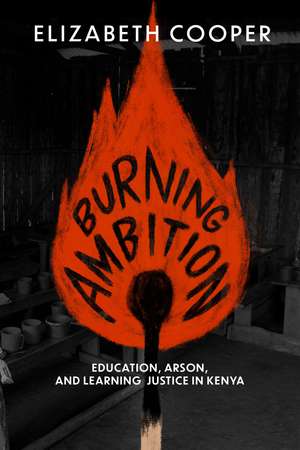
Burning Ambition: Education, Arson, and Learning Justice in Kenya
Autor Elizabeth Cooperen Limba Engleză Hardback – 19 iul 2022
Drawing from years of research and a rich array of sources, Cooper accounts for how school fires stoke a national conversation about the limited means for ordinary Kenyans, and especially youth, to peacefully influence the governance of their own lives. Further, Cooper argues that Kenyan students’ actions challenge the existing complacency with the globalized agenda of “education for all,” demonstrating that submissive despondency is not the only possible response to the failed promises of education to transform material and social inequalities.
Preț: 453.22 lei
Preț vechi: 588.60 lei
-23%
Puncte Express: 680
Preț estimativ în valută:
80.21€ • 93.74$ • 69.64£
80.21€ • 93.74$ • 69.64£
Carte tipărită la comandă
Livrare economică 19 februarie-05 martie
Preluare comenzi: 021 569.72.76
Specificații
ISBN-13: 9780299337902
ISBN-10: 0299337901
Pagini: 232
Ilustrații: 19 b-w illus.
Dimensiuni: 152 x 229 x 28 mm
Greutate: 0.4 kg
Ediția:First Edition
Editura: University of Wisconsin Press
Colecția University of Wisconsin Press
ISBN-10: 0299337901
Pagini: 232
Ilustrații: 19 b-w illus.
Dimensiuni: 152 x 229 x 28 mm
Greutate: 0.4 kg
Ediția:First Edition
Editura: University of Wisconsin Press
Colecția University of Wisconsin Press
Notă biografică
Elizabeth Cooper is an assistant professor in the School for International Studies at Simon Fraser University and a social anthropologist who conducts research concerning children and youth, inequality, and violence, with a primary focus on Kenya.
Cuprins
Contents
List of Illustrations
Acknowledgments
Introduction: Rising Disappointment
1 Kindling Contradictions
2 Striking Students
3 Troubling Unrest
4 Burning Schools
5 Striving for Success
6 Learning Experiences
7 Fighting Fire with Fire
8 Arising from the Ashes
Notes
Works Cited
Index
List of Illustrations
Acknowledgments
Introduction: Rising Disappointment
1 Kindling Contradictions
2 Striking Students
3 Troubling Unrest
4 Burning Schools
5 Striving for Success
6 Learning Experiences
7 Fighting Fire with Fire
8 Arising from the Ashes
Notes
Works Cited
Index
Recenzii
“Well-grounded in social and political theory. . . . Cooper successfully convinces her audience how the ominous and subversive materialities of fire play an important role in the students’ subaltern struggles to attain retributive justice. . . . This book provides a useful anthropological approach that is beneficial to historians, sociological historians, and anthropologists working in the fields of education and justice in post-colonial Africa.”
“Cooper provides a riveting tale of adolescent arsonists in Kenyan secondary schools and the ensuing demands for justice. Her judicious investigation into these cases presents a vital account of precarity and disillusionment in contemporary Kenya.”
“Cooper makes a valuable contribution to the existing literature, extending discussions of Kenyan political culture and moral economic relations into new and valuable spaces. The author convincingly helps us understand the active role that Kenyan youths take in forms of resistance. The voices of the students and the anecdotes illustrate the ways that their experiences are typical within this system and the inclusion of Kenyan intellectual perspectives helps us see how these issues are understood and debated within Kenya. This fine book presents rich ethnographic material that is expertly situated at an important theoretical juncture.”
“A fascinating account of the multiple and sometimes perplexing reasons Kenyan students give for burning and seeking to destroy an institution ostensibly designed to help them: the school. A brilliant and gifted writer, Cooper delivers a significant contribution to anthropological studies of politics and development. This book is a must-read for anyone interested in the social and political tensions surrounding school violence in Kenya and anywhere.”
Descriere
Burning Ambition explores how young people learn to understand and influence the workings of power and justice in their society. Since 2008, hundreds of secondary schools across Kenya have been targeted with fire by their students. Through an in-depth study of Kenyan secondary students' use of arson, Elizabeth Cooper asks why. With insightful ethnographic analysis, she shows that these young students deploy arson as moral punishment for perceived injustices and arson proves an effective tactic in their politics from below.