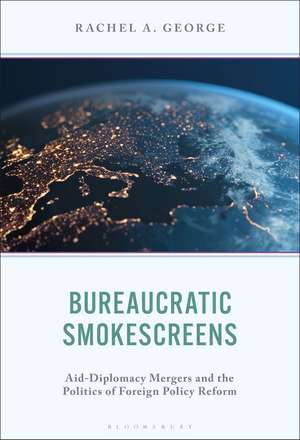
Bureaucratic Smokescreens: Aid-Diplomacy Mergers and the Politics of Foreign Policy Reform: Foreign Policies of the Middle Powers
Autor Rachel A. Georgeen Limba Engleză Hardback – 11 dec 2026
Bureaucratic Smokescreens: Aid-Diplomacy Mergers and the Future of Foreign Policy examines this global trend toward integrating aid and diplomacy and asks a central question: do these mergers actually advance states' foreign policy and security goals? Drawing on a comparative study of five countries over two decades, the book uses interviews with senior officials, civil servants, and activists to trace how institutional restructuring reshapes priorities, incentives, and everyday practice on the ground.
Against a backdrop of rising Chinese development finance, the emergence of alternative aid donors, and a contracting foreign aid landscape, Bureaucratic Smokescreens interrogates whether development and diplomacy can be meaningfully integrated, or whether their effectiveness depends on institutional distinction. It offers timely lessons for U.S. reform efforts and the future of foreign affairs practice.


Preț: 453.99 lei
Preț vechi: 637.50 lei
-29% Precomandă
Puncte Express: 681
Carte nepublicată încă
Livrare prin curier în România Precomanda se expediază când titlul devine disponibil.
Transport gratuit pentru acest produs Plată online sau ramburs, în funcție de opțiunile comenzii.
Retur gratuit în 14 zile Comandă securizată și suport în română.
Doresc să fiu notificat când acest titlu va fi disponibil:
Se trimite...
Specificații
ISBN-13: 9781666960075
ISBN-10: 1666960071
Pagini: 192
Ilustrații: 8 figures
Dimensiuni: 152 x 229 x 25 mm
Greutate: 0.45 kg
Editura: Bloomsbury Publishing
Colecția Bloomsbury Academic
Seria Foreign Policies of the Middle Powers
Locul publicării:New York, United States
ISBN-10: 1666960071
Pagini: 192
Ilustrații: 8 figures
Dimensiuni: 152 x 229 x 25 mm
Greutate: 0.45 kg
Editura: Bloomsbury Publishing
Colecția Bloomsbury Academic
Seria Foreign Policies of the Middle Powers
Locul publicării:New York, United States
Cuprins
Introduction
PART I. The Intersections of Development and Diplomacy
Chapter 1: Development and Diplomacy: Twin Fields or Isolated Islands?
Chapter 2: To Merge or Not to Merge? When Debates on Efficiency and Effectiveness Build New Bureaucracies
PART II. A Global Trend: Exploring Efforts to Integrate Development and Diplomacy
Chapter 3: Denmark
Chapter 4: Norway
Chapter 5: Australia
Chapter 6: Canada
Chapter 7: United Kingdom
Part III. Implications
Chapter 8: Mergers on the Agenda - the USA
Chapter 9: Bureaucratic Smokescreens: Lessons in the Search for New Approaches to Global Challenges
Recenzii
Bureaucratic Smokescreens offers a timely and trenchant analysis of the place of development aid in foreign policy. Rachel George cuts through the contemporary political assertion in many Western donor nations of the gains to be had from merging development and diplomacy bureaucracies. Her first of its kind comparative study highlights that realizing gains in practice requires a strategic clarity that is sorely lacking in a discourse focused on bureaucratic design.
What is aid's rightful place in foreign policy? That is the key question asked in Bureaucratic Smokescreens. The demolition of the US Agency for International Development has prompted much debate on whether and in what form its resurrection might take under an aid-friendly administration. Practitioners would be well advised to read Rachel's George book, which analyzes how other countries have grappled with aid reform and confronted organizational dilemmas that defy easy answers.
Scholars have paid far too little attention to the practical impacts of Aid-Diplomacy mergers. Fortunately for scholars and practitioners alike, Rachel George has stepped into the breach with this important book. It will serve as an invaluable guide to why aid-diplomacy mergers so often disappoint, and what reformers should do differently to avoid repeating the same mistakes.
Are countries better off integrating or separating diplomatic and foreign aid functions? In Bureaucratic Smokescreens, Rachel George provides the most extensive examination to date of the relationship between aid and diplomacy bureaucracies. George's analysis shows that the track record of mergers of aid and diplomacy is underwhelming, but skilled leadership, clear strategic direction, and the protection of bureaucratic expertise can make efforts to integrate aid and diplomacy more successful.