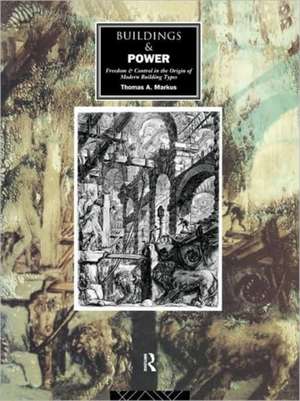
Buildings and Power: Freedom and Control in the Origin of Modern Building Types
Autor Thomas A. Markusen Limba Engleză Paperback – 30 sep 1993
Lavishly illustrated with photographs, drawings, maps and plans, Buildings and Power analyses architectural form, function and space to explore the reproduction and the subversion of power in the modern city.
Preț: 711.90 lei
Preț vechi: 868.18 lei
-18%
Puncte Express: 1068
Carte tipărită la comandă
Livrare economică 07-21 decembrie
Livrare prin curier în România Termenul estimat este afișat lângă disponibilitate.
Transport gratuit pentru acest produs Plată online sau ramburs, în funcție de opțiunile comenzii.
Retur gratuit în 14 zile Comandă securizată și suport în română.
Specificații
ISBN-13: 9780415076654
ISBN-10: 041507665X
Pagini: 368
Dimensiuni: 210 x 280 x 24 mm
Greutate: 1.34 kg
Ediția:New.
Editura: Taylor & Francis
Colecția Routledge
Locul publicării:Oxford, United Kingdom
ISBN-10: 041507665X
Pagini: 368
Dimensiuni: 210 x 280 x 24 mm
Greutate: 1.34 kg
Ediția:New.
Editura: Taylor & Francis
Colecția Routledge
Locul publicării:Oxford, United Kingdom
V-ar putea interesa
-
 The Poetics of SpaceGaston Bachelard-28%Preț: 78.50 lei108.40 lei
 -
 Architecture DependsJeremy TillPreț: 142.55 lei
 -
 Why We BuildRowan Moore-41%Preț: 63.96 lei108.59 lei
 -
 The Words Between the Spaces: Buildings and LanguageDeborah Cameron-15%Preț: 516.51 lei607.66 lei
 -
 -15%Preț: 482.84 lei568.04 lei
 -
 Mass Customisation and Personalisation in Architecture and ConstructionPoorang Piroozfar-15%Preț: 424.63 lei499.57 lei
 -
 The Contradiction Between Form and Function in ArchitectureJohn Shannon Hendrix-15%Preț: 461.72 lei543.20 lei
 -
 PeripheriesRuth Morrow-15%Preț: 438.34 lei515.69 lei
 -
 Thinking ArchitecturePeter ZumthorPreț: 261.74 lei
 -
 -21%Preț: 266.17 lei337.52 lei
Cuprins
Introduction Part I: Some Underlying Ideas 1. The Shape of the Argument 2. Why Can We Use Buildings? Part II: Buildings and People 3. Formation 4. Re-Formation 5. Cleanliness is next to Godliness 6. Re-Creation Part III: Buildings and Knowledge 7. Visible Knowledge 8. Emphmeral Knowledge 9. Invisible Knowledge Part IV: Buildings and Things 10. Production 11. Exchange Part V: Concluding Remarks Notes Biography Knowledge
Recenzii
'Markus's approach is not the only one available ... but it fulfils a vital function in raising more questions than it answers ... academic playground antics continue to hinder the development of new insights. Precisely because of this, the book will act as one of the bench marks to which the debate about architecture will refer. Everyone will find something to argue with, for this reason alone it should be read.' - Building Design
'You could call it the illustrated Foucault: it is an extraordinary, lavishly illustrated account ... the illustrations and commentaries are brilliant.' - RSA Journal
'The publishers and the printers of this book must be congratulated for the superb quality of the illustrations. Over 300 photographs, drawings and engravings are produced with silky black-and-white tones and contribute to making this work one of the best books on architectural and social history in a long time.' - Irish Times
'The outstanding feature is Markus' precision and exhaustive learning. To chart the historical evolution of even one type of building without error or omission is an achievement. Markus performs flawlessly across every field.. . the result of these endeavors, then, is a book of extraordinary and lasting value.' - Architecture Today
'Markus provides a valuable and powerful argument for placing the social context over evaluation of architecture as merely art, technological advancement or a component in an economic system ... The author's saluatory remark identifies the challenge to architects to demonstrate the added value of appropriate social meaning in their designs. This, though is one of the many questions addressed in this stimulating book, of which its own added value is its scholarship.' - Architectural Review
'Many of Markus' cases are unfamiliar and fascinating ... illustration is wonderfully profuse with plenty of plans. Much credit to the author for uncovering and bringing together all this interesting material.' - The Architects' Journal
'Dry but crunchy: architecture with morality.' - Modern Review
'This study is without doubt a very substantial contribution to our historical knowledge and makes the reader think much harder about the functional narrative and spatial organization of buildings.' - Journal of Environmental Psychology
'Rather than "decoding" architecture through words, understand it through images as Markus does, or better still go and see it.' - Times Higher Education Supplement
'The outstanding feature is Markus' precision and exhaustive learning. To chart the historical evolution of even one type of building without error or omission is an achievement. Markus performs flawlessly across every field ... the result of these endeavours, then, is a book of extraordinary and lasting value.' - Architecture Today
'You could call it the illustrated Foucault: it is an extraordinary, lavishly illustrated account ... the illustrations and commentaries are brilliant.' - RSA Journal
'The publishers and the printers of this book must be congratulated for the superb quality of the illustrations. Over 300 photographs, drawings and engravings are produced with silky black-and-white tones and contribute to making this work one of the best books on architectural and social history in a long time.' - Irish Times
'The outstanding feature is Markus' precision and exhaustive learning. To chart the historical evolution of even one type of building without error or omission is an achievement. Markus performs flawlessly across every field.. . the result of these endeavors, then, is a book of extraordinary and lasting value.' - Architecture Today
'Markus provides a valuable and powerful argument for placing the social context over evaluation of architecture as merely art, technological advancement or a component in an economic system ... The author's saluatory remark identifies the challenge to architects to demonstrate the added value of appropriate social meaning in their designs. This, though is one of the many questions addressed in this stimulating book, of which its own added value is its scholarship.' - Architectural Review
'Many of Markus' cases are unfamiliar and fascinating ... illustration is wonderfully profuse with plenty of plans. Much credit to the author for uncovering and bringing together all this interesting material.' - The Architects' Journal
'Dry but crunchy: architecture with morality.' - Modern Review
'This study is without doubt a very substantial contribution to our historical knowledge and makes the reader think much harder about the functional narrative and spatial organization of buildings.' - Journal of Environmental Psychology
'Rather than "decoding" architecture through words, understand it through images as Markus does, or better still go and see it.' - Times Higher Education Supplement
'The outstanding feature is Markus' precision and exhaustive learning. To chart the historical evolution of even one type of building without error or omission is an achievement. Markus performs flawlessly across every field ... the result of these endeavours, then, is a book of extraordinary and lasting value.' - Architecture Today
Descriere
Focusing on the emergence of new building types between the Enlightenment and the Industrial Revolution, this analyses architectural form, function and space to explore the reproduction and the subversion of power in the modern city.