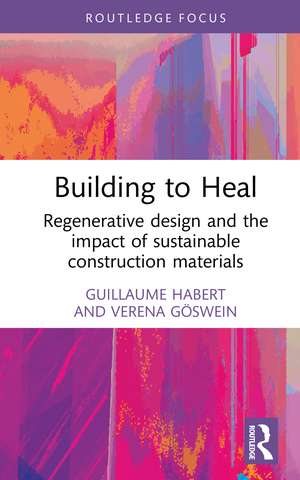
Building to Heal: Regenerative design and the impact of sustainable construction materials
Autor Guillaume Habert, Verena Gösweinen Limba Engleză Hardback – 24 apr 2026
Written for a broad audience of city planners, politicians, and decision-makers who have the power to transform the building sector, this book also targets investors and developers so that they can understand existing threats to their assets with a business-as-usual approach and find in this book solutions to allow new development to be future proofed towards climate change and health requirements. The solutions proposed will also be of interest to architects and engineers and equally for those who are living and owning buildings and can take an active role and demand the use of such regenerative building materials.
Preț: 545.44 lei
Preț vechi: 592.87 lei
-8%
Puncte Express: 818
Carte disponibilă
Livrare economică 18 noiembrie-02 decembrie
Livrare express 03-07 noiembrie pentru 31.17 lei
Livrare prin curier în România Termenul estimat este afișat lângă disponibilitate.
Transport gratuit pentru acest produs Plată online sau ramburs, în funcție de opțiunile comenzii.
Retur gratuit în 14 zile Comandă securizată și suport în română.
Specificații
ISBN-13: 9781032497723
ISBN-10: 1032497726
Pagini: 130
Ilustrații: 60
Dimensiuni: 138 x 216 mm
Greutate: 0.4 kg
Ediția:1
Editura: CRC Press
Colecția Routledge
ISBN-10: 1032497726
Pagini: 130
Ilustrații: 60
Dimensiuni: 138 x 216 mm
Greutate: 0.4 kg
Ediția:1
Editura: CRC Press
Colecția Routledge
Public țintă
Academic and Professional ReferenceCuprins
1. Defining Priorities 2. The Role of the Built Environment 3. Material Options in a Fair and Post-Carbon World 4. A New Material Diet 5. Positive Consequences of a Good Material Diet 6.Necessary Drivers and Processes of System Change 7. Conclusion
Notă biografică
Guillaume Habert is Professor of Sustainable Construction at the Swiss Federal Institute of Technology, ETH Zurich, Switzerland. He is an alumnus of the École Normale Supérieure in Paris, where he completed a Master’s degree in Earth, Atmosphere, and Ocean Sciences, and he holds a PhD in Structural Geology from the University of Toulouse (France), obtained in 2004. After his doctoral studies, he held research and teaching positions in France and Brazil before joining ETH Zurich, where he is Professor of Sustainable Construction in the Department of Civil, Environmental and Geomatic Engineering. His work bridges materials science, environmental engineering, and architecture, with a strong focus on regenerative and low-carbon construction materials such as earth, stone, bio-based, and recycled materials. Through his research, teaching, and close collaboration with industry and public stakeholders, he aims to transform the built environment by reducing embodied emissions, strengthening local material cycles, and reconnecting construction practices with territorial, social, and ecological contexts.
Verena Göswein is a researcher and practitioner working at the intersection of sustainable construction and real estate. She is currently a Postdoctoral Researcher at the Chair of Sustainable Construction at ETH Zurich. Originally from Germany, she completed her BSc and MSc in Civil Engineering at ETH Zurich and conducted her Master’s thesis research at MIT, analysing construction material flows in African cities. She holds a PhD in Civil Engineering from Instituto Superior Técnico in Lisbon, obtained in 2020, where she applied dynamic life cycle assessment to better understand present and future building stocks in terms of embodied energy and environmental impacts. Following her doctoral studies, she gained international experience across academia and industry, working as a project manager at the Portuguese circular economy consultancy 3drivers and as an ESG manager at FREO Group, a pan-European real estate investor, developer, and asset manager. Her interdisciplinary work focuses on decarbonising buildings by translating research into innovative solutions at the portfolio level and by bridging academia and real estate practice.
Verena Göswein is a researcher and practitioner working at the intersection of sustainable construction and real estate. She is currently a Postdoctoral Researcher at the Chair of Sustainable Construction at ETH Zurich. Originally from Germany, she completed her BSc and MSc in Civil Engineering at ETH Zurich and conducted her Master’s thesis research at MIT, analysing construction material flows in African cities. She holds a PhD in Civil Engineering from Instituto Superior Técnico in Lisbon, obtained in 2020, where she applied dynamic life cycle assessment to better understand present and future building stocks in terms of embodied energy and environmental impacts. Following her doctoral studies, she gained international experience across academia and industry, working as a project manager at the Portuguese circular economy consultancy 3drivers and as an ESG manager at FREO Group, a pan-European real estate investor, developer, and asset manager. Her interdisciplinary work focuses on decarbonising buildings by translating research into innovative solutions at the portfolio level and by bridging academia and real estate practice.
Descriere
This book shows that this is possible and that we have the required land, the economic power and the technical standards to do it.