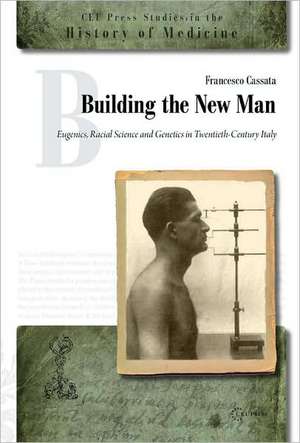
Building the New Man: Eugenics, Racial Science and Genetics in Twentieth-Century Italy: CEU Press Studies in the History of Medicine
Autor Francesco Cassataen Limba Engleză Hardback – 15 mai 2011





Preț: 1118.99 lei
Preț vechi: 1177.89 lei
-5%
Puncte Express: 1678
Carte disponibilă
Livrare economică 14-28 noiembrie
Livrare prin curier în România Termenul estimat este afișat lângă disponibilitate.
Transport gratuit pentru acest produs Plată online sau ramburs, în funcție de opțiunile comenzii.
Retur gratuit în 14 zile Comandă securizată și suport în română.
Specificații
ISBN-13: 9789639776838
ISBN-10: 9639776831
Pagini: 438
Dimensiuni: 152 x 229 x 28 mm
Greutate: 0.77 kg
Ediția:1
Editura: Amsterdam University Press
Colecția Central European University Press
Seria CEU Press Studies in the History of Medicine
Locul publicării:Oxford, United Kingdom
ISBN-10: 9639776831
Pagini: 438
Dimensiuni: 152 x 229 x 28 mm
Greutate: 0.77 kg
Ediția:1
Editura: Amsterdam University Press
Colecția Central European University Press
Seria CEU Press Studies in the History of Medicine
Locul publicării:Oxford, United Kingdom
Public țintă
AcademicNotă biografică
Francesco Cassata received his PhD in Contemporary History from the University of Turin. He published extensively on the ideology of Italian fascism and neo-fascism, and on the history of fascist racism. He is also author of the first in-depth study of Lysenkoism in Italy. His current research project concerns the Italian geneticist Adriano Buzzati-Traverso and the development of molecular biology in Italy.
Cuprins
Acknowledgements, Introduction, CHAPTER I Between Lombroso and Pareto: the Italian Way to Eugenics 1. Lombroso’s Way: the Problem of Degeneration 2. Pareto’s Way: the Problem of the Elite 3. The Italian Committee of Eugenic Studies CHAPTER II Eugenics and Dysgenics of War 1. The War as Counter-selection 2. The War as Gymnasium 3. The War as Laboratory 4. Eugenics and the “Sons of the Enemy” CHAPTER III Regenerating Italy (1919–1924) 1. Ettore Levi and the IPAS Campaign for Birth Control 2. A Concrete Proposal: Premarital Certificates 3. Sterilization and Euthanasia 4. The Work of the “Useless”: Mental Hygiene in Italy CHAPTER IV Quality through Quantity: Eugenics in Fascist Italy 1. Corrado Gini’s Hegemony 2. Constitutionalism and Latin Eugenics 3. Demography and Biotypology CHAPTER V Eugenics and Racism (1938–1943) 1. Biological Racism and Hereditarian Eugenics 2. Environmentalist Eugenics 3. Esoteric-traditionalist Racism and Eugenics 4. Assortative Mating and Racism 5. Toward a National Genetic Center CHAPTER VI Toward a New Eugenics 1. SIGE Schisms 2. From Premarital Examination to Genetic Counseling 3. Eugenics and Catholic Medical Genetics CHAPTER VII Against UNESCO: Italian Eugenics and American Scientific Racism 1. The IAAEE and The Mankind Quarterly (1959–1965) 2. Meticciato di Guerra: Luigi Gedda and Reginald Ruggles Gates 3. Corrado Gini and the “Guerrilla War” against UNESCO 4. Epilogue: “Race and Modern Science,” Conclusions, Bibliography, Index
Descriere
Based on previously unexplored archival documentation, this book offers the first general overview of the history of Italian eugenics, not limited to the decades of Fascist regime, but instead ranging from the beginning of the 1900s to the first half of the 1970s.