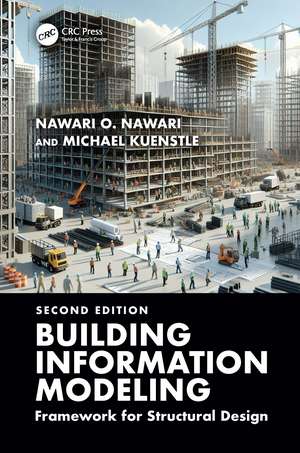
Building Information Modeling: Framework for Structural Design
Autor Nawari O. Nawari, Michael Kuenstleen Limba Engleză Hardback – 28 dec 2025
Key Features:
- Is updated throughout
- Adds new exercises; cutting‑edge information on the use of AI, Machine Learning (ML), and modelling; and issues of sustainability.
- Presents the use of BIM technology as part of a design process or framework that can lead to a more comprehensive, intelligent, and integrated building design.
- Places special emphasis on the application of BIM technology for exploring the intimate relationship between structural engineering and architectural design. Includes a discussion of current and emerging trends in structural engineering practice and the role of the structural engineer in building design using new BIM technologies.
| Toate formatele și edițiile | Preț | Express |
|---|---|---|
| Hardback (1) | 911.38 lei 6-8 săpt. | |
| CRC Press – 21 apr 2015 | 911.38 lei 6-8 săpt. | |
| Hardback (1) | 763.40 lei 6-8 săpt. | |
| CRC Press – 28 dec 2025 | 763.40 lei 6-8 săpt. |
Preț: 763.40 lei
Preț vechi: 930.98 lei
-18% Nou
Puncte Express: 1145
Preț estimativ în valută:
135.19€ • 157.89$ • 117.44£
135.19€ • 157.89$ • 117.44£
Carte tipărită la comandă
Livrare economică 21 februarie-07 martie
Preluare comenzi: 021 569.72.76
Specificații
ISBN-13: 9781032983165
ISBN-10: 1032983167
Pagini: 342
Ilustrații: 316
Dimensiuni: 156 x 234 x 21 mm
Greutate: 0.79 kg
Ediția:2nd edition
Editura: CRC Press
Colecția CRC Press
ISBN-10: 1032983167
Pagini: 342
Ilustrații: 316
Dimensiuni: 156 x 234 x 21 mm
Greutate: 0.79 kg
Ediția:2nd edition
Editura: CRC Press
Colecția CRC Press
V-ar putea interesa
-
 Management of Deteriorating Concrete StructuresGeorge Somerville-18%Preț: 1286.91 lei1569.41 lei
 -
 Culture in International ConstructionWilco Tijhuis-18%Preț: 1119.60 lei1365.37 lei
 -
 Computational Modelling of Concrete StructuresNenad Bicanic-18%Preț: 2808.39 lei3424.86 lei
 -
 Programming and Scheduling TechniquesThomas Uher-15%Preț: 470.46 lei553.48 lei
 -
 Ice and ConstructionL. Makkonen-18%Preț: 1586.46 lei1934.71 lei
 -
 Education Facility Security HandbookDon Philpott-30%Preț: 688.18 lei987.53 lei
 -
 Construction Management: Subcontractor Scopes of WorkJason G. Smith-18%Preț: 1294.28 lei1578.39 lei
 -
 -18%Preț: 1571.03 lei1915.89 lei
 -
 Building StructuresNawari O. Nawari-23%Preț: 1881.69 lei2443.75 lei
 -
 Analyzing Building Structures: An Exercise and Solutions ManualNawari O. Nawari-23%Preț: 670.62 lei870.93 lei
 -
 Project ManagementRobert J. Collins-31%Preț: 1234.63 lei1782.69 lei
 -
 -23%Preț: 1072.76 lei1393.19 lei
 -
 -18%Preț: 2715.15 lei3311.16 lei
 -
 Analyse Non Lineaire Du Flambage de Structures Legeres: Une Etude EconometriqueDidier Brice MBENDIPreț: 395.18 lei
 -
 Preț: 397.01 lei
 -
 Optimisation HeuristiqueImen Harbaoui Dridi-19%Preț: 556.58 lei687.13 lei
 -
 Construction of Buildings on Expansive SoilsE.A. Sorochan-18%Preț: 1857.63 lei2265.40 lei
Public țintă
Academic and Professional ReferenceCuprins
Second Edition Preface
About the Authors
Chapter 1 Introduction.
Chapter 2 Structure and Architecture Synergy Framework (SAS Framework).
Chapter 3 Building Information Modeling.
Chapter 4 Modeling Elements.
Chapter 5 Architectural Elements.
Chapter 6 Structural Analysis
About the Authors
Chapter 1 Introduction.
Chapter 2 Structure and Architecture Synergy Framework (SAS Framework).
Chapter 3 Building Information Modeling.
Chapter 4 Modeling Elements.
Chapter 5 Architectural Elements.
Chapter 6 Structural Analysis
Notă biografică
Dr. Nawari, (Ph.D., P.E., M.ASCE) has over 20 years of experience in design, teaching, and research specializing in building structures and building information modeling. Currently, he teaches graduate and undergraduate courses at the University of Florida. He has written and co-authored over 70 publications and three books. He is an active member of the U.S. National Building Information Modeling Standard Committee (NBIMS), BIM Committee of the Structural Engineering Institute (SEI), and co-chair of the subcommittee on BIM in education and many other professional societies. Dr. Nawari is also a board certified professional engineer in the states of Florida and Ohio.Michael W. Kuenstle, AIA, received his graduate architecture degree from Columbia University in New York City. He held a bachelor of architecture degree from the University of Houston. Kuenstle served as adjunct associate professor at the New York Institute of Technology from 1990 to 1993. He was a professor in the School of Architecture at the University of Florida since 1993 where he taught architecture design studio and advanced graduate structures courses. His building design projects received several AIA design awards and have been published and exhibited throughout North America. A licensed architect, he served as a member of the Board of Trustees to the Florida Foundation for Architecture.
Descriere
Building Information Modeling: Framework for Structural Design introduces a structure and architecture synergy (SAS) framework that helps develop and enhance the understanding of the fundamental principles of architectural analysis using BIM tools.
Recenzii
"The main strength of this book lies in its focus on applications of BIM on structural engineering, coupling the structural design task with architectural design."
—Gian A. Rassati, University of Cincinnati
"The detailed description of the steps in using a BIM tool for various aspects of structural design, together with aspects of interoperability with FEM and other tools, is the main strength of the material … Such detailed description is particularly useful for students to understand how to integrate BIM efficiently in the structural engineering. The descriptions followed by related exercises should foster ‘learning through examples and learning by doing’ and such content is currently missing in BIM textbooks."
—Vishal Singh, Aaalto University
—Gian A. Rassati, University of Cincinnati
"The detailed description of the steps in using a BIM tool for various aspects of structural design, together with aspects of interoperability with FEM and other tools, is the main strength of the material … Such detailed description is particularly useful for students to understand how to integrate BIM efficiently in the structural engineering. The descriptions followed by related exercises should foster ‘learning through examples and learning by doing’ and such content is currently missing in BIM textbooks."
—Vishal Singh, Aaalto University