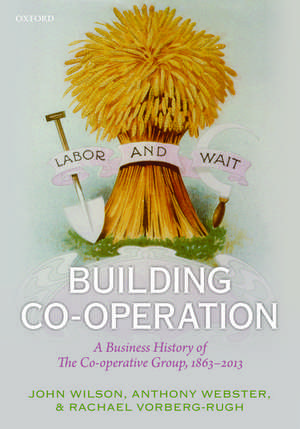
Building Co-operation: A Business History of The Co-operative Group, 1863-2013
Autor John F. Wilson, Anthony Webster, Rachael Vorberg-Rughen Limba Engleză Hardback – 10 oct 2013
Preț: 524.76 lei
Preț vechi: 722.83 lei
-27%
Puncte Express: 787
Carte tipărită la comandă
Livrare economică 20 noiembrie-01 decembrie
Livrare prin curier în România Termenul estimat este afișat lângă disponibilitate.
Transport gratuit pentru acest produs Plată online sau ramburs, în funcție de opțiunile comenzii.
Retur gratuit în 14 zile Comandă securizată și suport în română.
Specificații
ISBN-13: 9780199655113
ISBN-10: 0199655111
Pagini: 458
Ilustrații: Numerous black and white illustrations; colour plate sections
Dimensiuni: 181 x 251 x 28 mm
Greutate: 1.15 kg
Editura: OUP OXFORD
Colecția OUP Oxford
Locul publicării:Oxford, United Kingdom
ISBN-10: 0199655111
Pagini: 458
Ilustrații: Numerous black and white illustrations; colour plate sections
Dimensiuni: 181 x 251 x 28 mm
Greutate: 1.15 kg
Editura: OUP OXFORD
Colecția OUP Oxford
Locul publicării:Oxford, United Kingdom
V-ar putea interesa
-
 The Changing Face of Retailing in the Asia PacificElizabeth HowardPreț: 258.83 lei
 -
 Wilson, J: FerrantiJohn F. Wilson-23%Preț: 698.35 lei906.95 lei
 -
 International Retail MarketingChristopher Moore-45%Preț: 277.68 lei500.75 lei
 -
 -43%Preț: 229.99 lei404.23 lei
 -
 Commodities, Ports and Asian Maritime Trade Since 1750Anthony Webster-18%Preț: 791.61 lei965.38 lei
 -
 Principles of RetailingJohn Fernie-18%Preț: 684.76 lei835.08 lei
 -
 Contemporary Research in E-BrandingSubir Bandyopadhyay-18%Preț: 1116.04 lei1361.03 lei
 -
 Business Web StrategyLatif Al-Hakim-18%Preț: 1118.41 lei1363.92 lei
 -
 Cases on Managing E-ServicesAda Scupola-18%Preț: 1106.38 lei1349.25 lei
 -
 Consumer Behavior, Organizational Development, and Electronic CommerceD. B. A. Mehdi Khosrow-Pour-18%Preț: 1119.21 lei1364.90 lei
 -
 -18%Preț: 1120.97 lei1367.03 lei
 -
 -18%Preț: 940.36 lei1146.79 lei
 -
 -18%Preț: 1108.93 lei1352.36 lei
 -
 -18%Preț: 1109.73 lei1353.33 lei
 -
 Proliferation of the Internet EconomyMahmud Akhter Shareef-18%Preț: 937.20 lei1142.92 lei
 -
 Trust and Technology in B2B E-CommerceMuneesh Kumar-18%Preț: 1048.15 lei1278.23 lei
 -
 SelfridgeFergus MasonPreț: 52.97 lei
 -
 Garden Centre ManagementKen CraferPreț: 448.22 lei
 -
 Integrate You Logistic Processes with OpenerpPinckaers FabienPreț: 232.41 lei
Recenzii
...this handsomely-produced volume is an important contribution to the recent revival of academic interest in co-operation
Notă biografică
John Wilson is Director of Newcastle University Business School, where he is also professor of strategy. He has published extensively in the field of international business history, knowledge transfer, and the history of management education, including a dozen monographs and over fifty articles and chapters. As executive editor of Business History and a former President of the Association of Business Historians, he has played a major role in developing the discipline.Anthony Webster is a graduate of the University of Birmingham UK, where he won the Ashley Prize for best PhD thesis in the Faculty of Commerce and Social Science in 1985. In his career he has been a tax inspector and has lectured at three universities in the North West of England. He is currently Head of History at Liverpool John Moores University. He has published extensively on business in the British empire and co-operatives, producing four major books and numerous articles in leading international journals (including Enterprise and Society, the article for which won the Newcomen Prize for best article in the journal in 2005).Rachael Vorberg-Rugh is a doctoral candidate in Modern History at the University of Oxford, where she is completing a thesis on the British co-operative movement between 1880 and 1920. She has published articles and book chapters on co-operative history and business. In addition to her academic work, she has engaged in numerous public history projects in the US and UK. She is currently a researcher with The Co-operative College, and previously served as project officer for the National Co-operative Archive and Rochdale Pioneers Museum.