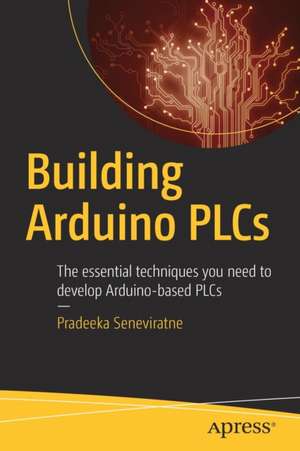
Building Arduino PLCs
Autor Pradeeka Seneviratneen Limba Engleză Paperback – 9 feb 2017
A comprehensive shopping guide includes the hardware and software components you need in your tool box. You will learn to use Arduino UNO, Arduino Ethernet shield, and Arduino WiFi shield.
Building Arduino PLCs shows you how to build and test a simple Arduino UNO-based 5V DC logic level PLC with Grove Base shield by connecting simple sensors and actuators. You will also learn how to build industry-grade PLCs with the help of ArduiBox.
What You'll Learn
- Build ModBus-enabled PLCs
- Map Arduino PLCs into the cloud using NearBus cloud connector to control the PLC through the Internet
- Use do-it-yourself light platforms such as IFTTT
- Enhance your PLC by adding Relay shields for connecting heavy loads
Engineers, designers, crafters, and makers. Basic knowledge in electronics and Arduino programming or any other programming language is recommended.
Preț: 294.23 lei
Preț vechi: 367.79 lei
-20%
Puncte Express: 441
Carte tipărită la comandă
Livrare economică 30 noiembrie-07 decembrie
Livrare prin curier în România Termenul estimat este afișat lângă disponibilitate.
Transport gratuit de la 400.00 lei Plată online sau ramburs, în funcție de opțiunile comenzii.
Retur gratuit în 14 zile Comandă securizată și suport în română.
Specificații
ISBN-13: 9781484226315
ISBN-10: 1484226313
Pagini: 200
Ilustrații: XIII, 183 p. 145 illus., 128 illus. in color.
Dimensiuni: 155 x 235 x 12 mm
Greutate: 0.31 kg
Ediția:1st edition
Editura: Apress
Locul publicării:Berkeley, CA, United States
ISBN-10: 1484226313
Pagini: 200
Ilustrații: XIII, 183 p. 145 illus., 128 illus. in color.
Dimensiuni: 155 x 235 x 12 mm
Greutate: 0.31 kg
Ediția:1st edition
Editura: Apress
Locul publicării:Berkeley, CA, United States
V-ar putea interesa
-
 -31%Preț: 441.34 lei639.30 lei
 -
 Technician's Guide to Programmable ControllersTerry Borden-22%Preț: 517.68 lei660.77 lei
 -
 Adventures in ArduinoBecky StewartPreț: 111.83 lei
 -
 Preț: 245.96 lei
 -
 Arduino for DummiesJohn Nussey-20%Preț: 147.60 lei184.49 lei
 -
 -20%Preț: 214.84 lei268.55 lei
 -
 -26%Preț: 278.04 lei374.10 lei
 -
 -31%Preț: 176.73 lei257.72 lei
 -
 -28%Preț: 89.31 lei123.57 lei
 -
 Programmable Logic Controllers: 2025 Release ISEFrank Petruzella-4%Preț: 379.98 lei395.80 lei
 -
 Make: Arduino Bots and GadgetsTero KarvinenPreț: 210.49 lei
 -
 -20%Preț: 228.19 lei283.73 lei
 -
 -35%Preț: 205.68 lei318.48 lei
 -
 -36%Preț: 284.35 lei440.95 lei
 -
 Concise Guide to the Internet of ThingsMichael Mccarthy-20%Preț: 421.74 lei527.18 lei
 -
 Arduino VIISteven F. Barrett-18%Preț: 930.85 lei1135.17 lei
 -
 -11%Preț: 484.08 lei543.91 lei
 -
 PLC SCADA for BeginnersAshraf Said AlmadhounPreț: 384.04 lei
Cuprins
Chapter 1: Getting Ready for the Development Environment
Chapter 2: Arduino, Ethernet, and WiFi
Chapter 3: Arduino at Heart
Chapter 4: Your First Arduino PLC
Chapter 5: Building with and ArduiBox
Chapter 6: Write PLC-style Applications with plcLib
Chapter 7: Modbus
Chapter 8: Mapping PLCs into the Cloud Using NearBus Cloud Connector
Chapter 9: Building a Better PLC
Notă biografică
Pradeeka Seneviratne is a software engineer with over 10 years of experience in computer programming and systems designing. He loves programming embedded systems such as Arduino and Raspberry Pi. Pradeeka started learning about electronics when he was at primary college by reading and testing various electronic projects found in newspapers, magazines, and books.
Pradeeka is currently a full-time software engineer who works with highly-scalable technologies. Previously, he worked as a software engineer for several IT infrastructure and technology servicing companies, and he was also a teacher for information technology and Arduino development.
He researches how to make Arduino-based unmanned aerial vehicles and Raspberry Pi-based security cameras and is the author of the Internet of Things with Arduino Blueprints [Packt Publishing]
Pradeeka is currently a full-time software engineer who works with highly-scalable technologies. Previously, he worked as a software engineer for several IT infrastructure and technology servicing companies, and he was also a teacher for information technology and Arduino development.
He researches how to make Arduino-based unmanned aerial vehicles and Raspberry Pi-based security cameras and is the author of the Internet of Things with Arduino Blueprints [Packt Publishing]
Textul de pe ultima copertă
This book presents the fundamentals of PLCs and explains in a practical approach how to draw Ladder Logic diagrams to represent PLC design methods for wide variety of automated applications.
Building Arduino PLCs starts by explaining how to build and test a simple Arduino-based 5V DC PLC with Arduino hardware and Grove base shield. You'll then learn how to build 12V DC PLC with Arduino hardware, relays, and various passive components.
Then the final part of the book will show readers how to control 120v/240V applications with PLCs by enhancing the design with optocouplers and relays. The Arduino development environment, including Arduino UNO, Arduino Ethernet board, Arduino Ethernet shield, and Arduino WiFi shield are also featured in building a set of simple to complex PLCs.
Building Arduino PLCs starts by explaining how to build and test a simple Arduino-based 5V DC PLC with Arduino hardware and Grove base shield. You'll then learn how to build 12V DC PLC with Arduino hardware, relays, and various passive components.
Then the final part of the book will show readers how to control 120v/240V applications with PLCs by enhancing the design with optocouplers and relays. The Arduino development environment, including Arduino UNO, Arduino Ethernet board, Arduino Ethernet shield, and Arduino WiFi shield are also featured in building a set of simple to complex PLCs.
Caracteristici
The first Arduino book about programmable logic controllers Knowledge gained through this book can be extended to industrial and non-industrial automation projects The projects build in the book are based on IoT and are cloud-supported