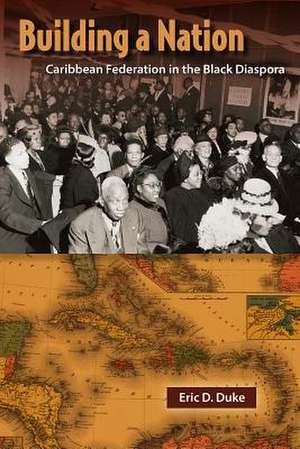
Building a Nation
Autor Eric D. Dukeen Limba Engleză Paperback – 20 noi 2018
The initial push for a federation among British Caribbean colonies might have originated among colonial officials and white elites, but the banner for federation was quickly picked up by Afro-Caribbean activists who saw in the possibility of a united West Indian nation a means of securing political power and more.
In Building a Nation, Eric Duke moves beyond the narrow view of federation as only relevant to Caribbean and British imperial histories. By examining support for federation among many Afro-Caribbean and other black activists in and out of the West Indies, Duke convincingly expands and connects the movement's history squarely into the wider history of political and social activism in the early to mid-twentieth century black diaspora.
Exploring the relationships between the pursuit of Caribbean federation and black diaspora politics, Duke convincingly posits that federation was more than a regional endeavor; it was a diasporic, black nation-building undertaking--with broad support in diaspora centers such as Harlem and London--deeply immersed in ideas of racial unity, racial uplift, and black self-determination.
A volume in this series New World Diasporas, edited by Kevin A. Yelvington
Preț: 227.35 lei
Puncte Express: 341
Carte tipărită la comandă
Livrare economică 24 noiembrie-08 decembrie
Livrare prin curier în România Termenul estimat este afișat lângă disponibilitate.
Transport gratuit de la 400.00 lei Plată online sau ramburs, în funcție de opțiunile comenzii.
Retur gratuit în 14 zile Comandă securizată și suport în română.
Specificații
ISBN-13: 9780813064963
ISBN-10: 0813064961
Pagini: 386
Dimensiuni: 156 x 234 x 23 mm
Greutate: 0.59 kg
Editura: University Press of Florida
ISBN-10: 0813064961
Pagini: 386
Dimensiuni: 156 x 234 x 23 mm
Greutate: 0.59 kg
Editura: University Press of Florida
Descriere
By examining support for federation among many Afro-Caribbean and other black activists in and out of the West Indies, Eric Duke convincingly expands and connects the movement's history squarely into the wider history of political and social activism in the early to mid-twentieth century black diaspora.