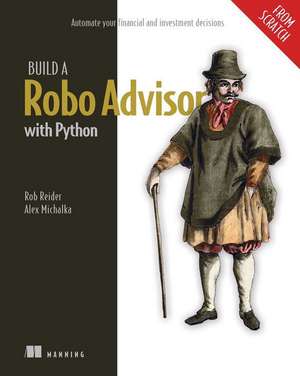
Build a Robo-Advisor with Python (from Scratch)
Autor Rob Reider, Alex Michalkaen Limba Engleză Paperback – 18 feb 2025
ACTUALIZAREA: Față de lucrările teoretice standard despre digitalizarea finanțelor, Build a Robo-Advisor with Python (from Scratch) aduce o perspectivă aplicată, integrând tehnologii moderne precum învățarea prin recompensă pentru a determina calea optimă de investiții până la pensie. Subliniem faptul că autorii, Rob Reider și Alex Michalka, nu se limitează la prezentarea unor concepte, ci oferă instrumentele necesare pentru a construi, pas cu pas, un consilier digital funcțional. Ne-a atras atenția structura tehnică riguroasă care acoperă întreg ciclul de viață al unei investiții. Găsim în această carte metode concrete de măsurare a randamentelor, utilizarea simulărilor Monte Carlo pentru testarea planurilor financiare și implementarea modelului Black-Litterman pentru alocarea activelor. Un element distinctiv este accentul pus pe eficiența fiscală prin tehnici de „tax-loss harvesting”, un aspect adesea ignorat în manualele de programare financiară, dar esențial în gestionarea reală a portofoliilor. Abordarea diferă de Robo-Advisory de Peter Scholz prin faptul că este mult mai puțin abstractă și mult mai aplicabilă; în timp ce Scholz analizează fenomenul la nivel de piață, Rob Reider oferă codul sursă pentru execuție. De asemenea, comparativ cu Personal Finance with Python, lucrarea de față trece dincolo de simple calculatoare de buget, explorând optimizarea convexă și paritatea riscului. Ritmul este alert, orientat spre implementare, fiind o resursă tehnică solidă publicată de Manning Publications care transformă teoria FinTech în instrumente automate de lucru.
Preț: 288.73 lei
Preț vechi: 360.92 lei
-20%
Carte disponibilă
Livrare economică 07-21 noiembrie
Specificații
ISBN-10: 1633439674
Pagini: 336
Dimensiuni: 188 x 232 x 18 mm
Greutate: 0.58 kg
Editura: Manning Publications
V-ar putea interesa
-
 Using Artificial Intelligence Absolute Beginner's GuideMichael Miller-20%Preț: 201.24 lei251.56 lei
 -
 Machine Learning for Factor Investing: Python VersionGuillaume Coqueret-15%Preț: 569.15 lei669.60 lei
 -
 Reproducible Finance with R: Code Flows and Shiny Apps for Portfolio AnalysisJonathan K. Regenstein, Jr.-8%Preț: 585.26 lei636.15 lei
 -
 The Little Book of Robo InvestingElizabeth MacBridePreț: 146.93 lei
 -
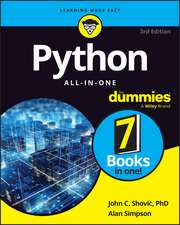 Python All-in-One For DummiesJohn C. Shovic-20%Preț: 239.60 lei299.50 lei
 -
 AI Investing For DummiesPaul Mladjenovic-20%Preț: 142.50 lei178.13 lei
 -
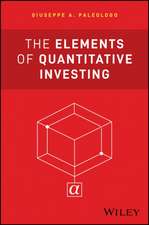 The Elements of Quantitative InvestingGiuseppe A. Paleologo-8%Preț: 450.09 lei489.23 lei
 -
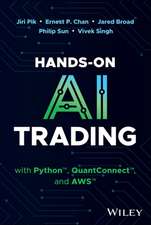 Hands-On AI Trading with Python, QuantConnect and AWSErnest P. ChanPreț: 330.07 lei
 -
 Quantitative Portfolio OptimizationAlberto Bueno Guerrero-8%Preț: 479.41 lei521.10 lei
 -
 The Bogleheads' Guide to the Three-Fund PortfolioTaylor LarimorePreț: 92.96 lei
 -
 Investing For Dummies, UK EditionDavid StevensonPreț: 157.74 lei
 -
 Statistical Analysis with Python For DummiesJoseph SchmullerPreț: 197.44 lei
 -
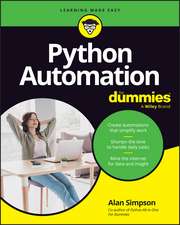 Python Automation For DummiesAlan Simpson-20%Preț: 146.52 lei183.15 lei
 -
 Friends That InvestSimran KaurPreț: 127.19 lei
 -
 -20%Preț: 346.79 lei433.49 lei
 -
 -34%Preț: 293.68 lei447.85 lei
 -
 Your Perfect PortfolioCullen RochePreț: 157.40 lei
 -
 Building Your Money MachineMel H. Abraham-19%Preț: 98.06 lei120.73 lei
 -
 How to Make AI UsefulMagnus ReinerPreț: 94.13 lei
 -
 -20%Preț: 249.86 lei312.33 lei
De ce să citești această carte
Recomandăm această carte programatorilor și pasionaților de finanțe care doresc să își automatizeze strategiile de investiții. Veți câștiga competențe practice în Python aplicate direct în managementul activelor, învățând să construiți sisteme care gestionează riscul și optimizează taxele. Este un ghid esențial pentru a trece de la analiza manuală la un sistem de consultanță financiară complet automatizat și personalizat.