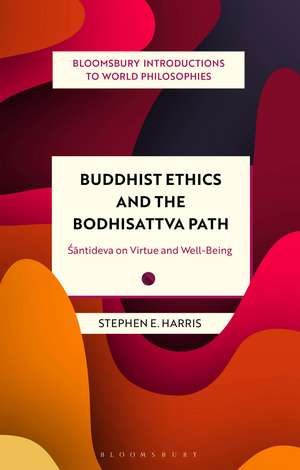
Buddhist Ethics and the Bodhisattva Path: Santideva on Virtue and Well-Being: Bloomsbury Introductions to World Philosophies
Autor Stephen Harrisen Limba Engleză Paperback – 16 noi 2023
As the first book-length English language philosophical study of Santideva's most influential text, this will be essential reading for students and scholars of Buddhist ethics, as well as for anyone interested in intercultural ethics and the philosophy of well-being.
Din seria Bloomsbury Introductions to World Philosophies
- 20%
 Preț: 160.32 lei
 - 20%
 Preț: 133.85 lei
 - 20%
 Preț: 134.93 lei
 - 20%
 Preț: 127.49 lei
 - 35%
 Preț: 132.99 lei
 - 19%
 Preț: 148.87 lei
 - 17%
 Preț: 131.60 lei
 - 10%
 Preț: 132.83 lei
 - 16%
 Preț: 133.33 lei
 - 17%
 Preț: 128.90 lei
 - 15%
 Preț: 134.79 lei
 - 15%
 Preț: 141.33 lei
 - 15%
 Preț: 133.77 lei
 - 20%
 Preț: 147.08 lei
 - 16%
 Preț: 128.65 lei
 - 16%
 Preț: 152.68 lei
 - 21%
 Preț: 142.42 lei
 - 20%
 Preț: 133.33 lei
 - 21%
 Preț: 123.32 lei
 - 21%
 Preț: 125.75 lei
 - 14%
 Preț: 162.16 lei
 - 22%
 Preț: 121.29 lei
 - 15%
 Preț: 124.16 lei
 - 16%
 Preț: 121.39 lei
 - 18%
 Preț: 165.98 lei
Preț: 144.36 lei
Preț vechi: 169.86 lei
-15%
Puncte Express: 217
Carte disponibilă
Livrare economică 16-30 noiembrie
Livrare express 30 octombrie-05 noiembrie pentru 50.15 lei
Livrare prin curier în România Termenul estimat este afișat lângă disponibilitate.
Transport gratuit de la 400.00 lei Plată online sau ramburs, în funcție de opțiunile comenzii.
Retur gratuit în 14 zile Comandă securizată și suport în română.
Specificații
ISBN-13: 9781350379534
ISBN-10: 1350379530
Pagini: 264
Dimensiuni: 136 x 214 x 16 mm
Greutate: 0.32 kg
Editura: Bloomsbury Publishing
Colecția Bloomsbury Academic
Seria Bloomsbury Introductions to World Philosophies
Locul publicării:London, United Kingdom
ISBN-10: 1350379530
Pagini: 264
Dimensiuni: 136 x 214 x 16 mm
Greutate: 0.32 kg
Editura: Bloomsbury Publishing
Colecția Bloomsbury Academic
Seria Bloomsbury Introductions to World Philosophies
Locul publicării:London, United Kingdom
Cuprins
Series Editor Preface
Acknowledgements
Introduction
1. Selfless Character: Virtue without a Self
2. Giving as Abandoning
3. Three: Patience and the Irrationality of Anger
4. Compassion and Desire
5. Joy
6. Wisdom and the Transformation of Experience
7. Dedication: Until the End of Space and Time
Conclusion
Notes
Works Cited
Index
Acknowledgements
Introduction
1. Selfless Character: Virtue without a Self
2. Giving as Abandoning
3. Three: Patience and the Irrationality of Anger
4. Compassion and Desire
5. Joy
6. Wisdom and the Transformation of Experience
7. Dedication: Until the End of Space and Time
Conclusion
Notes
Works Cited
Index
Recenzii
[Buddhist Ethics and the Bodhisattva Path] is precisely cut, with careful attention to canonical and secondary literature and clean articulation of arguments underpinned by meticulous philology. It is deeply colored by attention to the larger ethical and moral psychological issues Santideva raises. It is beautifully clear, written in an accessible prose style that makes Santideva's project accessible to any reader, presupposing no background in Buddhist philosophy. And it is comprehensive, addressing Santideva's system in its entirety. This volume will hence be of enormous value to ethicists who want to learn something about Buddhist ethics, to Buddhist Studies scholars who want to talk to their philosopher colleagues, and to teachers who want to address Buddhist philosophy ... Those coming to Buddhist ethics, or to Santideva's texts for the first time-whether as students or as philosophers new to this area-will find it a lucid and reliable guide to the Guide.
This is an essential companion to the study of the most influential treatise on ethics in Mahayana Buddhism. Harris clarifies the logic of Santideva's moral theory and demonstrates convincingly the foundational role of virtue in his conception of well-being.
In developing a case for a virtue-theoretic interpretation of Santideva's Bodhicaryavatara, Stephen Harris sheds considerable light on the overall structure of this key text of Mahayana ethics. This will be a welcome addition to the growing body of literature on the topic.
Santideva's Bodhicaryavatara is the most extensive and profound articulation of Mahayana Buddhist ethical thought, and is a masterpiece of moral psychology that should be studied by anyone interested in human ethical cultivation or in ethical theory. Stephen Harris's study of this text provides the contemporary reader with the means to enter into Santideva's project, to read and to understand his arguments, and to appreciate his vision of moral excellence and the path to achieving that excellence. The exposition is always clear and reliable, while remaining precise and philologically rigorous, with careful attention to other recent literature. Harris' interpretation is compelling, and he places Santideva in conversation with contemporary metaethical theory and moral psychology with great skill. This book is an enormous contribution to Buddhist Studies and to Ethical theory, and will be of great value to students and to neophytes in Buddhist ethical thought as well as to scholars immersed in Mahayana studies.
With clear and insightful analysis, Harris brings Santideva's Guide into conversation with contemporary philosophical ethics, showing how compassion can complement self-interest, emphasizing the sociality and rationality of the bodhisattva ideal. This is a landmark contribution to the philosophical study of Buddhist ethics, a rich resource for students, scholars, and practitioners.
This is an essential companion to the study of the most influential treatise on ethics in Mahayana Buddhism. Harris clarifies the logic of Santideva's moral theory and demonstrates convincingly the foundational role of virtue in his conception of well-being.
In developing a case for a virtue-theoretic interpretation of Santideva's Bodhicaryavatara, Stephen Harris sheds considerable light on the overall structure of this key text of Mahayana ethics. This will be a welcome addition to the growing body of literature on the topic.
Santideva's Bodhicaryavatara is the most extensive and profound articulation of Mahayana Buddhist ethical thought, and is a masterpiece of moral psychology that should be studied by anyone interested in human ethical cultivation or in ethical theory. Stephen Harris's study of this text provides the contemporary reader with the means to enter into Santideva's project, to read and to understand his arguments, and to appreciate his vision of moral excellence and the path to achieving that excellence. The exposition is always clear and reliable, while remaining precise and philologically rigorous, with careful attention to other recent literature. Harris' interpretation is compelling, and he places Santideva in conversation with contemporary metaethical theory and moral psychology with great skill. This book is an enormous contribution to Buddhist Studies and to Ethical theory, and will be of great value to students and to neophytes in Buddhist ethical thought as well as to scholars immersed in Mahayana studies.
With clear and insightful analysis, Harris brings Santideva's Guide into conversation with contemporary philosophical ethics, showing how compassion can complement self-interest, emphasizing the sociality and rationality of the bodhisattva ideal. This is a landmark contribution to the philosophical study of Buddhist ethics, a rich resource for students, scholars, and practitioners.