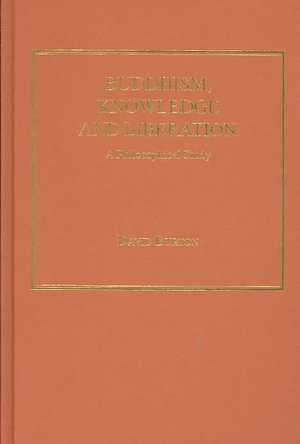
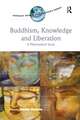
Buddhism, Knowledge and Liberation: A Philosophical Study: Ashgate World Philosophies Series
Autor David Burtonen Limba Engleză Hardback – 28 ian 2004
Preț: 1101.14 lei
Preț vechi: 1459.63 lei
-25%
Puncte Express: 1652
Carte indisponibilă temporar
Doresc să fiu notificat când acest titlu va fi disponibil:
Se trimite...
Specificații
ISBN-13: 9780754604358
ISBN-10: 0754604357
Pagini: 200
Dimensiuni: 156 x 234 mm
Greutate: 0.53 kg
Ediția:1
Editura: Taylor & Francis
Colecția Routledge
Seria Ashgate World Philosophies Series
Locul publicării:Oxford, United Kingdom
ISBN-10: 0754604357
Pagini: 200
Dimensiuni: 156 x 234 mm
Greutate: 0.53 kg
Ediția:1
Editura: Taylor & Francis
Colecția Routledge
Seria Ashgate World Philosophies Series
Locul publicării:Oxford, United Kingdom
Cuprins
Contents: Preface; First thoughts on knowledge and liberation; Impermanence, not-self and suffering; Thorough knowledge versus deficient understanding; Moral knowledge and the Buddhist path; Buddhist anti-realism; Buddhist scepticism; Mysticism and ineffability; Compassion, faith and human fallibility; Bibliography; Index.
Recenzii
'This erudite volume is a welcome addition to the philosophical literature on Buddhism... Burton writes as a philosopher, reconstructing arguments with care, and subjecting them to judicious, critical scrutiny. This exemplary engagement with the Buddhist tradition is grounded in sound textual scholarship. The prose is clear, and the volume will be accessible to scholars of Buddhism, to philosophers with little exposure to Buddhism, and to students of philosophy or Buddhism.' Journal of Contemporary Religion
Descriere
Buddhism is essentially a teaching about liberation - from suffering, ignorance, selfishness and continued rebirth. Knowledge of 'the way things really are' is thought by many Buddhists to be vital in bringing about this emancipation. Buddhism, Knowledge and Liberation assesses the common Buddhist idea that knowledge of the three characteristics of existence (impermanence, not-self and suffering) is the key to liberation. It argues that this claim must be seen in the context of the Buddhist path and training as a whole. Sensitive to the wide diversity of philosophical perspectives and interpretation that Buddhism has engendered, this book makes a serious contribution to critical and philosophically aware engagement with Buddhist thought. Written in an accessible style, it will be of value to those interested in Buddhist Studies and broader issues in comparative philosophy and religion.