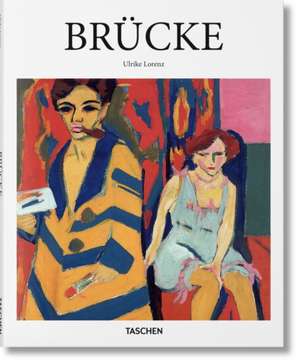
Brucke
Autor Ulrike Lorenzen Limba Engleză Hardback – 14 iun 2016
Observăm cum, între paginile acestui volum, dialogul dintre manifestul radical al grupului Die Brücke și forța vizuală a operelor lor prinde viață. Textul semnat de Ulrike Lorenz nu se limitează la o simplă descriere, ci reinterpretează arta expresionistă ca pe o geografie interioară, unde culorile stridente și formele brute devin limbajul unei libertăți absolute. Recomandăm acest album pentru modul în care reușește să ancoreze privitorul în atmosfera efervescentă a Dresdei anului 1905, acolo unde Kirchner, Bleyl, Heckel și Schmidt-Rottluff au decis să dărâme barierele academismului.
Experimentăm o incursiune tactilă și vizuală în tehnica xilogravurii, o metodă prin care acești rebeli ai modernismului au recuperat tradiția lui Dürer pentru a exprima tensiunile secolului XX. Ca și German Expressionism de Iris Müller-Westermann, acest volum pune în valoare revoluția estetică a tinerilor studenți la arhitectură, dar cu un accent pe contextul istoric și biografiile individuale care au format „Podul” către viitorul artei. Analizele punctuale ale tablourilor, prezentate pe pagini duble, permit o imersiune profundă în detalii care altfel ar putea trece neobservate: de la nudurile candide la peisajele citadine aglomerate, totul pulsează de o energie subiectivă.
În contextul operei sale, Ulrike Lorenz continuă explorarea modernismului german începută în lucrări precum Brücke (ediția germană), rafinând aici capacitatea de a sintetiza curente complexe pentru publicul larg. Remarcăm calitatea producției specifice Taschen Books, unde claritatea reproducerilor completează rigoarea academică a autoarei, transformând lectura într-o experiență estetică completă, esențială pentru înțelegerea rădăcinilor expresionismului european.
Preț: 115.91 lei
Disponibil
Livrare economică 29 octombrie-12 noiembrie
Specificații
ISBN-10: 3836537001
Pagini: 96
Dimensiuni: 266 x 219 x 13 mm
Greutate: 0.57 kg
Editura: Taschen Books
V-ar putea interesa
-
 Preț: 356.65 lei
 -
 Elina Brotherus: Why not?Ingo Clauß-19%Preț: 182.91 lei224.46 lei
 -
 -14%Preț: 191.79 lei222.20 lei
 -
 THOMAS PUTZEMarko SchacherPreț: 271.53 lei
De ce să citești această carte
Recomandăm această carte oricărui pasionat de artă care dorește să înțeleagă cum a început modernismul în Germania. Cititorul câștigă o perspectivă clară asupra modului în care emoția pură a înlocuit realitatea obiectivă, totul într-un format vizual de excepție. Este un instrument esențial pentru a descifra simbolistica și tehnicile brutale, dar fascinante, ale primilor expresioniști, oferind o sinteză perfectă între istorie și analiză vizuală.
Despre autor
Ulrike Lorenz este o figură proeminentă în peisajul cultural german, ocupând funcția de director al Kunsthalle Mannheim și, anterior, pe cea de director al Art Forum East German Gallery din Regensburg. Cu studii solide în istoria artei și arheologie la Universitatea din Leipzig și un doctorat obținut la Bauhaus-University din Weimar, Lorenz aduce o expertiză academică profundă în scrierile sale. Interesul său pentru mișcările de avangardă și capacitatea de a contextualiza arta în raport cu societatea se reflectă în întreaga sa activitate editorială, fiind una dintre vocile autorizate în analiza expresionismului german.
Descriere scurtă
Descriere
In the German city of Dresden on June 7, 1905, the foundation of the Die Brücke artists’ group (1905–1913) is widely regarded as the birth of Expressionism. Led by Ernst Ludwig Kirchner, Fritz Bleyl, Erich Heckel, and Karl Schmidt-Rottluff, the group sought to reject the limits of academia and, as their name suggested, to bridge the path to an artistic future. Their manifesto, printed with woodblock, insisted on absolute freedom from convention in their work as well as their lives.
This new, liberated art incorporated portraits, landscapes, and city scenes, but substituted an objective rendering of reality with an expression of interior geography. In paintings, as well as their favored wood and linocut prints, the artists of Die Brücke would fill pictorial space with jagged lines, crude forms, and clashing colors, all to express their subjective experience of the world. Like the Fauves, the artists took stylistic lead from non-Western traditions of Oceanic and African arts, while also reviving the print and painting techniques of Albrecht Dürer and Lucas Cranach the Elder.
This richly illustrated book introduces this essential expressionist movement. We examine Die Brücke’s key works and protagonists; its varied, international inspirations; and its crucial influence on later 20th century art. Along the way, we find candid nudes, crowded street views, and blissful bathing idylls, each of them vivid with energy and intent on a new kind of art.
About the series
Born back in 1985, the Basic Art Series has evolved into the best-selling art book collection ever published. Each book in TASCHEN’s Basic Art History series features:
approximately 100 color illustrations with explanatory captions
a detailed, illustrated introduction
a selection of the most important works of the epoch, each presented on a two-page spread with a full-page image and accompanying interpretation, as well as a portrait and brief biography of the artist