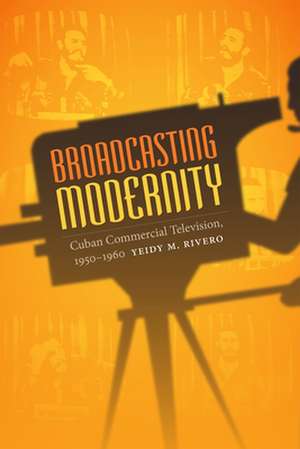
Broadcasting Modernity
Autor Yeidy M Riveroen Limba Engleză Hardback – 31 mar 2015
"
Preț: 646.97 lei
Preț vechi: 761.15 lei
-15%
Puncte Express: 970
Carte tipărită la comandă
Livrare economică 06-20 iulie
Specificații
ISBN-13: 9780822358596
ISBN-10: 082235859X
Pagini: 264
Dimensiuni: 172 x 231 x 18 mm
Greutate: 0.47 kg
Editura: Duke University Press
ISBN-10: 082235859X
Pagini: 264
Dimensiuni: 172 x 231 x 18 mm
Greutate: 0.47 kg
Editura: Duke University Press
Cuprins
Acknowledgments ix
Introduction. Broadcasting Modernity, Spectacles, and Television 1
1. Prelude to the Spectacles: Constituting a Modern Broadcasting System through the Law, 1923–1950 23
2. Spectacles of Progress: Technology, Expansion, and the Law 45
3. Spectacles of Decency: Morality as a Matter of the Industry and the State 75
4. Spectacles of Democracy and a Prelude to the Spectacles of Revolution 102
5. Spectacles of Revolution: A Rebirth of Cubanness 129
6. From Broadcasting Modernity to Constructing Modernity 163
Epilogue 176
Notes 181
Bibliography 221
Index 233
Introduction. Broadcasting Modernity, Spectacles, and Television 1
1. Prelude to the Spectacles: Constituting a Modern Broadcasting System through the Law, 1923–1950 23
2. Spectacles of Progress: Technology, Expansion, and the Law 45
3. Spectacles of Decency: Morality as a Matter of the Industry and the State 75
4. Spectacles of Democracy and a Prelude to the Spectacles of Revolution 102
5. Spectacles of Revolution: A Rebirth of Cubanness 129
6. From Broadcasting Modernity to Constructing Modernity 163
Epilogue 176
Notes 181
Bibliography 221
Index 233