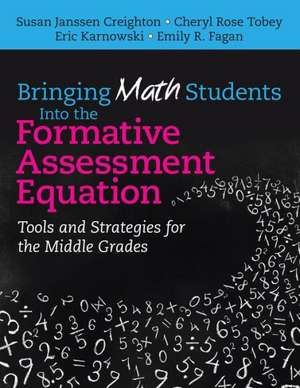
Bringing Math Students Into the Formative Assessment Equation
Autor Susan Janssen Creighton, Cheryl Rose Tobey, Eric Karnowskien Limba Engleză Paperback – 22 ian 2015
Preț: 295.32 lei
Puncte Express: 443
Carte tipărită la comandă
Livrare economică 19 noiembrie-03 decembrie
Livrare prin curier în România Termenul estimat este afișat lângă disponibilitate.
Transport gratuit de la 400.00 lei Plată online sau ramburs, în funcție de opțiunile comenzii.
Retur gratuit în 14 zile Comandă securizată și suport în română.
Specificații
ISBN-13: 9781483350103
ISBN-10: 148335010X
Pagini: 314
Dimensiuni: 216 x 280 x 17 mm
Greutate: 0.79 kg
Ediția:1
Editura: Corwin
Locul publicării:Thousand Oaks, United States
ISBN-10: 148335010X
Pagini: 314
Dimensiuni: 216 x 280 x 17 mm
Greutate: 0.79 kg
Ediția:1
Editura: Corwin
Locul publicării:Thousand Oaks, United States
V-ar putea interesa
-
 -29%Preț: 133.04 lei188.22 lei
 -
 Exploring Language Assessment and TestingAnthony GreenPreț: 363.29 lei
 -
 Assessment in Early Childhood SettingsMargaret CarrPreț: 405.08 lei
 -
 Leaders of Their Own LearningRon BergerPreț: 200.42 lei
 -
 Teacher's Skills Tests for DummiesColin BeveridgePreț: 172.02 lei
 -
 Five Dimensions of QualityLinda SuskiePreț: 328.20 lei
 -
 Succeeding with Your DoctorateJerry Wellington-15%Preț: 602.82 lei709.20 lei
 -
 Standard SettingGregory J. Cizek-18%Preț: 821.70 lei1002.07 lei
 -
 Assessment of LearningWynne Harlen-15%Preț: 614.74 lei723.22 lei
 -
 How to Assess Authentic LearningKathleen B. BurkePreț: 322.63 lei
 -
 Uncovering Student Thinking in Mathematics, Grades K-5Cheryl Rose TobeyPreț: 323.53 lei
 -
 Multiple Assessments for Multiple IntelligencesJames BellancaPreț: 348.72 lei
 -
 Preț: 260.11 lei
Recenzii
“This book not only provides the skills for both teachers and students to take part in the formative assessment process, but demonstrates a high level of the thinking required when teachers plan lessons.”
“This book would be extremely helpful in helping my students learn to focus 1) consider and articulate the mathematics understanding, 2) shift their focus to making sense of student understanding, and 3) realize that true teaching is then acting on the gap between the understandings the student holds and the full set of understandings that you would like them to hold.”
“This book was outstanding, and I would recommend it to any math educator. The depth of research integrated into practice is extensive and, as a result, is the most practical book I have seen related to either formative assessment or mathematics. The most helpful aspect of the book is the affective nature so often ignored in educational works. The self-regulation aspects, as well as the ownership and involvement emphasized in the book went beyond the traditional cognitive strategies endorsed in most books.”
? “The ideas [in this book] are brought to life with mathematics examples of teachers and students in the classroom. The teacher voices, comments, and quotes lend credibility and are a big component of the book’s strengths as well as the visuals and graphics.”
“This book would be extremely helpful in helping my students learn to focus 1) consider and articulate the mathematics understanding, 2) shift their focus to making sense of student understanding, and 3) realize that true teaching is then acting on the gap between the understandings the student holds and the full set of understandings that you would like them to hold.”
“This book was outstanding, and I would recommend it to any math educator. The depth of research integrated into practice is extensive and, as a result, is the most practical book I have seen related to either formative assessment or mathematics. The most helpful aspect of the book is the affective nature so often ignored in educational works. The self-regulation aspects, as well as the ownership and involvement emphasized in the book went beyond the traditional cognitive strategies endorsed in most books.”
? “The ideas [in this book] are brought to life with mathematics examples of teachers and students in the classroom. The teacher voices, comments, and quotes lend credibility and are a big component of the book’s strengths as well as the visuals and graphics.”
Cuprins
Chapter 1: Using Formative Assessment to Build Student Engagement in Mathematics Learning
Being a Self-Regulating Learner
Using Formative Assessment Practices to Develop Self-Regulation Skills
Using Formative Assessment in Your Classroom
Teaching Students How to Participate in Formative Assessment
How to Use this Book to Learn What You Want to Learn
Conclusion
Resources
Chapter 2: Using Mathematics Learning Intentions and Success Criteria
What Are Learning Intentions and Success Criteria?
Creating Learning Intentions and Success Criteria for Your Classroom
Conclusion
Resources
Chapter 3: Gathering, Interpreting, and Acting on Evidence
What Is Evidence?
Using Evidence in Your Classroom: The Teacher's Role
The Student's Role and How You Can Develop and Support It
Conclusion
Resources
Chapter 4: Providing and Using Formative Feedback
What Is Formative Feedback?
Using Formative Feedback in Your Classroom
Conclusion
Resources
Chapter 5: Developing Student Ownership and Involvement in Your Students
Student Ownership and Involvement
What Do Students Need to Learn?
Helping Students Develop Ownership and Involvement in Their Mathematics Learning
Self-Regulation: It's Not a Linear Process
Conclusion
Resources
Chapter 6: Using Mathematics Learning Progressions
What Is a Learning Progression?
How Can You Use Learning Progressions in Your Instruction?
Using Learning Progressions to Help Develop Student Ownership and Involvement
Conclusion
Resources
Chapter 7: Establishing a Classroom Environment
Elements of the Classroom Environment
The Social and Cultural Environment: Promoting Intellectual Safety and Curiosity
The Instructional Environment: Framing Instruction to Encourage and Make Visible Students' Thinking and to Optimize Learning
The Physical Environment: Keeping Resources Available
Conclusion
Resources
Chapter 8: Moving Toward Implementation
Implementation Principles for Formative Assessment
Sustaining Your Effort Over the Long Term
Conclusion: Final Words of Encouragement
Resources
Appendix A: Resources
Appendix B: Implementation Indicators for Formative Assessment
Being a Self-Regulating Learner
Using Formative Assessment Practices to Develop Self-Regulation Skills
Using Formative Assessment in Your Classroom
Teaching Students How to Participate in Formative Assessment
How to Use this Book to Learn What You Want to Learn
Conclusion
Resources
Chapter 2: Using Mathematics Learning Intentions and Success Criteria
What Are Learning Intentions and Success Criteria?
Creating Learning Intentions and Success Criteria for Your Classroom
Conclusion
Resources
Chapter 3: Gathering, Interpreting, and Acting on Evidence
What Is Evidence?
Using Evidence in Your Classroom: The Teacher's Role
The Student's Role and How You Can Develop and Support It
Conclusion
Resources
Chapter 4: Providing and Using Formative Feedback
What Is Formative Feedback?
Using Formative Feedback in Your Classroom
Conclusion
Resources
Chapter 5: Developing Student Ownership and Involvement in Your Students
Student Ownership and Involvement
What Do Students Need to Learn?
Helping Students Develop Ownership and Involvement in Their Mathematics Learning
Self-Regulation: It's Not a Linear Process
Conclusion
Resources
Chapter 6: Using Mathematics Learning Progressions
What Is a Learning Progression?
How Can You Use Learning Progressions in Your Instruction?
Using Learning Progressions to Help Develop Student Ownership and Involvement
Conclusion
Resources
Chapter 7: Establishing a Classroom Environment
Elements of the Classroom Environment
The Social and Cultural Environment: Promoting Intellectual Safety and Curiosity
The Instructional Environment: Framing Instruction to Encourage and Make Visible Students' Thinking and to Optimize Learning
The Physical Environment: Keeping Resources Available
Conclusion
Resources
Chapter 8: Moving Toward Implementation
Implementation Principles for Formative Assessment
Sustaining Your Effort Over the Long Term
Conclusion: Final Words of Encouragement
Resources
Appendix A: Resources
Appendix B: Implementation Indicators for Formative Assessment
Notă biografică
Susan Janssen Creighton is a senior mathematics associate at Education Development Center (EDC) in Massachusetts. She has worked in mathematics education for 30 years, both in schools and at EDC, where her work has focused largely on K-12 mathematics curriculum development and mathematics teacher professional development. Currently, her work focuses on helping mathematics teachers adopt and successfully implement formative assessment practices, and on supporting teachers' understanding and use of the CCSS Standards for Mathematical Practice. As a member of the NSF-funded project, Formative Assessment in Mathematics Classrooms: Engaging Teachers and Students (FACETS), she was a lead facilitator for several of the participating districts.
Creighton has written print and online materials for numerous clients, including the international Department of Defense schools, the Columbus, Ohio public schools, the National Board of Professional Teaching Standards, Everyday Learning publishers, the PBS TeacherLine project, the Massachusetts Dept. of Education, and the E-Learning for Educators project funded by the U.S. Dept. of Education. She has also served as the director of the MathScape Curriculum Center, a national center that supported the implementation of the NSF-funded mathematics curriculum MathScape developed at EDC, for which she was also one of the writers, and has led numerous teacher professional development opportunities for middle and high school teachers on the teaching and learning of mathematics. Prior to coming to EDC, she taught middle school and high school mathematics for a number of years in Portland and Saco, Maine and in Brookline, Massachusetts. She received a B.A. mathematics and a M.Ed. in Secondary Education, with a concentration in curriculum, both from the University of New Hampshire. She currently lives in western Massachusetts with her husband, her two teenagers, and the world's softest dog.
Creighton has written print and online materials for numerous clients, including the international Department of Defense schools, the Columbus, Ohio public schools, the National Board of Professional Teaching Standards, Everyday Learning publishers, the PBS TeacherLine project, the Massachusetts Dept. of Education, and the E-Learning for Educators project funded by the U.S. Dept. of Education. She has also served as the director of the MathScape Curriculum Center, a national center that supported the implementation of the NSF-funded mathematics curriculum MathScape developed at EDC, for which she was also one of the writers, and has led numerous teacher professional development opportunities for middle and high school teachers on the teaching and learning of mathematics. Prior to coming to EDC, she taught middle school and high school mathematics for a number of years in Portland and Saco, Maine and in Brookline, Massachusetts. She received a B.A. mathematics and a M.Ed. in Secondary Education, with a concentration in curriculum, both from the University of New Hampshire. She currently lives in western Massachusetts with her husband, her two teenagers, and the world's softest dog.
Descriere
A professional resource for teachers that addresses the implementation of formative assessment as a comprehensive instructional model.