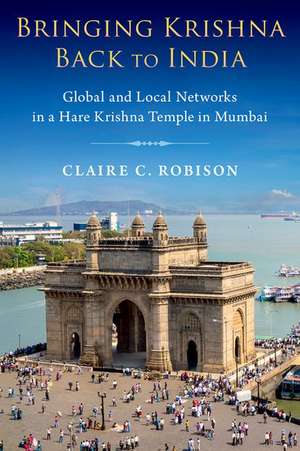
Bringing Krishna Back to India: Global and Local Networks in a Hare Krishna Temple in Mumbai
Autor Claire C. Robisonen Limba Engleză Hardback – 29 aug 2024
Preț: 543.59 lei
Preț vechi: 802.34 lei
-32%
Puncte Express: 815
Carte disponibilă
Livrare economică 30 octombrie-04 noiembrie
Livrare prin curier în România Termenul estimat este afișat lângă disponibilitate.
Transport gratuit pentru acest produs Plată online sau ramburs, în funcție de opțiunile comenzii.
Retur gratuit în 14 zile Comandă securizată și suport în română.
Specificații
ISBN-13: 9780197656457
ISBN-10: 0197656455
Pagini: 336
Ilustrații: 12, b/w
Dimensiuni: 165 x 246 x 31 mm
Greutate: 0.64 kg
Editura: Oxford University Press
Colecția OUP USA
Locul publicării:New York, United States
ISBN-10: 0197656455
Pagini: 336
Ilustrații: 12, b/w
Dimensiuni: 165 x 246 x 31 mm
Greutate: 0.64 kg
Editura: Oxford University Press
Colecția OUP USA
Locul publicării:New York, United States
Recenzii
In this richly-textured and readable ethnography of the ISKCON community in Mumbai, India, Claire C. Robison offers us an insightful take on the globalization of a religious movement. In exploring how religious revivalism changes people's relationships to their religion, family, culture, and nation, Robison innovatively argues that ISKCON educates Hindus into a new cosmopolitan vision of their own tradition. This provocative and lively lesson in religious originality has applications and implications far beyond India and should be read by all students of religion and globalization.
With care and nuance, Claire C. Robison follows the diverse members of the ISKCON temple community-with a white American guru at their head-as they define themselves at the cutting edge of a transnational, twenty-first-century Hinduism. From the worldly to the spiritual, the hi-tech to the traditional, the global to the familial and national, ISKCON's teachers must resolve the dilemmas confronting upwardly mobile young metropolitan Indians. From their answers, Robison derives questions that will speak to scholars of Hinduism, of urban India, and beyond.
Using extensive research conducted with devotee networks, Claire C. Robison expertly leads readers into the everyday lives of those who embrace ISKCON's religious conservatism against prevailing currents of liberal values and secular ideas of success and happiness. By analyzing diverse resources, including social media platforms that feature monks-turned-wellness gurus gaining celebrity status, Robison captures the rich texture of religion in practice. She includes engaging accounts of devotees' personal and professional struggles with leaving behind social norms to emphasize religious piety. Robison renders transparent the gravitas of ISKCON's 'rhetoric of revivalism,' pioneering a thoroughly intersectional approach to studying religion and globalization in contemporary contexts.
Bringing Krishna Back to India examines the place of this globalized religious community in Mumbai, India's business and entertainment capital, where ISKCON draws Indians from diverse regional and religious backgrounds and devotees adopt a conservative religious identity amidst a neoliberal urban context. Claire C. Robison examines the full-circle globalization of this religious movement and considers how religious revivalism shifts people's relationships to their religion, family, culture, and nation.
This book serves as a description of the way in which the International Society for Krishna Consciousness (ISKCON) grew from a North American religious community to a major force in Hindu revivalism in India. At times dense, the book presents fascinating research on a unique religious movement.
This book offer valuable scholarly insight into ISKCON's survivaland transformation in the decades after its founder's demise. It provide informative updates to older studies of ISKCON and will be appreciated by scholars and graduate students.
This book is clearly written and accessible, especially for readers who have a little bit of familiarity with the basics of South Asian religious traditions. It would interest anyone who is researching religious revivalism, new religious movements, globalisation, middle-class religion or urban religion. It would also be an excellent read for graduate or advanced undergraduate courses addressing similar themes.
With care and nuance, Claire C. Robison follows the diverse members of the ISKCON temple community-with a white American guru at their head-as they define themselves at the cutting edge of a transnational, twenty-first-century Hinduism. From the worldly to the spiritual, the hi-tech to the traditional, the global to the familial and national, ISKCON's teachers must resolve the dilemmas confronting upwardly mobile young metropolitan Indians. From their answers, Robison derives questions that will speak to scholars of Hinduism, of urban India, and beyond.
Using extensive research conducted with devotee networks, Claire C. Robison expertly leads readers into the everyday lives of those who embrace ISKCON's religious conservatism against prevailing currents of liberal values and secular ideas of success and happiness. By analyzing diverse resources, including social media platforms that feature monks-turned-wellness gurus gaining celebrity status, Robison captures the rich texture of religion in practice. She includes engaging accounts of devotees' personal and professional struggles with leaving behind social norms to emphasize religious piety. Robison renders transparent the gravitas of ISKCON's 'rhetoric of revivalism,' pioneering a thoroughly intersectional approach to studying religion and globalization in contemporary contexts.
Bringing Krishna Back to India examines the place of this globalized religious community in Mumbai, India's business and entertainment capital, where ISKCON draws Indians from diverse regional and religious backgrounds and devotees adopt a conservative religious identity amidst a neoliberal urban context. Claire C. Robison examines the full-circle globalization of this religious movement and considers how religious revivalism shifts people's relationships to their religion, family, culture, and nation.
This book serves as a description of the way in which the International Society for Krishna Consciousness (ISKCON) grew from a North American religious community to a major force in Hindu revivalism in India. At times dense, the book presents fascinating research on a unique religious movement.
This book offer valuable scholarly insight into ISKCON's survivaland transformation in the decades after its founder's demise. It provide informative updates to older studies of ISKCON and will be appreciated by scholars and graduate students.
This book is clearly written and accessible, especially for readers who have a little bit of familiarity with the basics of South Asian religious traditions. It would interest anyone who is researching religious revivalism, new religious movements, globalisation, middle-class religion or urban religion. It would also be an excellent read for graduate or advanced undergraduate courses addressing similar themes.
Notă biografică
Claire C. Robison is Assistant Professor of Religion and Asian Studies at Bowdoin College. She examines religion in urban India amidst changing ideas about family, gender, class, and regional heritage and the interplay between transnational networks and local religion.