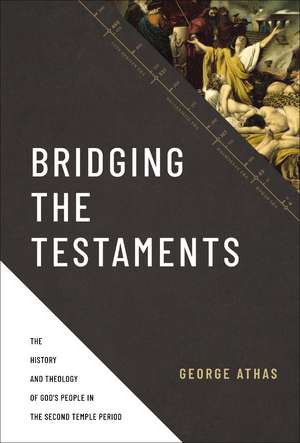
Bridging the Testaments: The History and Theology of God’s People in the Second Temple Period
Autor George Athasen Limba Engleză Hardback – 14 noi 2023
Prin volumul Bridging the Testaments, George Athas propune o resursă academică esențială care recalibrează înțelegerea noastră asupra tranziției dintre canonul ebraic și scrierile creștine timpurii. Remarcăm o structură riguroasă, organizată cronologic și tematic, care refuză abordarea simplistă a unei perioade de „tăcere” divină. Autorul segmentează istoria post-exilică în patru mari ere — Persană, Elenistică, Hasmoneană și Romană — oferind cititorului un cadru de referință pentru dezvoltările politice și sociale ce au definit identitatea iudaică.
Putem afirma că forța acestui text rezidă în capacitatea de a integra sursele extrabiblice cu analiza teologică. În prima parte, dedicată erei persane târzii, Athas explorează misiunile lui Ezra și Neemia, pilonii identității israelite și consolidarea monoteismului. Progresia către era elenistică și cea hasmoneană evidențiază tensiunile dintre tradiție și influențele externe, culminând cu perioada romană ce oferă contextul imediat pentru nașterea lui Isus. Cititorii familiarizați cu The Bridge to the New Testament de Denny Sissom vor aprecia la acest volum profunzimea academică sporită și accentul pus pe teologia biblică, depășind simpla narațiune istorică. În timp ce Second Temple Studies III se concentrează pe sociologia perioadei, Athas reușește să sintetizeze istoria și dogmatica într-un format accesibil, dar dens în informație.
Apărut la Zondervan Academic, acest titlu de referință de aproape 700 de pagini funcționează ca un manual cuprinzător. Stilul este precis, axat pe date concrete, iar epilogul ce analizează situația de la moartea lui Irod servește drept punte logică și istorică spre Noul Testament, explicând de ce peisajul religios al secolului I arăta așa cum îl găsim în Evanghelii.
Preț: 351.03 lei
Carte disponibilă
Livrare economică 02-16 noiembrie
Livrare express 16-22 octombrie pentru 60.18 lei
Specificații
ISBN-10: 0310520940
Pagini: 688
Dimensiuni: 161 x 236 x 40 mm
Greutate: 0.89 kg
Editura: Zondervan Academic
Colecția Zondervan Academic
Locul publicării:Grand Rapids, United States
De ce să citești această carte
Această lucrare este indispensabilă pentru studenții la teologie și cititorii pasionați de istorie biblică. George Athas oferă o perspectivă clară asupra celor cinci secole de dezvoltare teologică adesea ignorate, explicând rădăcinile iudaismului din timpul lui Isus. Veți câștiga o înțelegere profundă a contextului politic și social care a modelat scrierile Noului Testament, demontând prejudecata că perioada intertestamentară a fost una lipsită de activitate spirituală.
Recenzii
'Even Old and New Testament experts often ignore or don't pay sufficient attention to the period between the Testaments. George Athas provides a detailed yet accessible account of this fascinating period that helps us understand the biblical material more fully. His presentation of the Persian, Greek, and Roman periods with a focus on Judah is riveting and insightful. I recommend this book to all who are interested in biblical history and theology.'
'For too long students of Scripture have jumped historically from the fall of Jerusalem to the birth of Jesus, skipping some of the key moments in the redemptive story and the key theological role that these wrongly named 'intertestamental' years and texts play in biblical theology. George Athas invites us into this era and its literature, showing how the communities of the Second Temple as well as enduring exile continue the history of redemption that emerges with the same community gathered around the temple in the Gospels and Acts. Historically accurate, carefully presented, Bridging the Testaments is an extremely helpful invitation to what is for many unfortunately the 'dark ages' of Jewish and biblical history.'
'George Athas has done us a great service in writing Bridging the Testaments. This is an outstanding book--it is interesting, well-written, erudite, and relevant for anyone seeking to understand either the postexilic period or the social, historical, and religious background for the New Testament. Providing more information and going more in depth than most other New Testament background studies, this volume will serve as a valuable textbook for any college or graduate class seeking to understand the intertestamental period and its impact on the New Testament. Furthermore, even if it is not required for class, it is a great read.'
'In his volume Bridging the Testaments, Athas exposes the political, cultural, religious, economic, and social realities of the Second Temple period. Through a serious inquiry into biblical and extrabiblical literature written in Hebrew, Aramaic, Persian, Greek, and Latin, the author counters the notions that there was a cessation of Jewish literature that led to a silent intertestamental period. Athas provides an exhaustive description of major events under Persian, Hellenistic, Hasmonean, and Roman rules between 597 BC and 4 BC. As stated by the author, 'these centuries are laden with fascinating twists and turns, close calls, and a cast of enthralling characters.' This masterpiece bridges the gap between the worlds of the Old and New Testaments and paints a clear picture of Second Temple Judaism during the centuries that precede the advent of the Messiah. Highly recommended.'
'In this extremely useful volume, George Athas provides an accessible, highly readable, and comprehensive guide to the crucial period covering the end of the Old Testament era up to the beginning of the New Testament. In a remarkable achievement, Athas successfully weaves the interpretation of biblical books dealing with that later period and essential elements of New Testament background into the broader tapestry of world history of the centuries that saw the rise and fall of the Persian and Hellenistic kingdoms and the rise of Rome. This is a book that will engage both scholars and students, while providing an essential reference work for years to come.'
'Sooner or later all students of the Bible must consider the relationship between what we call the Old and the New Testaments. The relationship is complex, rich, and important. There is continuity (the God of Israel is the God and Father of Jesus) and discontinuity (there is something 'new' about the New Testament). All this may be profitably explored from various angles. In this impressive and stimulating volume George Athas explores chiefly the historical connections between the Testaments. How did the 'world' of the Old Testament become the 'world' of the New? Dr. Athas dispels popular misunderstandings (for example, that there were 400 years of prophetic 'silence' between the Testaments) and introduces readers to outstanding characters and world-changing events unfamiliar to most of us. Some of his suggestions will raise further questions for readers, but all will benefit from Dr. Athas's deep grasp of his subject. The careful reading of this book will enrich the reader's understanding of the message of the New Testament that has turned the world upside down.'
'Taking a traditional critical viewpoint, Athas provides a useful synthesis of the biblical texts and the extrabiblical sources to weave together an important review of these diverse elements. The work is worthy of consideration as a means to understand the complex picture of these centuries.'
'This is a winsomely written yet carefully nuanced account of the historical landscape of Judea in the Second Temple period. It is unburdened by excessive footnotes, yet clearly informed by extensive research. Athas helps us hear how passages both from the Jewish Scriptures and extrabiblical texts spoke to people in their lived contexts during this period--and makes some provocative suggestions for how several Old Testament texts are actually part of the bridge between the testaments. I highly recommend this book to those looking for a solid immersion into the story of the deceptively blank page that separates Malachi from Matthew.'
'With great detail, nuance, and insight, George Athas walks the reader through a remarkable expanse of history and the way it affected the growth and reception of Scripture. He shows how the texts transmitted within the Bible provide ways to cope with world-changing events carrying great theological relevance both for modern readers and for the ancient communities who experienced them. This book contributes enormously to a thoughtful engagement of the biblical tradition as a cornerstone of the human reckoning with history.'
Descriere
Bridging the end of the Old Testament period and the beginning of the New Testament period, this book surveys the history and theological developments of four significant eras in Israel's post-exilic history: the Persian Era (539-331 BC), the Hellenistic Era (332-167 BC), the Hasmonean Era (167-63 BC), and the Roman Era (63-4 BC). In doing so, it does away with the notion that there were four hundred years of prophetic silence before Jesus.
Bridging the Testaments outlines the political and social developments of these four periods, with particular focus on their impact upon Judeans and Samarians. Using a wide range of biblical and extra-biblical sources, George Athas reconstructs what can be known about the history of Judah and Samaria in these eras, providing the framework for understanding the history of God's covenant people, and the theological developments that occurred at the end of the Old Testament period, leading into the New Testament. In doing so, Athas shows that the notion of a supposed period of four hundred years of prophetic silence is not supported by the biblical or historical evidence. Finally, an epilogue sketches the historical and theological situation prevailing at the death of Herod in 4 BC, providing important context for the New Testament writings.
In this way, the book bridges the Old and New Testaments by providing a historical and theological understanding of the five centuries leading up to the birth of Jesus, tracking a biblical theology through them, and abolishing the notion of a four-century prophetic silence.