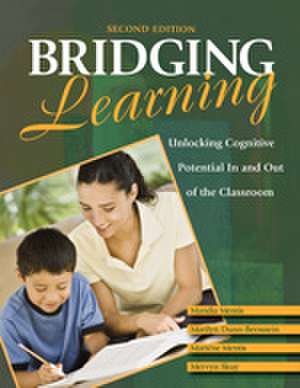
Bridging Learning: Unlocking Cognitive Potential In and Out of the Classroom
Editat de Mandia Mentis, Marilyn Dunn-Bernstein, Martene Mentis, Mervyn Skuyen Limba Engleză Paperback – 27 iul 2009
Observăm că succesul academic depinde adesea de capacitatea elevului de a transfera logica de la tablă în viața cotidiană. Bridging Learning începe tocmai cu această componentă practică, oferind exerciții și studii de caz menite să transforme abilitățile cognitive abstracte în instrumente de navigare socială. Remarcăm modul în care autorii propun activități ce pot fi integrate rapid, facilitând o punte („bridge”) între mediul școlar și comunitate. Volumul este structurat riguros, dedicând capitole specifice unor competențe precum organizarea, comparația, categorizarea și orientarea spațială, fiecare fiind analizată prin prisma utilității sale în învățarea formală și informală.
Această a doua ediție aduce un plus de rigoare prin includerea unor studii de cercetare recente care atestă eficiența programului de Îmbogățire Instrumentală (IE). Textul completează perspectiva oferită de Thinking about the Teaching of Thinking de Dorothy R. Howie, adăugând o dimensiune aplicativă mult mai pronunțată și strategii concrete pentru părinți și consilieri, nu doar pentru cadrele didactice. Dacă lucrarea anterioară a editorilor, Mediated Learning, servea ca un ghid introductiv pentru nespecialiști, volumul de față aprofundează aplicarea practică a conceptelor lui Reuven Feuerstein despre modificabilitatea cognitivă.
În viziunea echipei editoriale, coordonată de Mandia Mentis, inteligența nu este o trăsătură statică, ci un potențial ce poate fi deblocat prin mediere. Progresia capitolelor reflectă această filozofie, ghidând cititorul de la înțelegerea teoretică a unei abilități până la aplicarea sa în situații de „Cyber Counseling” sau gestionarea efortului energetic. Este un instrument de lucru precis, care evită generalitățile în favoarea unor tehnici de mediere testate.
Preț: 272.47 lei
Carte tipărită la comandă
Livrare economică 28 septembrie-12 octombrie
Specificații
ISBN-10: 1412969956
Pagini: 152
Dimensiuni: 216 x 279 x 10 mm
Greutate: 0.43 kg
Ediția:Second Edition
Editura: SAGE Publications
Colecția Corwin
Locul publicării:Thousand Oaks, United States
V-ar putea interesa
-
 Creative Dialogue: Talk for Thinking in the ClassroomRobert FisherPreț: 342.15 lei
 -
 Teaching Skills For DummiesSue CowleyPreț: 144.30 lei
 -
 Mediated LearningMandia MentisPreț: 351.06 lei
 -
 Differentiation Through Learning Styles and MemoryMarilee SprengerPreț: 281.44 lei
 -
 Fierce TeachingEric JensenPreț: 190.41 lei
 -
 The Book of ThunksIan GilbertPreț: 105.21 lei
 -
 Building Better Behaviour in the Early YearsChris DukesPreț: 396.20 lei
 -
 Changing Behaviour in SchoolsSue RoffeyPreț: 373.38 lei
 -
 Contemporary Issues in Learning and TeachingMargery McmahonPreț: 400.31 lei
De ce să citești această carte
Această carte este esențială pentru educatorii, psihologii școlari și părinții care doresc să dezvolte activ gândirea critică a copiilor. Cititorul câștigă o metodologie clară, bazată pe modelul Feuerstein, pentru a preda paisprezece abilități cognitive cheie. Este o resursă valoroasă deoarece transformă teoria psihologică în pași acționabili care ajută elevii să devină autonomi în învățare, atât la școală, cât și în viața de zi cu zi.
Despre autor
Mandia Mentis este psiholog educațional și conferențiar în cadrul programelor de Educație Specială la Massey University, Noua Zeelandă. Expertiza sa este ancorată în formarea directă la Centrul Internațional pentru Îmbunătățirea Învățării din Israel, sub îndrumarea renumitului Reuven Feuerstein. Cu o experiență de peste 20 de ani în coordonarea atelierelor de Îmbogățire Instrumentală în Africa de Sud și Noua Zeelandă, Mandia Mentis și-a dedicat cariera implementării practice a teoriilor despre învățarea mediată, fiind o autoritate recunoscută în domeniul modificabilității cognitive aplicate.
Descriere scurtă
'Using real-world examples and applications, this book makes cognitive psychology and cognitive education accessible to all who work with children and other learners. I immediately felt more confident in applying my new thinking and understanding to my practice'—Wendy Holley, School Psychologist, Bend-La Pine School District, OR
Based on Instrumental Enrichment (IE), a cognitive education approach pioneered by internationally renowned psychologist and child development expert Reuven Feuerstein, this updated volume provides practitioners with much-needed techniques to develop students' thinking skills and "bridge" these skills to the home and community.
This user-friendly book outlines fourteen core thinking skills that increase students' cognitive capacity, including organization, comparison, categorization, and problem solving. The authors demonstrate how teachers can mediate learning in the classroom and help parents, social workers, counsellors, and other adults who work with youth to extend learning beyond the classroom. Each chapter features:
- An introduction to and description of a specific skill
- Examples and applications for formal and informal learning contexts
- An outline of how the skill aligns with Feuerstein's theories of Mediated Learning and Cognitive Modifiability
Expanded to include an overview of many IE-related research studies and quotes to stimulate reflection on each skill, this second edition of Bridging Learning is a dynamic resource for creative educators dedicated to enhancing thinking skills in all learners.
Recenzii
"This book seamlessly blends theory with practical, real-life applications and activities that can be completed quickly and easily in both school and home/community settings. This encourages a partnership between all stakeholders to help students succeed."
"The idea that cognitive potential can be unlocked has become a powerful and influential idea in all sectors of education, be it early childhood education or higher education. This book consists of a series of activities framed by the most up-to-date thinking and research on cognition and mediation. The book makes available to parents, teachers, caregivers, community workers, and counselors a thought-provoking stance on thinking and learning and easy-to-apply techniques for getting it right."
"Using real-world examples and applications, this book makes cognitive psychology and cognitive education accessible to all those who work with children and other learners. The format is easy to follow, as the authors explore one key cognitive strategy in each chapter. I immediately felt more confident in applying my new thinking and understanding to my practice."
"A valuable companion text for educators and others utilizing Reuven Feuerstein's programs and methods for the teaching of thinking. The authors provide practical examples and clearly illustrate how to effectively mediate each of the fourteen areas of thinking identified by Feuerstein."
"Effective learning of thinking strategies and skills requires inspired bridging to meaningful examples. The authors share exciting up-to-date examples, particularly for bridging generally to all learning, to personal and community health, and to technology."
Cuprins
Acknowledgments
About the Authors
Introduction
1. Organization
Organization: What, Why, When, and Where?
Bridging Organization to Formal Learning Concepts
Bridging Organization to Informal Learning Concepts
Application of Organization: Energy Efforts
Feuerstein's Theory in Mediating Organization
2. Comparisons
Comparisons: What, Why, When, and Where?
Bridging Comparisons to Formal Learning Contexts
Bridging Comparisons to Informal Learning Contexts
Application of Comparison: Cyber Counseling
Feuerstein's Theory in Mediating Comparison
3. Categorization
Categorization: What, Why, When, and Where?
Bridging Categorization to Formal Learning Contexts
Bridging Categorization to Informal Learning Contexts
Application of Categorization: Toys and Tots
Feuerstein's Theory in Mediating Categorization
4. Relational Orientation in Space
Relational Orientation in Space: What, Why, When, and Where?
Bridging Relational Orientation in Space to Formal Learning Contexts
Bridging Relational Orientation in Space to Informal Learning Contexts
Application of Relational Orientation in Space: Family Feuds
Feuerstein's Theory in Mediating Relational Orientation in Space
5. Cardinal Orientation in Space
Cardinal Orientation in Space: What, Why, When, and Where?
Bridging Cardinal Orientation in Space to Formal Learning Contexts
Bridging Cardinal Orientation in Space to Informal Learning Contexts
Application of Cardinal Orientation in Space: Cultural Compass
Feuerstein's Theory in Mediating Cardinal Orientation in Space
6. Analysis and Synthesis
Analysis and Synthesis: What, Why, When, and Where?
Bridging Analysis and Synthesis to Formal Learning Contexts
Bridging Analysis and Synthesis to Informal Learning Contexts
Application of Analysis and Synthesis: Think Global, Act Local
Feuerstein's Theory in Mediating Analysis and Synthesis
7. Problem Solving
Problem Solving: What, Why, When, and Where?
Bridging Problem Solving to Formal Learning Contexts
Bridging Problem Solving to Informal Learning Contexts
Application of Problem Solving: Cyber Bullies and Suicide Scripts
Feuerstein's Theory in Mediating Problem Solving
8. Relationships
Relationships: What, Why, When, and Where?
Bridging Relationships to Formal Learning Contexts
Bridging Relationships to Formal Learning Contexts
Application of Relationships: Relatives and Relations
Feuerstein's Theory in Mediating Relationships
9. Temporal Concepts
Temporal Concepts: What, Why, When, and Where?
Bridging Temporal Concepts to Formal Learning Contexts
Bridging Temporal Concepts to Informal Learning Contexts
Application of Temporal Concepts: Slow and Steady
Feuerstein's Theory in Mediating Temporal Concepts
10. Instructions
Instructions: What, Why, When, and Where?
Bridging Instructions to Formal Learning Contexts
Bridging Instructions to Informal Learning Contexts
Application of Instructions: Implied Instruction
Feuerstein's Theory in Mediating Instructions
11. Progressions
Progressions: What, Why, When, and Where?
Bridging Progressions to Formal Learning Contexts
Bridging Progressions to Informal Learning Contexts
Application of Progressions: Cultural Constants and Continuities
Feuerstein's Theory in Mediating Progressions
12. Transitive Relations
Transitive Relations: What, Why, When, and Where?
Bridging Transitive Relations to Formal Learning Contexts
Bridging Transitive Relations to Informal Learning Contexts
Application of Transitive Relations: Global Greed
Feuerstein's Theory in Mediating Transitive Relations
13. Syllogisms
Syllogisms: What, Why, When, and Where?
Bridging Syllogisms to Formal Learning Contexts
Bridging Syllogisms to Informal Learning Contexts
Application of Syllogisms: Silly Syllogism
Feuerstein's Theory in Mediating Syllogisms
14. Scaffolding
Scaffolding: What, Why, When, and Where?
Bridging Scaffolding to Formal Learning Contexts
Bridging Scaffolding to Informal Learning Contexts
Application of Scaffolding: Project Planning
Feuerstein's Theory in Mediating Scaffolding
Appendix A: 12 Criteria of a Mediated Learning Experience (MLE)
Appendix B: Cognitive Functions and Dysfunctions
Appendix C: Cognitive Map
Glossary
References
Index