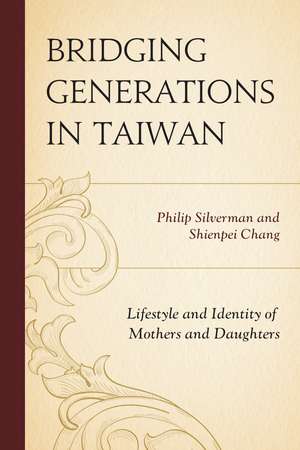
Bridging Generations in Taiwan: Lifestyle and Identity of Mothers and Daughters
Autor Philip Silverman, Shienpei Changen Limba Engleză Hardback – 30 oct 2015
Preț: 566.66 lei
Preț vechi: 861.62 lei
-34%
Puncte Express: 850
Carte tipărită la comandă
Livrare economică 10-24 noiembrie
Livrare prin curier în România Termenul estimat este afișat lângă disponibilitate.
Transport gratuit pentru acest produs Plată online sau ramburs, în funcție de opțiunile comenzii.
Retur gratuit în 14 zile Comandă securizată și suport în română.
Specificații
ISBN-13: 9781498514101
ISBN-10: 1498514103
Pagini: 134
Ilustrații: 6 Tables
Dimensiuni: 156 x 239 x 14 mm
Greutate: 0.32 kg
Editura: Bloomsbury Publishing
Colecția Lexington Books
Locul publicării:New York, United States
ISBN-10: 1498514103
Pagini: 134
Ilustrații: 6 Tables
Dimensiuni: 156 x 239 x 14 mm
Greutate: 0.32 kg
Editura: Bloomsbury Publishing
Colecția Lexington Books
Locul publicării:New York, United States
Cuprins
Chapter 1: Introduction
Chapter 2: Chen Family: A Life of Hard Work
Chapter 3: Han Family: From Accepting Fate to Shaping It
Chapter 4: Lin Family: From Oppression to Liberation
Chapter 5: Wang Family: Generations Apart
Chapter 6: Lee Family: Bitter Lives
Chapter 7: Comparison of Narrative Tropes and Lifestyle Activities
Chapter 8: Conclusion
Chapter 2: Chen Family: A Life of Hard Work
Chapter 3: Han Family: From Accepting Fate to Shaping It
Chapter 4: Lin Family: From Oppression to Liberation
Chapter 5: Wang Family: Generations Apart
Chapter 6: Lee Family: Bitter Lives
Chapter 7: Comparison of Narrative Tropes and Lifestyle Activities
Chapter 8: Conclusion
Recenzii
It is enormously invigorating to read a book revisiting classic issues in Chinese kinship with the lives of mothers and daughters as a starting point. Philip Silverman and Shienpei Chang's Bridging generations in Taiwan raises new questions about women's lives as they have been transformed through the rapid changes of late twentieth- and early twenty-first-century society in Taiwan. This intimate study of relatedness explores how transitions in the modern political economy of Chinese societies affect family and gender relations, and opens a new door for thinking about contemporary patriarchy as it is refigured in East Asian Chinese societies.
Imagine Taiwan society as an inherently ambiguous and slowly morphing jungle gym. Some bars and posts are firm, dependable or unavoidable: enforced laws, hard-shelled demographic events, market values. Others are rubbery, unreliable or flexible: taxes easily evaded, fictive kinship ties, prices for 'special customers.' Some are merely notional: norms of filial piety, social values, selves. With admirable transparency, Philip Silverman and Shienpei Chang show five mother-daughters pairs struggling through these limitations and opportunities toward safe perches and acceptable identities in their complex, cosmopolitan world.
This book provides an intimate look into the lives of two generations of rural, working class Taiwanese women, revealing how Taiwanese women combine tradition and individual lifestyles under conditions of high modernity. It will be relevant to women's studies, but also to readers interested in how individuals create and maintain life-worlds within the social constraints of their times.
That Taiwan experienced profound changes in the postwar period is not news, but the way Bridging Generations in Taiwan brings those transformations to life is new, and startling. The struggles of two generations of Taiwanese women recounted in this book offer a fresh perspective on the suffering and endurance on which the island's economic, social, and political 'miracles' are built.
Imagine Taiwan society as an inherently ambiguous and slowly morphing jungle gym. Some bars and posts are firm, dependable or unavoidable: enforced laws, hard-shelled demographic events, market values. Others are rubbery, unreliable or flexible: taxes easily evaded, fictive kinship ties, prices for 'special customers.' Some are merely notional: norms of filial piety, social values, selves. With admirable transparency, Philip Silverman and Shienpei Chang show five mother-daughters pairs struggling through these limitations and opportunities toward safe perches and acceptable identities in their complex, cosmopolitan world.
This book provides an intimate look into the lives of two generations of rural, working class Taiwanese women, revealing how Taiwanese women combine tradition and individual lifestyles under conditions of high modernity. It will be relevant to women's studies, but also to readers interested in how individuals create and maintain life-worlds within the social constraints of their times.
That Taiwan experienced profound changes in the postwar period is not news, but the way Bridging Generations in Taiwan brings those transformations to life is new, and startling. The struggles of two generations of Taiwanese women recounted in this book offer a fresh perspective on the suffering and endurance on which the island's economic, social, and political 'miracles' are built.