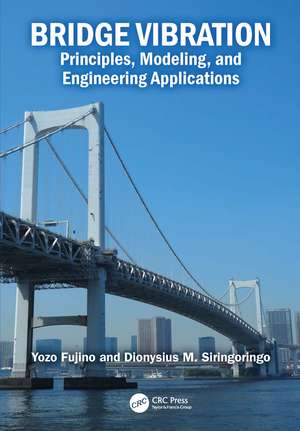
Bridge Vibration: Principles, Modeling, and Engineering Applications
Autor Yozo Fujino, Dionysius M. Siringoringoen Limba Engleză Hardback – 9 dec 2026
This book presents the research contributions of the authors, together with selected works of leading scholars and recent developments, to provide a comprehensive treatment of bridge vibrations. The book is divided into two parts. Part I introduces the fundamental theories of bridge vibration, with linear, nonlinear, and random vibrations as its core concepts. Part II discusses vibration mechanisms, analytical methodologies, and representative case studies involving vehicle-, train-, wind-, seismic-, and pedestrian-induced bridge vibrations, as well as cable vibrations in cable-supported bridges. Real-world case studies are included throughout to illustrate significant vibration events and practical engineering solutions.
Providing a self-contained and rigorous framework for understanding bridge vibrations, the book combines theoretical insight with robust analytical methods for advanced study and serves as a practical reference for engineers addressing vibration-related challenges in bridge engineering.
Preț: 702.42 lei
Preț vechi: 911.04 lei
-23% Precomandă
Puncte Express: 1054
Carte nepublicată încă
Livrare prin curier în România Precomanda se expediază când titlul devine disponibil.
Transport gratuit pentru acest produs Plată online sau ramburs, în funcție de opțiunile comenzii.
Retur gratuit în 14 zile Comandă securizată și suport în română.
Doresc să fiu notificat când acest titlu va fi disponibil:
Se trimite...
Specificații
ISBN-13: 9781041362012
ISBN-10: 1041362013
Pagini: 496
Ilustrații: 686
Dimensiuni: 178 x 254 mm
Ediția:1
Editura: CRC Press
Colecția CRC Press
ISBN-10: 1041362013
Pagini: 496
Ilustrații: 686
Dimensiuni: 178 x 254 mm
Ediția:1
Editura: CRC Press
Colecția CRC Press
Public țintă
Postgraduate and Professional ReferenceCuprins
PART I: Fundamental Principles of Bridge Vibration 1. Introduction 2. Analytical Modelling for Bridge Dynamic Analysis 3. Dynamic Characteristics of Bridge Structure 4. Linear Bridge Vibration under Deterministic Dynamic Force 5. Nonlinear Bridge Vibration under Deterministic Dynamic Force 6. Bridge Vibration under Random Dynamic Force 7. Bridge Damping – Mechanism, Model and Measurement PART II: Mechanisms and Case-Studies of Bridge Vibration 8. Vehicle-Induced Bridge Vibration 9. Train-Induced Railway Bridge Vibration 10. Wind-Induced Bridge Vibration and Aerodynamic Instabilities 11. Seismic-Induced Bridge Vibration 12. Human-Induced Vibration of Pedestrian Bridge 13. Vibration Mechanisms of Cables in Cable-Supported Bridges Appendix A: Numerical Integration Methods for Linear System Appendix B Numerical Integration Methods for Nonlinear System Appendix C Phase Plane Representation for Nonlinear Dynamical System Appendix D Basic Properties of Random Vibration Transmission Appendix E Mathematical Models of Damping in Structure Appendix F Methodologies for Damping Estimation from Measurements Index
Notă biografică
Yozo Fujino is President of Josai University and Professor Emeritus at both the University of Tokyo and Yokohama National University. He has made pioneering contributions in bridge dynamics and control, nonlinear vibration modeling, vibration control of cable-supported bridges, pedestrian-induced bridge vibrations, and the development of multiple tuned mass dampers and tuned liquid dampers. More recently, he has advanced vibration-based monitoring of long-span bridges and base-isolated buildings, with significant findings during the 2011 Tohoku Earthquake. He has published over 400 journal papers and 1,000 conference papers and serves on the editorial boards of 15 leading international journals. His distinguished honors include the Medal with Purple Ribbon (2007), Japan Academy (Nippon Gakushi-in) in 2025, and the Japan Academy Prize (2019), where he became only the seventh civil engineer to receive this award in its 109-year history. Internationally, he has received numerous ASCE awards (Raymond C. Reese Prize, Scanlan Medal, George Winter Medal, Moisseiff Award, Housner Medal), the T.Y. Lin Medal, Nishino Medal, and the International Award of Merit in Structural Engineering (IABSE) award, and delivered the Newmark Distinguished Lecture at UIUC in 2023. He has also served as President of the International Association of Structural Control and Monitoring, Vice President of IABSE, and President of the Asia-Pacific Network for Research in Smart Structures Technology.
Dionysius M. Siringoringo is IMS Professor of Safety and Resilience of Infrastructure at the Institute of Multidisciplinary Sciences, Yokohama National University, Japan. He received his PhD from the University of Tokyo, where he later served as an assistant professor. His research expertise is in bridge vibration, system identification, and structural health monitoring of bridges, as well as seismic and wind-induced vibration response analysis and control of long-span bridges. He has published hundreds of papers and has been involved in numerous research projects, including seismic and wind monitoring of long-span bridges in the Tokyo metropolitan area, studies on vehicle-bridge interaction under earthquakes and strong winds, seismic monitoring using wireless sensor networks, vision-based vibration measurement, pedestrian-induced bridge vibration, and seismic monitoring of base-isolated bridges. His work has been recognized with multiple awards, including the JSCE Tanaka Award for Best Paper, the IABSE Outstanding Scientific Research Paper Award, the Japan Association of Wind Engineering (JAWE) Award, the Takuji Kobori Award of the International Association of Structural Control and Monitoring (IASCM), and the ASCE Bridge Engineering Best Reviewer Award.
Descriere
Bridge vibration has fascinated civil engineers since the pursuit of longer bridge spans began in the early twentieth century. As bridges became longer, lighter, and more flexible, engineers increasingly recognized the need for a deeper understanding of structural vibration and its effects on safety, serviceability, and durability.