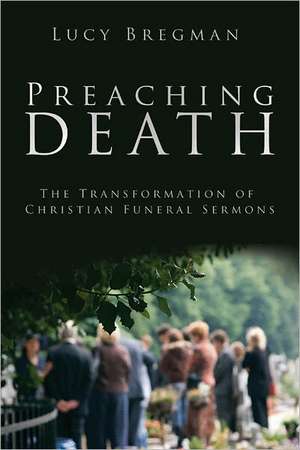
Bregman, L: Preaching Death
en Limba Engleză Paperback – oct 2011
Preț: 285.87 lei
Puncte Express: 429
Carte tipărită la comandă
Livrare economică 03-17 decembrie
Livrare prin curier în România Termenul estimat este afișat lângă disponibilitate.
Transport gratuit de la 400.00 lei Plată online sau ramburs, în funcție de opțiunile comenzii.
Retur gratuit în 14 zile Comandă securizată și suport în română.
Specificații
ISBN-13: 9781602583207
ISBN-10: 160258320X
Pagini: 264
Ilustrații: black & white illustrations
Dimensiuni: 152 x 229 x 15 mm
Greutate: 0.41 kg
ISBN-10: 160258320X
Pagini: 264
Ilustrații: black & white illustrations
Dimensiuni: 152 x 229 x 15 mm
Greutate: 0.41 kg
V-ar putea interesa
-
 The ResurrectionGeza VermesPreț: 63.81 lei
-
 JesusGeza VermesPreț: 125.33 lei
-
 Home with GodNeale Donald Walsch-26%Preț: 68.61 lei93.27 lei
-
 Preț: 152.15 lei
-
 The Wisdom of the EnneagramDon Richard Riso-24%Preț: 115.28 lei152.66 lei
-
 ChurchNextEddie GibbsPreț: 203.26 lei
-
 The Ezekiel OptionJoel C RosenbergPreț: 110.96 lei
-
 Preț: 369.85 lei
-
 Teaching Global Theologies: Power and PraxisPui-lan KWOKPreț: 300.17 lei
-
 Preț: 276.37 lei
-
 Preț: 314.95 lei
-
 Preț: 230.45 lei
-
 ChristianityKeith WardPreț: 71.21 lei
Recenzii
"Lucy Bregman's incredible scholarship, laced with her practical judgment, creates sparkling insights at every turn. A must-read for pastors, for those who teach them, and for grief counselors of any stripe; this is their story, too." --Dennis Klass, author of The Spiritual Lives of Bereaved Parents
"Lucy Bregman's primary concern is our legacy, not in terms of what we leave behind when we die but with the images and meanings we create as we live in the presence of death. In a unique and provocative twist, she challenges readers to use historical imagination to envision alternative theologies of death in 20th century America. Preaching Death should be read by historians, preachers, and poets, and by anyone who longs to re-imagine death and grief in the 21st century." --Margaret R. McLean, Associate Director and Director of Bioethics, Markkula Center for Applied Ethics, Santa Clara University
"Lucy Bregman has once again brought her experience to bear upon the weighty topic of death, dying, and the afterlife. Clear, concise, and accessibly written, this book will doubtless be of interest to a wide audience, including not only those interested in Christian theology but those with a general interest in modern attitudes to death, dying, loss, and bereavement." -- Christopher M. Moreman, Assistant Professor of Philosophy, California State University, East Bay
Bregman offers very interesting perspectives for pastoral workers as well as for empirical researchers in the field of death and dying. -- Brenda Mathijssen, Radboud University Nijmegen -- Modern Believing
Cuprins
Part I: What Christians Used to Say about Death 1. A Changeover of Messages and Images2. What Is a Christian Funeral?3. Funeral Theologies of Death4. Heaven as Home5. Heaven as Journey6. Natural Immortality7. The Lord's Will Part II: The Age of Silence and Denial 8. "Please Omit Funeral"9. The Challenge of New Theologies10. Death as Enemy Part III: What Came Next 11. New Words for Death, Dying, and Grief12. The Triumph of the Biographical Part IV: What Might Have Been 13. Two Alternatives14. What Might Have Been--Lament15. The Eclipse of Poetry Part V: Conclusion 16. What Christians No Longer Want to Say about Death