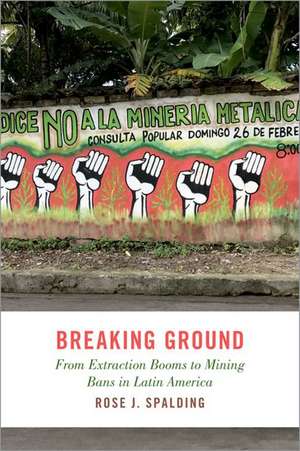
Breaking Ground: From Extraction Booms to Mining Bans in Latin America: STUDIES COMPAR ENERGY ENVIRON POL SERIES
Autor Rose J. Spaldingen Limba Engleză Hardback – 13 iun 2023
Preț: 408.91 lei
Preț vechi: 582.86 lei
-30%
Puncte Express: 613
Carte disponibilă
Livrare economică 12-17 noiembrie
Livrare prin curier în România Termenul estimat este afișat lângă disponibilitate.
Transport gratuit pentru acest produs Plată online sau ramburs, în funcție de opțiunile comenzii.
Retur gratuit în 14 zile Comandă securizată și suport în română.
Specificații
ISBN-13: 9780197643150
ISBN-10: 0197643159
Pagini: 328
Dimensiuni: 226 x 157 x 43 mm
Greutate: 0.59 kg
Editura: Oxford University Press
Colecția OUP USA
Seria STUDIES COMPAR ENERGY ENVIRON POL SERIES
Locul publicării:New York, United States
ISBN-10: 0197643159
Pagini: 328
Dimensiuni: 226 x 157 x 43 mm
Greutate: 0.59 kg
Editura: Oxford University Press
Colecția OUP USA
Seria STUDIES COMPAR ENERGY ENVIRON POL SERIES
Locul publicării:New York, United States
Recenzii
Breaking Ground offers an extraordinary comparative work of social movement struggles in Central America over the environmental threats of extractivism. Based on decades of field research, Spalding provides a fresh and compelling framework for understanding the outcomes of anti-mining campaigns—a perspective that is indispensable to community activists and environmental policymakers around the globe attempting to turn back an accelerating ecological crisis.
I have had the honor of watching Spalding develop this project over more than a decade. It has reflected her love of theory, of Central America, of methodological rigor, and of collaborative thinking. These commitments have produced what stands as the most incisive and comprehensive statement to date on social movement and policy dynamics surrounding mining in Central America. Each of Spalding's in-depth case studies of the contentious politics surrounding mining in Costa Rica, El Salvador, Guatemala, and Nicaragua is a stand-alone classic. Her comparative analysis of these cases is exquisite, offering a framework for analyzing the politics of policy change whose relevance goes far, far beyond the question of mining. This is quite simply a wonderful piece of scholarship.
This book offers a master course for understanding why countries approach the allure of gold and silver mining so differently—from open embrace to complete rejection. Drawing on four deeply-researched case studies in Central America, Spalding develops a sophisticated theoretical framework about the interaction between elites and social mobilization that combines theoretical clarity with empirical insight and interest. A stellar work, not to be missed.
Breaking Ground should be widely read. It offers a giant leap forward both in general explanations for when and how social movements impact policy and institutional change, and in the highly conflictive area of mining-based extractive development in particular; an issue even more topical given the need for minerals in new climate change-related technologies. Spalding constructs an elegant, interdisciplinary three factor explanation for variation across cases that draws from political economy, social movement theory, and comparative politics. The comprehensiveness, depth, and clarity of the analytical dimensions of the subject are impressive and refreshing. This book will endure as a towering testament to the explanatory power of intensive, in-depth, committed, long-term field research. An extraordinary achievement.
I have had the honor of watching Spalding develop this project over more than a decade. It has reflected her love of theory, of Central America, of methodological rigor, and of collaborative thinking. These commitments have produced what stands as the most incisive and comprehensive statement to date on social movement and policy dynamics surrounding mining in Central America. Each of Spalding's in-depth case studies of the contentious politics surrounding mining in Costa Rica, El Salvador, Guatemala, and Nicaragua is a stand-alone classic. Her comparative analysis of these cases is exquisite, offering a framework for analyzing the politics of policy change whose relevance goes far, far beyond the question of mining. This is quite simply a wonderful piece of scholarship.
This book offers a master course for understanding why countries approach the allure of gold and silver mining so differently—from open embrace to complete rejection. Drawing on four deeply-researched case studies in Central America, Spalding develops a sophisticated theoretical framework about the interaction between elites and social mobilization that combines theoretical clarity with empirical insight and interest. A stellar work, not to be missed.
Breaking Ground should be widely read. It offers a giant leap forward both in general explanations for when and how social movements impact policy and institutional change, and in the highly conflictive area of mining-based extractive development in particular; an issue even more topical given the need for minerals in new climate change-related technologies. Spalding constructs an elegant, interdisciplinary three factor explanation for variation across cases that draws from political economy, social movement theory, and comparative politics. The comprehensiveness, depth, and clarity of the analytical dimensions of the subject are impressive and refreshing. This book will endure as a towering testament to the explanatory power of intensive, in-depth, committed, long-term field research. An extraordinary achievement.
Notă biografică
Rose J. Spalding is Professor of Political Science at DePaul University, where she specializes in the study of Latin American social movements and political economy. She is the author of Contesting Trade in Central America: Market Reform and Resistance; Capitalists and Revolution in Nicaragua: Opposition and Accommodation, 1979-1993; and The Political Economy of Revolutionary Nicaragua. Spalding's research has been supported by grants from the Social Science Research Council, American Council of Learned Societies, Fulbright, and the Kellogg Institute at Notre Dame University, among others. She is a founding contributor to the Research Group MEGA (Mobilization, Extractivism, and Government Action) at Tulane University.