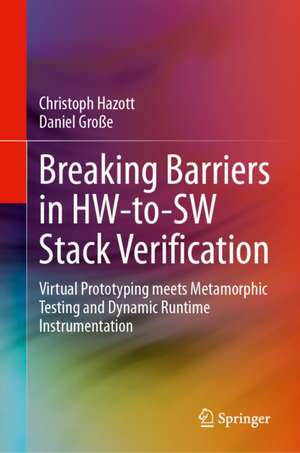
Breaking Barriers in HW-to-SW Stack Verification
Autor Christoph Hazott, Daniel Großeen Limba Engleză Hardback – 11 noi 2026
Preț: 712.69 lei
Preț vechi: 890.85 lei
-20% Precomandă
Puncte Express: 1069
Carte nepublicată încă
Livrare prin curier în România Precomanda se expediază când titlul devine disponibil.
Transport gratuit pentru acest produs Plată online sau ramburs, în funcție de opțiunile comenzii.
Retur gratuit în 14 zile Comandă securizată și suport în română.
Doresc să fiu notificat când acest titlu va fi disponibil:
Se trimite...
Specificații
ISBN-13: 9783032235831
ISBN-10: 3032235839
Pagini: 126
Dimensiuni: 155 x 235 mm
Editura: Springer Nature Switzerland AG
ISBN-10: 3032235839
Pagini: 126
Dimensiuni: 155 x 235 mm
Editura: Springer Nature Switzerland AG
Notă biografică
Christoph Hazott received the M.Sc. degree in Embedded Systems Design from the University of Applied Sciences Hagenberg, Austria, in 2012. After his master studies, he worked at Infineon Technologies AG for the Test Engineering Department. In 2021, he started as a PhD student with the Institute for Complex Systems, Johannes Kepler University Linz, Austria and received his PhD in computer science in 2025. He published several papers at international conferences and journals, such as ASP-DAC, ETS, DDECS, FDL, and Integration, the VLSI Journal. His current research interests include RISC-V, SystemC/TLM based Virtual Prototyping as well as test and analysis of embedded HW/SW systems.
Cuprins
Introduction.- Preliminaries.- Breaking the Test Oracle Barrier.- Breaking the Isolated Analysis Barrier.- Conclusion and Outlook.