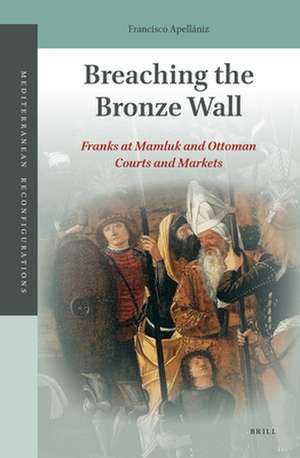
Breaching the Bronze Wall: Franks at Mamluk and Ottoman Courts and Markets
Autor Francisco Apellánizen Limba Engleză Hardback – 6 aug 2020
Preț: 748.98 lei
Preț vechi: 972.70 lei
-23%
Puncte Express: 1123
Preț estimativ în valută:
132.51€ • 156.23$ • 115.09£
132.51€ • 156.23$ • 115.09£
Carte tipărită la comandă
Livrare economică 23 martie-06 aprilie
Specificații
ISBN-13: 9789004382749
ISBN-10: 9004382747
Pagini: 332
Dimensiuni: 155 x 234 x 21 mm
Greutate: 0.65 kg
Ediția:Approx. 360 Pp. edition
Editura: Brill
ISBN-10: 9004382747
Pagini: 332
Dimensiuni: 155 x 234 x 21 mm
Greutate: 0.65 kg
Ediția:Approx. 360 Pp. edition
Editura: Brill
Notă biografică
Francisco Apellániz, Ph.D. (2006) European University Institute, has taught Islamic and Ottoman History at Aix-en-Provence and is currently at the Orientale in Naples. He is the author of Pouvoir et finance en Méditerranée pré-moderne: le deuxième Etat mamelouk et le commerce des épices (1382-1517) (CSIC 2009).
Cuprins
Acknowledgements
Abbreviations
1 Introduction
1.1 Structure of the Book
2 Producing, Handling and Archiving Evidence in Mediterranean Societies
2.1 The 'Archival Divide'
2.2 Islamic Notions and Doctrines on Proof and Evidence
2.3 Notaries in the Cross-Confessional Middle Ages
2.4 The Case of the Outremer Notaries
2.5 New Attitudes towards the Written
3 ‘Men Like the Franks’: Dealing with Diversity in Medieval Norms and Courts
3.1 An Introduction to Siyāsa
3.2 The Crusader Marketplace
3.3 The actor sequitur forum rei Principle
3.4 Empowering One Consul over the Others
3.5 An Iberian Epilogue
3.6 Siyāsa Justice in Theory and Practice
3.7 Conflict Resolution in and out of the Courtroom
3.8 Merchants at the Islamic Courts: a Lender of Last Resort?
3.9 Mixed Cases at the Qadi Court
3.10 Mixed Cases before Siyāsa Courts
3.11 Siyāsa among the Franks
4 Ottoman Legal Attitudes towards Diversity
4.0 The ‘Witness System’: a Bronze Wall?
4.1 The Legal Grounds of the Ottoman Witness System
4.2 The Ban on Muslim Witnesses
4.3 Dhimmī Claims on Communal Exclusivity: the Carazari Clause
4.4 False Witnessing
4.5 Proving Enslavement
4.6 Legal Truth and the Governance of Frontier Zones
4.7 The Aleppo Ferman
4.8 A Death in Damascus
5 Conclusions
Bibliography
Index
Abbreviations
1 Introduction
1.1 Structure of the Book
2 Producing, Handling and Archiving Evidence in Mediterranean Societies
2.1 The 'Archival Divide'
2.2 Islamic Notions and Doctrines on Proof and Evidence
2.3 Notaries in the Cross-Confessional Middle Ages
2.4 The Case of the Outremer Notaries
2.5 New Attitudes towards the Written
3 ‘Men Like the Franks’: Dealing with Diversity in Medieval Norms and Courts
3.1 An Introduction to Siyāsa
3.2 The Crusader Marketplace
3.3 The actor sequitur forum rei Principle
3.4 Empowering One Consul over the Others
3.5 An Iberian Epilogue
3.6 Siyāsa Justice in Theory and Practice
3.7 Conflict Resolution in and out of the Courtroom
3.8 Merchants at the Islamic Courts: a Lender of Last Resort?
3.9 Mixed Cases at the Qadi Court
3.10 Mixed Cases before Siyāsa Courts
3.11 Siyāsa among the Franks
4 Ottoman Legal Attitudes towards Diversity
4.0 The ‘Witness System’: a Bronze Wall?
4.1 The Legal Grounds of the Ottoman Witness System
4.2 The Ban on Muslim Witnesses
4.3 Dhimmī Claims on Communal Exclusivity: the Carazari Clause
4.4 False Witnessing
4.5 Proving Enslavement
4.6 Legal Truth and the Governance of Frontier Zones
4.7 The Aleppo Ferman
4.8 A Death in Damascus
5 Conclusions
Bibliography
Index