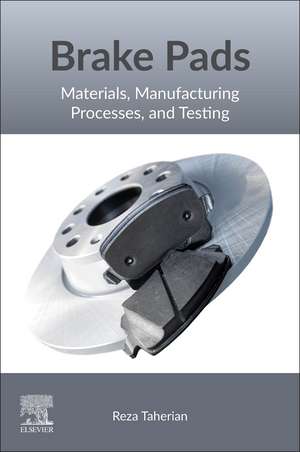
Brake Pads: Materials, Manufacturing Processes, and Testing
Autor Reza Taherianen Limba Engleză Paperback – 7 noi 2025
It encompasses, in Part I, an overview of friction materials already available on the market and other more recently developed formulations and, in Part II, step-by-step examinations of a range of manufacturing parameters with related effects on the specific properties of the selected compounds as well as testing techniques.
Discussions on regulatory standards, literature reviews, case studies, application scenarios, and analytical modeling make for a unique contribution that is not only timely but also shows the field’s potential for ever-growing transformation.
- Covers different materials that can be used for brake pads
- Features real-life case studies, facilitating understanding of current challenges
- Includes sustainability considerations which have acquired importance for academic researchers and manufacturing specialists alike
Preț: 1237.32 lei
Preț vechi: 1793.57 lei
-31%
Puncte Express: 1856
Carte tipărită la comandă
Livrare economică 24 noiembrie-08 decembrie
Livrare prin curier în România Termenul estimat este afișat lângă disponibilitate.
Transport gratuit pentru acest produs Plată online sau ramburs, în funcție de opțiunile comenzii.
Retur gratuit în 14 zile Comandă securizată și suport în română.
Specificații
ISBN-13: 9780443266454
ISBN-10: 044326645X
Pagini: 540
Dimensiuni: 152 x 229 x 28 mm
Greutate: 0.84 kg
Editura: ELSEVIER SCIENCE
ISBN-10: 044326645X
Pagini: 540
Dimensiuni: 152 x 229 x 28 mm
Greutate: 0.84 kg
Editura: ELSEVIER SCIENCE
V-ar putea interesa
-
 Pipe Trades Pocket ManualMcGraw-HillPreț: 293.95 lei
 -
 Stick and Rudder: An Explanation of the Art of FlyingWolfgang Langewiesche-32%Preț: 192.07 lei283.57 lei
 -
 Ace The Technical Pilot Interview 2/EGary Bristow-33%Preț: 171.41 lei254.30 lei
 -
 -24%Preț: 364.38 lei479.88 lei
 -
 The Official DVSA Theory Test for Car Drivers - 2025Driver and Vehicle Standards AgencyyPreț: 155.83 lei
 -
 Materials and the Environment: Eco-informed Material ChoiceMichael F. Ashby-31%Preț: 357.55 lei520.30 lei
 -
 Automotive Brake SystemsJames Halderman-23%Preț: 1191.24 lei1547.06 lei
 -
 Alloys for Powder-Based Additive ManufacturingHossein Eskandari Sabzi-30%Preț: 439.75 lei629.31 lei
 -
 Materials Selection in Mechanical DesignMichael F. Ashby-30%Preț: 455.82 lei654.07 lei
 -
 Manufacturing Processes for Design ProfessionalsRob Thompson-16%Preț: 499.76 lei596.55 lei
 -
 -23%Preț: 714.25 lei927.59 lei
 -
 -34%Preț: 190.31 lei287.05 lei
 -
 Essentials of Advanced Composite Fabrication and RepairLouis C Dorworth-8%Preț: 448.81 lei487.83 lei
 -
 -30%Preț: 97.81 lei139.80 lei
 -
 Ceramics: A Green ApproachKevin Millward-43%Preț: 137.14 lei239.01 lei
 -
 The Engineer's Guide to MaterialsK. T. Voisey-15%Preț: 484.79 lei570.34 lei
 -
 Advanced Materials and ManufacturingJitendra Kumar Katiyar-18%Preț: 1402.65 lei1710.55 lei
 -
 Recent Advances in Materials and ManufacturingC. V. Chandrashekara-18%Preț: 1579.53 lei1926.25 lei
 -
 Advances in Materials EngineeringPramod Bhingole-18%Preț: 1274.10 lei1553.78 lei
 -
 Advances in Materials and Agile ManufacturingNarendra Kumar-18%Preț: 1156.63 lei1410.52 lei
Cuprins
Part I: Materials
1. Classification of brake pads in automotive and aerospace applications
2. An overview of composite materials
3. Binders for brake pads
4. Reinforcement fiber materials for brake pads
5. Organic additives for brake pads
6. Filler materials for brake pads
7. Abrasive and lubricant materials for brake pads
8. Carbon allotropes in Brake Pads
9. Using eco-friendly materials in brake pads
10. Design and materials of aircraft brake pads: types, formulations, and case studies
Part II: Manufacturing, testing, and modeling
11. Manufacturing parameters (i.e., temperature, pressure, mixing method, and heat treatment) and their effect on the properties of brake pads
12. Mechanical and tribological testing in brake pads: wear resistance, coefficient of friction, hardness, tensile, and compression tests
13. Thermal conductivity in brake pads
14. Noise testing
15. Porosity in brake pads: origins, measurement, and its influence on performance
16. Advancements in brake pad modeling and predictive maintenance
1. Classification of brake pads in automotive and aerospace applications
2. An overview of composite materials
3. Binders for brake pads
4. Reinforcement fiber materials for brake pads
5. Organic additives for brake pads
6. Filler materials for brake pads
7. Abrasive and lubricant materials for brake pads
8. Carbon allotropes in Brake Pads
9. Using eco-friendly materials in brake pads
10. Design and materials of aircraft brake pads: types, formulations, and case studies
Part II: Manufacturing, testing, and modeling
11. Manufacturing parameters (i.e., temperature, pressure, mixing method, and heat treatment) and their effect on the properties of brake pads
12. Mechanical and tribological testing in brake pads: wear resistance, coefficient of friction, hardness, tensile, and compression tests
13. Thermal conductivity in brake pads
14. Noise testing
15. Porosity in brake pads: origins, measurement, and its influence on performance
16. Advancements in brake pad modeling and predictive maintenance