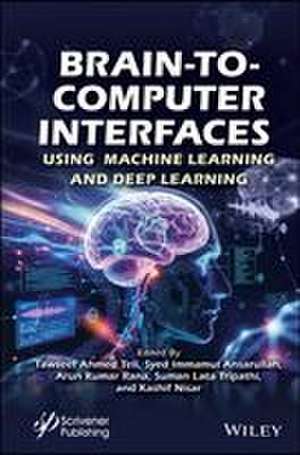
Brain-to-Computer Interfaces
Editat de Arun Kumar Rana, Kashif Nisar, Suman Lata Tripathi, Syed Immamul Ansarullah, Tawseef Ahmed Telien Limba Engleză Hardback – 27 aug 2026
What if the most powerful interface you will ever use requires no keyboard, no screen, no voice, just thought? Brain-computer interfaces are making this a reality, and brainwave-to-machine commands are the comprehensive technical roadmaps to understanding, building, and deploying them. These innovative technologies provide previously unheard-of opportunities for control, rehabilitation, and communication by bridging the gap between the human brain and external equipment.
This book presents the fundamentals of neuroscience that make brain-computer interfaces possible, covering the electrical language of neurons, the recording modalities that capture it, and the preprocessing pipelines that transform raw brainwaves into analysis-ready data. From that foundation, it builds systematically through classical machine learning algorithms, convolutional neural networks for spatial EEG pattern recognition, and long short-term memory-based recurrent architectures for decoding the temporal dynamics of brain activity, always anchored to real implementation, not just theory. Dedicated chapters and case studies address neurorehabilitation for stroke and spinal cord injury recovery, early detection of dementia, and the convergence of brain-computer interfaces with augmented and virtual reality. Competing titles either restrict themselves to a single modality or a single technique; This book refuses that narrowness, delivering a unified framework that moves from algorithm design to sustainable hardware deployment. This essential guide is both a rigorous graduate-level text and an enduring reference for the researchers, engineers, and clinicians who will shape the future of human-computer interaction.
Preț: 1271.42 lei
Preț vechi: 1589.28 lei
-20% Precomandă
Puncte Express: 1907
Carte nepublicată încă
Livrare prin curier în România Precomanda se expediază când titlul devine disponibil.
Transport gratuit pentru acest produs Plată online sau ramburs, în funcție de opțiunile comenzii.
Retur gratuit în 14 zile Comandă securizată și suport în română.
Doresc să fiu notificat când acest titlu va fi disponibil:
Se trimite...
Specificații
ISBN-13: 9781394389506
ISBN-10: 1394389507
Pagini: 448
Ediția:1. Auflage
Editura: John Wiley & Sons, Inc.
ISBN-10: 1394389507
Pagini: 448
Ediția:1. Auflage
Editura: John Wiley & Sons, Inc.
Notă biografică
Tawseef Ahmed Teli, PhD is an Assistant Professor in the Higher Education Department at Government Degree College Anantnag, Jammu and Kashmir, India. He holds a PhD in computer science from the University of Kashmir, with research spanning machine and deep learning, IoT, autonomous systems, robotics, drug discovery, and network security.
Syed Immamul Ansarullah, PhD is an Assistant Professor in the Department of IMBA at the University of Kashmir. He holds a PhD in machine learning and AI and publishes actively at the intersection of soft computing, data mining, and cybersecurity.
Arun Kumar Rana, PhD is an Assistant Professor at Galgotias College of Engineering. He brings more than 16 years of teaching and research experience, with more than 30 SCI-indexed papers, ten granted patents, and domain strength in image processing, IoT, and wireless sensor networks.
Suman Lata Tripathi, PhD is a Professor at the Symbiosis Institute of Technology with more than 22 years in academia. She has published more than 141 peer-reviewed publications, 14 Indian patents, and serves as a book series editor.
Kashif Nisar, PhD is a Lecturer in Information Technology at Swinburne University of Technology. He is a Senior IEEE Member, Dean's Award-winning lecturer, and cybersecurity specialist with a PhD from Universiti Teknologi Petronas and postdoctoral training at Auckland University of Technology, New Zealand.
Syed Immamul Ansarullah, PhD is an Assistant Professor in the Department of IMBA at the University of Kashmir. He holds a PhD in machine learning and AI and publishes actively at the intersection of soft computing, data mining, and cybersecurity.
Arun Kumar Rana, PhD is an Assistant Professor at Galgotias College of Engineering. He brings more than 16 years of teaching and research experience, with more than 30 SCI-indexed papers, ten granted patents, and domain strength in image processing, IoT, and wireless sensor networks.
Suman Lata Tripathi, PhD is a Professor at the Symbiosis Institute of Technology with more than 22 years in academia. She has published more than 141 peer-reviewed publications, 14 Indian patents, and serves as a book series editor.
Kashif Nisar, PhD is a Lecturer in Information Technology at Swinburne University of Technology. He is a Senior IEEE Member, Dean's Award-winning lecturer, and cybersecurity specialist with a PhD from Universiti Teknologi Petronas and postdoctoral training at Auckland University of Technology, New Zealand.
Cuprins
Preface xix
1 Topography of Brain-Machine Interfaces: Mapping Neural Signals for Advanced Interaction 1
Sheikh Umar Mushtaq, Bazila Farooq, Umar Bashir and Sophiya Sheikh
1.1 Introduction 2
1.2 Neural Signal Acquisition for Brain-Machine Interfaces 3
1.3 Topographical Mapping of Neural Signals 5
1.4 Machine Learning in BMI Signal Translation 6
1.5 Neuroimaging and Deep Learning Integration 8
1.6 Case Studies Related to the Topography of BMIs: Mapping Neural Signals for Advanced Interaction 9
1.7 Challenges and Future Directions 11
1.8 Conclusion 12
2 Understanding Nerve Signal and the Nervous System 17
Irtiqa Amin, Quraazah Akeemu Amin, Sheikh Ikhlaq and Obaid Ahmad Bhat
2.1 Introduction 18
2.2 Mechanism of Neurotransmission and Synaptic Transmission 26
2.3 Nervous System Disorders and Diseases 27
2.4 Advances in Neuroscience and Future Advancements 29
2.5 Conclusion 31
3 Acquisition of Brain Signals and Preprocessing for Machine Learning 35
Viveka S.
3.1 Introduction 36
3.2 Brain Signal Acquisition 36
3.3 Types of Brain Signals and Acquisition Methods 37
3.4 Preprocessing Methods 39
3.5 Feature Extraction and Selection 44
3.6 Machine Learning in Brain Signal Analysis 49
3.7 Application of Machine Learning on Brain Signals: DEAP Dataset Case Study 50
3.8 Conclusion 58
4 Basics of Machine Learning for Brain Signal Decoding 61
Richa and Sakshi Mittal
4.1 Introduction to Brain Signal Decoding 61
4.2 What Does Brain Signal Decoding Involve 63
4.3 Machine Learning's Role in Brain Signal Decoding 65
4.4 Signal Preprocessing and Feature Extraction 75
4.5 Challenges in Brain Signal Decoding 78
4.6 Applications of Machine Learning in Brain Signal Decoding 78
4.7 Future Trends in Brain Signal Decoding 79
4.8 Conclusion 79
5 Deep Learning Architectures for Brain Signal Processing 83
Goldwyn Sudhakar Jebaraj, Vidhya S. and Konguvel Elango
5.1 Introduction to Deep Learning in Neuroscience 84
5.2 Foundational Deep Learning Architectures 85
5.3 Deep Learning Applications and Advanced Topics in Brain Signal Processing 114viii Contents
5.4 Future Directions & Emerging Trends 133
6 Decoding Motor Imagery with Machine Learning and Deep Learning 139
Irtiqa Amin, Quraazah Akeemu Amin, Khair Ul Nisa, Sheikh Ikhlaq and Obaid Ahmad Bhat
6.1 Introduction 140
6.2 Basic Architecture of the Human Brain 141
6.3 Architecture of MI via DL and ML 142
6.4 Neuroscientific Basis of Motor Imagery 144
6.5 Types of MI 149
6.6 Application of Motor Imagery 151
6.7 Challenges in Motor Imagery in DL and ML Research 153
6.8 Conclusion 155
7 Beyond Motor Control: Decoding Speech and Thoughts with ML and DL 159
Irtiqa Amin, Quraazah Akeemu Amin, Towseef Ahmad Wani, Aaquib Hussain Ganai and Fida Hussain Bhat
7.1 Introduction 160
7.2 Neural Basics of Speech and Thoughts 164
7.3 ML and DL for Neural Decoding 169
7.4 Data Acquisition for Speech and Thought Decoding 171
7.5 Challenges, Future Directions, and Emerging Tools 174
7.6 Conclusion 176
8 Machine Learning and Deep Learning for Brain-Computer Interface Rehabilitation 179
M. Menagadevi, M. Nirmala, D. Thiyagarajan and Suman Lata Tripathi
8.1 Introduction 180
8.2 Brain-Computer Interfaces (BCIs) in Neurorehabilitation 181
8.3 Machine Learning Approaches in Brain-Computer Interfaces 183
8.4 Deep Learning Techniques for BCIs 185
8.5 Challenges and Limitations in BCI-Based Neurorehabilitation 189
8.6 Future Directions and Innovations in BCI Research 190
9 Ethics of AI-Driven Brain-Computer Interfaces: A Focus on Security and Data Privacy 195
Nitin Soni, Prince Soni and Kushal Jain
9.1 Introduction 196
9.2 Understanding Brain Signals and BCI Architecture 197
9.3 Security Challenges in BCIs 201
9.4 ML/DL-Based Security Mechanisms for Brain-Computer Interfaces (BCIs) 205
9.5 Ethical and Privacy Considerations in ML/DL-Based BCIs 208
9.6 Future Directions and Recommendations 211
9.7 Conclusion 213
10 The Evolving Landscape of Brain-Computer Interfaces 217
Kritika Arora, Thayanithi C.A., Elipe Arjun and Priyanka Singh
10.1 Introduction 218
10.2 Recent Technological Advances 221
10.3 Emerging Applications 228
10.4 Next-Generation BCI Systems 234
10.5 Challenges and Solutions 241
10.6 Future Directions 245
10.7 Ethical and Societal Implications 252
10.8 Conclusion 254
11 Advancing Brain-Computer Interfaces with Innovative Deep Learning Approaches 261
Ashaq Hussain Bhat, Hashmat Fida, Arshid Ahmad Wani and Danish Rashid Pala
11.1 Introduction 262
11.2 The Evolution of Brain-Computer Interfaces 263
11.3 Deep Learning in BCIs: An Overview 265
11.4 Representation Learning in BCIs 267
11.5 Transfer Learning for Model Generalization 268
11.6 Self-Supervised Learning (SSL) in Brain-Computer Interfaces (BCIs) 271
11.7 Applications of DL-Based BCIs 272
11.8 Challenges and Future Directions 278
11.9 Future Research Directions 281
12 Applications of Brain-Computer Interfacing 285
Sanjay Kumar, Vikram Bali, Kuldeep Singh Kashwan, Inderpreet Kaur and Mohit Mittal
12.1 Introduction 286
12.2 Objectives and Scope of the Chapter 290
12.3 Fundamentals of Brain Signals 292
12.4 Basics of Machine Learning 295
12.5 Case Studies and Applications 302
12.6 Challenges and Future Directions 306
12.7 Conclusion 308
13 Boosting Workforce Potential with Human Augmentation Using Brain-Computer Interface 313
Rajesh Singh, Fraiz Parveen and Praveen Kumar Malik
13.1 Introduction to Human Resource Management 314
13.2 Human Augmentation 318
13.3 Case Studies 322
13.4 Discussion and Future Prospects 324
13.5 Conclusions 325
14 Brain-Computer Interface for Trust and Transparency in Human-Centric Artificial Intelligence 329
Rajesh Singh, Aashna Sinha, Anita Gehlot and Praveen Kumar Malik
14.1 Introduction to Human Centric AI 330
14.2 AI in Transparency and Trust 333
14.3 Human-Centric AI in Different Sectors 336
14.4 Human-Centric Explainable AI (HCEAI) in Education and Healthcare 337
14.5 Case Study 339
14.6 Discussion and Future Perspective 340
15 Brain-Computer Interface Rehabilitation: Challenges & Future Directions 345
Rabiya Nazeer and Dhanpratap Singh
15.1 Introduction 346
15.2 Machine Learning in BCI Rehabilitation 348
15.3 Deep Learning for BCI Rehabilitation 351
15.4 Case Studies and Applications of ML/DL-Based BCIs in Rehabilitation 354
15.5 Challenges and Limitations in ML/DL-Based BCI Rehabilitation 357
15.6 Workflow of Motor Imagery-Based BCI Rehabilitation Using Deep Learning 359
15.7 Future Research Directions in ML/DL-Based BCI Rehabilitation 362
15.8 Conclusion 364
16 Brain Signal Processing with a Focus on Electroencephalography in Attention-Deficit Hyperactivity Disorder 367
Gaurav Gangwar, Nimisha Singh, Ramandeep Sandhu, Deepika Ghai and Suman Lata Tripathi
16.1 Introduction 368
16.2 Related Work 369
16.3 Methodology 373
16.4 Results and Discussion 385
16.5 Conclusion 395
References 396
Index 399
1 Topography of Brain-Machine Interfaces: Mapping Neural Signals for Advanced Interaction 1
Sheikh Umar Mushtaq, Bazila Farooq, Umar Bashir and Sophiya Sheikh
1.1 Introduction 2
1.2 Neural Signal Acquisition for Brain-Machine Interfaces 3
1.3 Topographical Mapping of Neural Signals 5
1.4 Machine Learning in BMI Signal Translation 6
1.5 Neuroimaging and Deep Learning Integration 8
1.6 Case Studies Related to the Topography of BMIs: Mapping Neural Signals for Advanced Interaction 9
1.7 Challenges and Future Directions 11
1.8 Conclusion 12
2 Understanding Nerve Signal and the Nervous System 17
Irtiqa Amin, Quraazah Akeemu Amin, Sheikh Ikhlaq and Obaid Ahmad Bhat
2.1 Introduction 18
2.2 Mechanism of Neurotransmission and Synaptic Transmission 26
2.3 Nervous System Disorders and Diseases 27
2.4 Advances in Neuroscience and Future Advancements 29
2.5 Conclusion 31
3 Acquisition of Brain Signals and Preprocessing for Machine Learning 35
Viveka S.
3.1 Introduction 36
3.2 Brain Signal Acquisition 36
3.3 Types of Brain Signals and Acquisition Methods 37
3.4 Preprocessing Methods 39
3.5 Feature Extraction and Selection 44
3.6 Machine Learning in Brain Signal Analysis 49
3.7 Application of Machine Learning on Brain Signals: DEAP Dataset Case Study 50
3.8 Conclusion 58
4 Basics of Machine Learning for Brain Signal Decoding 61
Richa and Sakshi Mittal
4.1 Introduction to Brain Signal Decoding 61
4.2 What Does Brain Signal Decoding Involve 63
4.3 Machine Learning's Role in Brain Signal Decoding 65
4.4 Signal Preprocessing and Feature Extraction 75
4.5 Challenges in Brain Signal Decoding 78
4.6 Applications of Machine Learning in Brain Signal Decoding 78
4.7 Future Trends in Brain Signal Decoding 79
4.8 Conclusion 79
5 Deep Learning Architectures for Brain Signal Processing 83
Goldwyn Sudhakar Jebaraj, Vidhya S. and Konguvel Elango
5.1 Introduction to Deep Learning in Neuroscience 84
5.2 Foundational Deep Learning Architectures 85
5.3 Deep Learning Applications and Advanced Topics in Brain Signal Processing 114viii Contents
5.4 Future Directions & Emerging Trends 133
6 Decoding Motor Imagery with Machine Learning and Deep Learning 139
Irtiqa Amin, Quraazah Akeemu Amin, Khair Ul Nisa, Sheikh Ikhlaq and Obaid Ahmad Bhat
6.1 Introduction 140
6.2 Basic Architecture of the Human Brain 141
6.3 Architecture of MI via DL and ML 142
6.4 Neuroscientific Basis of Motor Imagery 144
6.5 Types of MI 149
6.6 Application of Motor Imagery 151
6.7 Challenges in Motor Imagery in DL and ML Research 153
6.8 Conclusion 155
7 Beyond Motor Control: Decoding Speech and Thoughts with ML and DL 159
Irtiqa Amin, Quraazah Akeemu Amin, Towseef Ahmad Wani, Aaquib Hussain Ganai and Fida Hussain Bhat
7.1 Introduction 160
7.2 Neural Basics of Speech and Thoughts 164
7.3 ML and DL for Neural Decoding 169
7.4 Data Acquisition for Speech and Thought Decoding 171
7.5 Challenges, Future Directions, and Emerging Tools 174
7.6 Conclusion 176
8 Machine Learning and Deep Learning for Brain-Computer Interface Rehabilitation 179
M. Menagadevi, M. Nirmala, D. Thiyagarajan and Suman Lata Tripathi
8.1 Introduction 180
8.2 Brain-Computer Interfaces (BCIs) in Neurorehabilitation 181
8.3 Machine Learning Approaches in Brain-Computer Interfaces 183
8.4 Deep Learning Techniques for BCIs 185
8.5 Challenges and Limitations in BCI-Based Neurorehabilitation 189
8.6 Future Directions and Innovations in BCI Research 190
9 Ethics of AI-Driven Brain-Computer Interfaces: A Focus on Security and Data Privacy 195
Nitin Soni, Prince Soni and Kushal Jain
9.1 Introduction 196
9.2 Understanding Brain Signals and BCI Architecture 197
9.3 Security Challenges in BCIs 201
9.4 ML/DL-Based Security Mechanisms for Brain-Computer Interfaces (BCIs) 205
9.5 Ethical and Privacy Considerations in ML/DL-Based BCIs 208
9.6 Future Directions and Recommendations 211
9.7 Conclusion 213
10 The Evolving Landscape of Brain-Computer Interfaces 217
Kritika Arora, Thayanithi C.A., Elipe Arjun and Priyanka Singh
10.1 Introduction 218
10.2 Recent Technological Advances 221
10.3 Emerging Applications 228
10.4 Next-Generation BCI Systems 234
10.5 Challenges and Solutions 241
10.6 Future Directions 245
10.7 Ethical and Societal Implications 252
10.8 Conclusion 254
11 Advancing Brain-Computer Interfaces with Innovative Deep Learning Approaches 261
Ashaq Hussain Bhat, Hashmat Fida, Arshid Ahmad Wani and Danish Rashid Pala
11.1 Introduction 262
11.2 The Evolution of Brain-Computer Interfaces 263
11.3 Deep Learning in BCIs: An Overview 265
11.4 Representation Learning in BCIs 267
11.5 Transfer Learning for Model Generalization 268
11.6 Self-Supervised Learning (SSL) in Brain-Computer Interfaces (BCIs) 271
11.7 Applications of DL-Based BCIs 272
11.8 Challenges and Future Directions 278
11.9 Future Research Directions 281
12 Applications of Brain-Computer Interfacing 285
Sanjay Kumar, Vikram Bali, Kuldeep Singh Kashwan, Inderpreet Kaur and Mohit Mittal
12.1 Introduction 286
12.2 Objectives and Scope of the Chapter 290
12.3 Fundamentals of Brain Signals 292
12.4 Basics of Machine Learning 295
12.5 Case Studies and Applications 302
12.6 Challenges and Future Directions 306
12.7 Conclusion 308
13 Boosting Workforce Potential with Human Augmentation Using Brain-Computer Interface 313
Rajesh Singh, Fraiz Parveen and Praveen Kumar Malik
13.1 Introduction to Human Resource Management 314
13.2 Human Augmentation 318
13.3 Case Studies 322
13.4 Discussion and Future Prospects 324
13.5 Conclusions 325
14 Brain-Computer Interface for Trust and Transparency in Human-Centric Artificial Intelligence 329
Rajesh Singh, Aashna Sinha, Anita Gehlot and Praveen Kumar Malik
14.1 Introduction to Human Centric AI 330
14.2 AI in Transparency and Trust 333
14.3 Human-Centric AI in Different Sectors 336
14.4 Human-Centric Explainable AI (HCEAI) in Education and Healthcare 337
14.5 Case Study 339
14.6 Discussion and Future Perspective 340
15 Brain-Computer Interface Rehabilitation: Challenges & Future Directions 345
Rabiya Nazeer and Dhanpratap Singh
15.1 Introduction 346
15.2 Machine Learning in BCI Rehabilitation 348
15.3 Deep Learning for BCI Rehabilitation 351
15.4 Case Studies and Applications of ML/DL-Based BCIs in Rehabilitation 354
15.5 Challenges and Limitations in ML/DL-Based BCI Rehabilitation 357
15.6 Workflow of Motor Imagery-Based BCI Rehabilitation Using Deep Learning 359
15.7 Future Research Directions in ML/DL-Based BCI Rehabilitation 362
15.8 Conclusion 364
16 Brain Signal Processing with a Focus on Electroencephalography in Attention-Deficit Hyperactivity Disorder 367
Gaurav Gangwar, Nimisha Singh, Ramandeep Sandhu, Deepika Ghai and Suman Lata Tripathi
16.1 Introduction 368
16.2 Related Work 369
16.3 Methodology 373
16.4 Results and Discussion 385
16.5 Conclusion 395
References 396
Index 399