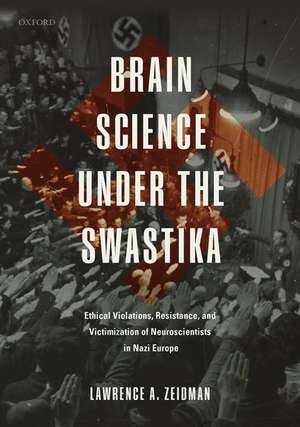
Brain Science under the Swastika: Ethical Violations, Resistance, and Victimization of Neuroscientists in Nazi Europe
Autor Lawrence A. Zeidmanen Limba Engleză Hardback – 26 mai 2020
Preț: 463.82 lei
Preț vechi: 643.47 lei
-28%
Puncte Express: 696
Carte disponibilă
Livrare economică 12-18 noiembrie
Livrare prin curier în România Termenul estimat este afișat lângă disponibilitate.
Transport gratuit pentru acest produs Plată online sau ramburs, în funcție de opțiunile comenzii.
Retur gratuit în 14 zile Comandă securizată și suport în română.
Specificații
ISBN-13: 9780198728634
ISBN-10: 0198728638
Pagini: 784
Dimensiuni: 176 x 251 x 41 mm
Greutate: 1.7 kg
Editura: OUP OXFORD
Colecția OUP Oxford
Locul publicării:Oxford, United Kingdom
ISBN-10: 0198728638
Pagini: 784
Dimensiuni: 176 x 251 x 41 mm
Greutate: 1.7 kg
Editura: OUP OXFORD
Colecția OUP Oxford
Locul publicării:Oxford, United Kingdom
V-ar putea interesa
-
 Signalers and Receivers: Mechanisms and Evolution of Arthropod CommunicationMichael D. Greenfield-30%Preț: 546.51 lei785.90 lei
 -
 The Lost Self: Pathologies of the Brain and IdentityTodd E. Feinberg-29%Preț: 506.00 lei709.05 lei
 -
 Neuroscience of Rule-Guided BehaviorSilvia A. Bunge-31%Preț: 684.61 lei988.02 lei
 -
 Spatial Representation in AnimalsSue Healy-33%Preț: 523.89 lei777.26 lei
 -
 The Cognitive and Neural Bases of Spatial NeglectHans-Otto Karnath-32%Preț: 986.35 lei1461.07 lei
 -
 Computational Neuroscience of VisionEdmund Rolls-33%Preț: 709.46 lei1060.86 lei
 -
 -31%Preț: 923.12 lei1336.33 lei
 -
 Autism: Mind and BrainUta Frith-34%Preț: 700.07 lei1055.08 lei
 -
 -28%Preț: 541.06 lei754.13 lei
 -
 -28%Preț: 481.12 lei670.15 lei
 -
 Consciousness and the Social BrainMichael S. A. GrazianoPreț: 365.36 lei
 -
 Meditations of a Buddhist SkepticB. Alan WallacePreț: 136.27 lei
 -
 Dante's BonesGuy P. RaffaPreț: 265.76 lei
 -
 Endocannabinoid Regulation of Monoamines in Psychiatric and Neurological DisordersElisabeth J. van Bockstaele-18%Preț: 987.61 lei1204.41 lei
 -
 Animal Models of Speech and Language DisordersSantosh A. Helekar-5%Preț: 1141.71 lei1201.81 lei
 -
 -27%Preț: 1217.19 lei1659.32 lei
 -
 Neural Progenitor CellsBrent A. Reynolds-15%Preț: 671.91 lei790.48 lei
 -
 Neuronal Cell CultureShohreh Amini-15%Preț: 666.48 lei784.09 lei
 -
 Brain DevelopmentSimon G Sprecher-15%Preț: 676.81 lei796.25 lei
 -
 Huntington's Disease: Symptoms, Risk Factors & PrognosisKevin Guillory-27%Preț: 885.39 lei1208.29 lei
 -
 Neurosciences - From Molecule to Behavior: a university textbookC. Giovanni Galizia-15%Preț: 723.68 lei851.38 lei
 -
 -18%Preț: 983.39 lei1199.26 lei
 -
 -15%Preț: 660.37 lei776.91 lei
 -
 Methods in Neuroethological ResearchHiroto Ogawa-18%Preț: 979.14 lei1194.07 lei
 -
 Cortical DevelopmentRyoichiro Kageyama-18%Preț: 643.02 lei784.17 lei
 -
 Functional Magnetic Resonance Imaging ProcessingXingfeng Li-18%Preț: 981.70 lei1197.19 lei
 -
 Cellular and Molecular Control of Neuronal MigrationLaurent Nguyen-18%Preț: 983.14 lei1198.94 lei
Recenzii
The history here is double: on the upper level, it is that of the practices of Nazi Germany for a supposed betterment of population; but, at a subterranean level, it is also the history of the complacency of a profession, which illustrates the fragility of medical ethics, the relativity of codes, and the possibly constant threat of politics.
And this book is timely: despite the appalling abuse of human life by doctors in the Third Reich, the clash between the demands of research and medical ethics is as relevant today as it has ever been...
And this book is timely: despite the appalling abuse of human life by doctors in the Third Reich, the clash between the demands of research and medical ethics is as relevant today as it has ever been...
Notă biografică
Dr. Zeidman is from Chicagoland and is a board-certified clinical neurologist and neuromuscular specialist, along with being a Fellow of the American Academy of Neurology. He is currently an Associate Professor at the Loyola University Stritch School of Medicine, with joint appointments in the Department of Neurology and the Neiswanger Institute of Bioethics. In addition to being Neuro-history Associate Editor for the Journal of Child Neurology, Dr. Zeidman has taught seminars on historical-ethical issues in neuroscience. He has been awarded the prestigious Rockefeller Archive Center Grant-in-Aid, has authored numerous journal articles and book chapters, and has presented his works internationally. He also was instrumental in naming two neuroscientists as "Righteous Among the Nations" by Israel's Yad Vashem Museum for resistance against the Nazis.