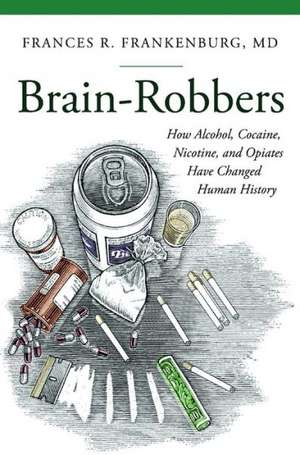
Brain-Robbers: How Alcohol, Cocaine, Nicotine, and Opiates Have Changed Human History
Autor Frances R. Frankenburg MDen Limba Engleză Hardback – 28 mar 2014
Alcohol, cocaine, nicotine, and opiates have spurred some of the greatest human pleasure and pain across time. Providing information that ranges as widely as from ancient Egypt to modern times, this book comprehensively addresses the good, the bad, and the very ugliest aspects of these substances, examining their history, their effects on the brain and body, and on civilization itself. Frances R. Frankenburg, MD, employs accessible, everyday language to explain the neurology of addiction and describe how these "brain-robbing" substances work to hijack the brain's pleasure systems to create powerful addictions. The author also provides perspective into the intertwined, inescapable, and often uneasy relationship between these substances and human culture, economics, and politics-for example, how individuals become physically or psychologically addicted to alcohol, cocaine, nicotine, and opiates, while governments become financially "addicted" to the revenue, such as taxes, that can be collected from the sale and use of these substances.
Preț: 390.11 lei
Preț vechi: 466.90 lei
-16%
Puncte Express: 585
Carte tipărită la comandă
Livrare economică 30 noiembrie-14 decembrie
Livrare prin curier în România Termenul estimat este afișat lângă disponibilitate.
Transport gratuit de la 400.00 lei Plată online sau ramburs, în funcție de opțiunile comenzii.
Retur gratuit în 14 zile Comandă securizată și suport în română.
Specificații
ISBN-13: 9781440829314
ISBN-10: 1440829314
Pagini: 368
Ilustrații: 41 bw illus
Dimensiuni: 156 x 235 x 33 mm
Greutate: 0.77 kg
Ediția:New.
Editura: Bloomsbury Publishing
Colecția Praeger
Locul publicării:New York, United States
ISBN-10: 1440829314
Pagini: 368
Ilustrații: 41 bw illus
Dimensiuni: 156 x 235 x 33 mm
Greutate: 0.77 kg
Ediția:New.
Editura: Bloomsbury Publishing
Colecția Praeger
Locul publicării:New York, United States
V-ar putea interesa
-
 Swing!, TheTracy ReifkindPreț: 83.46 lei
 -
 BabyCalm: A Guide for Calmer Babies and Happier ParentsSarah Ockwell-Smith-26%Preț: 78.65 lei106.55 lei
 -
 Doctor, Doctor: Incredible True Tales From a GP's SurgeryDr Rosemary Leonard-27%Preț: 67.82 lei92.81 lei
 -
 Delavier's Sculpting Anatomy for WomenFrederic DelavierPreț: 134.30 lei
 -
 -15%Preț: 82.70 lei97.46 lei
 -
 The Vitamin Cure for DepressionBo H. JonssonPreț: 95.45 lei
 -
 -32%Preț: 51.42 lei75.50 lei
 -
 Pathogenic Vibrios & Food SafetyYi-Cheng Su-26%Preț: 1779.33 lei2420.00 lei
 -
 Natural Pregnancy BookAnne CharlishPreț: 74.98 lei
 -
 Childbirth Without FearGrantly Dick-Read-10%Preț: 92.35 lei102.39 lei
Cuprins
Acknowledgments
Introduction
1. Alcohol
2. Why We Need Water
3. Fermentation
4. Distillation
5. Alcohol and the Adams Family: The Scourge of Intemperance
6. Patent Medicines, Lydia Pinkham, and the Great American Fraud
7. Carry Nation: Hatchetation against Saloonacy
8. Cocaine
9. Sniffing Cocaine, Heroin, and Tobacco
10. William Stewart Halsted
11. Sigmund Freud and Cocaine
12. Nicotine
13. Tobacco and Illness: The Discovery
14. Women and Cigarettes
15. Opiates
16. Discovery of the Opiate Receptor
17. Pain and Anesthesia: The Role of Cocaine and Opiates
18. The Gladstones and Opium
19. Opium Smoking, the Opium Wars, and Emigration from China
20. The Brain
21. Addiction
Glossary
Index
Introduction
1. Alcohol
2. Why We Need Water
3. Fermentation
4. Distillation
5. Alcohol and the Adams Family: The Scourge of Intemperance
6. Patent Medicines, Lydia Pinkham, and the Great American Fraud
7. Carry Nation: Hatchetation against Saloonacy
8. Cocaine
9. Sniffing Cocaine, Heroin, and Tobacco
10. William Stewart Halsted
11. Sigmund Freud and Cocaine
12. Nicotine
13. Tobacco and Illness: The Discovery
14. Women and Cigarettes
15. Opiates
16. Discovery of the Opiate Receptor
17. Pain and Anesthesia: The Role of Cocaine and Opiates
18. The Gladstones and Opium
19. Opium Smoking, the Opium Wars, and Emigration from China
20. The Brain
21. Addiction
Glossary
Index
Recenzii
Brain-Robbers is an engaging overview of how individuals, governments, and societies have interacted with four major drugs of use, abuse, and trade over the course of human history. This . . . makes the book's scope unique. . . . comprehensive and engaging. The inclusion of numerous historical anecdotes and asides makes a potentially dry history relevant to a modern worldview. The writing is nontechnical . . . Overall, this is a useful introduction to the human history of drug use. Summing Up: Highly recommended. Lower- and upper-division undergraduates and general readers.
Brain-Robbers is a wonderful book of great importance. . . . [It] provides a splendid trip through the brain, culture, and pharmacology of addictions.
Brain-Robbers is a wonderful book of great importance. . . . [It] provides a splendid trip through the brain, culture, and pharmacology of addictions.