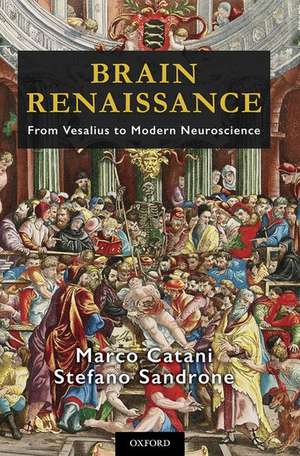
Brain Renaissance: From Vesalius to Modern Neuroscience
Autor Marco Catani, Stefano Sandroneen Limba Engleză Hardback – 21 mai 2015
Preț: 664.57 lei
Preț vechi: 899.64 lei
-26%
Puncte Express: 997
Carte tipărită la comandă
Livrare economică 26 noiembrie-02 decembrie
Livrare prin curier în România Termenul estimat este afișat lângă disponibilitate.
Transport gratuit pentru acest produs Plată online sau ramburs, în funcție de opțiunile comenzii.
Retur gratuit în 14 zile Comandă securizată și suport în română.
Specificații
ISBN-13: 9780199383832
ISBN-10: 0199383839
Pagini: 304
Dimensiuni: 157 x 236 x 25 mm
Greutate: 0.64 kg
Editura: Oxford University Press
Colecția OUP USA
Locul publicării:New York, United States
ISBN-10: 0199383839
Pagini: 304
Dimensiuni: 157 x 236 x 25 mm
Greutate: 0.64 kg
Editura: Oxford University Press
Colecția OUP USA
Locul publicării:New York, United States
V-ar putea interesa
-
 Foundations of the Neuron Doctrine: 25th Anniversary EditionGordon M. Shepherd-17%Preț: 712.39 lei854.21 lei
 -
 The Birth of Modern Neuroscience in TurinStefano Sandrone-26%Preț: 462.89 lei623.82 lei
 -
 Atlas of Human Brain ConnectionsMarco Catani-30%Preț: 823.41 lei1180.80 lei
 -
 Nobel LifeStefano SandronePreț: 146.32 lei
 -
 -5%Preț: 289.82 lei305.07 lei
 -
 Clinical NeuroanatomyHans J. Ten Donkelaar-5%Preț: 1990.77 lei2095.55 lei
 -
 -5%Preț: 1772.85 lei1866.15 lei
 -
 Epilepsy Surgery: A Practical Case-Based ApproachAline Herlopian-5%Preț: 1155.41 lei1216.22 lei
 -
 Mind, Brain and EducationVida Demarin-5%Preț: 1009.00 lei1062.10 lei
 -
 Atlas of Sleep MedicineRobert J. Thomas-5%Preț: 2272.68 lei2392.29 lei
 -
 Effects of Opera Music from Brain to BodyLorenzo Lorusso-5%Preț: 702.90 lei739.89 lei
 -
 Klinische ElektroenzephalographieStephan Zschocke-5%Preț: 1014.64 lei1068.04 lei
 -
 Arztbriefe in der NeurologieTobias Schmidt-Wilcke-5%Preț: 380.86 lei400.91 lei
 -
 NeuroRehabilitationPeter Frommelt-5%Preț: 1027.26 lei1081.33 lei
 -
 Handbook of NeurourologyLimin Liao-5%Preț: 6750.23 lei7105.51 lei
Recenzii
Catani and Sandrone have produced a remarkable compilation of the history of neuroscience from Vesalius to the present day. The book highlights the complexity and wonder of the human body, specifically the brain and its functions. At the same time, the book honors the first physicians to observe and explore the human body like Vesalius. Catani and Sandrone's work is relevant both to students of medicine, and to those interested in Renaissance studies, medicine, and history.
[This book is] a convincing attempt to use the fundamental discoveries of Andreas Vesalius as a key to start and develop multiple explorations of the brain. . . To have used an anatomist of five centuries ago as a guide through centuries of research on the brain is an original and somehow strange challenge. The fascination of Brain Renaissance, tells us that the goal was fully achieved.
This book is a compact and historically important contribution of interest to historians of science, especially biology. . . I feel it is even more valuable for those teaching neuroscience. . . [It helps] put our modern conceits as part of a long journey to understand mind and behaviour.
In Brain Renaissance, neuroscientists Marco Catani and Stefano Sandrone present a translation from the Latin of the Fabricas last volume, which focuses on the brain..... Brain Renaissance is not the only English translation, but it is the only one available at a price that individuals might afford. Accompanying texts by Catani and Sandrone place the work in its historical and scientific context.
[This book is] a convincing attempt to use the fundamental discoveries of Andreas Vesalius as a key to start and develop multiple explorations of the brain. . . To have used an anatomist of five centuries ago as a guide through centuries of research on the brain is an original and somehow strange challenge. The fascination of Brain Renaissance, tells us that the goal was fully achieved.
This book is a compact and historically important contribution of interest to historians of science, especially biology. . . I feel it is even more valuable for those teaching neuroscience. . . [It helps] put our modern conceits as part of a long journey to understand mind and behaviour.
In Brain Renaissance, neuroscientists Marco Catani and Stefano Sandrone present a translation from the Latin of the Fabricas last volume, which focuses on the brain..... Brain Renaissance is not the only English translation, but it is the only one available at a price that individuals might afford. Accompanying texts by Catani and Sandrone place the work in its historical and scientific context.
Notă biografică
Marco CataniNeuroanatomy and Tractography Brain LaboratoryDepartment of Forensic and Neurodevelopmental SciencesInstitute of PsychiatryStefano SandroneNeuroanatomy and Tractography Brain LaboratoryDepartment of Forensic and Neurodevelopmental SciencesInstitute of Psychiatry