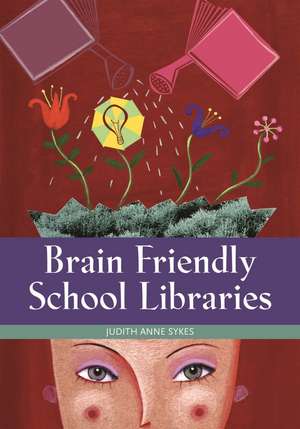
Brain Friendly School Libraries
Autor Judith Anne Sykesen Limba Engleză Paperback – 30 dec 2005
This title, Brain Friendly School Libraries, gives concrete practical examples of how to align school library programs and instructional practice with the six key concepts of brain-compatible learning: increasing input to the brain; increasing experiential data; multiple source feedback; reducing threat; involving students in learning decision making; and interdisciplinary unit planning. It includes chapters that summarize the current brain research and current thinking about its implication for instructional practice in the school library media center as well as discusses the work of Ellen Langer (mindful learning), Geoffrey and Renette Caine, Bob Sylwester and other major proponents of teaching with the brain in mind.
Preț: 234.01 lei
Preț vechi: 304.18 lei
-23%
Puncte Express: 351
Carte tipărită la comandă
Livrare economică 01-15 decembrie
Livrare prin curier în România Termenul estimat este afișat lângă disponibilitate.
Transport gratuit de la 400.00 lei Plată online sau ramburs, în funcție de opțiunile comenzii.
Retur gratuit în 14 zile Comandă securizată și suport în română.
Specificații
ISBN-13: 9781591582465
ISBN-10: 1591582466
Pagini: 136
Dimensiuni: 178 x 254 x 10 mm
Greutate: 0.3 kg
Editura: Bloomsbury Publishing
Colecția Libraries Unlimited
Locul publicării:New York, United States
ISBN-10: 1591582466
Pagini: 136
Dimensiuni: 178 x 254 x 10 mm
Greutate: 0.3 kg
Editura: Bloomsbury Publishing
Colecția Libraries Unlimited
Locul publicării:New York, United States
V-ar putea interesa
-
 Childhood Under SiegeJoel BakanPreț: 111.70 lei
 -
 Children and the Capability ApproachM. Biggeri-15%Preț: 649.61 lei764.25 lei
 -
 The Child in British LiteratureA. GavinPreț: 283.32 lei
 -
 Restless Youth in Ancient RomeEmiel EybenPreț: 474.77 lei
 -
 Unequal ChildhoodsAnnette LareauPreț: 258.00 lei
 -
 The Agency of ChildrenDavid OswellPreț: 289.51 lei
 -
 Turn of the CenturyEllen JacksonPreț: 65.77 lei
 -
 Portraits of Children on Roman Funerary MonumentsJason Mander-23%Preț: 1097.87 lei1425.80 lei
 -
 -14%Preț: 757.87 lei881.25 lei
 -
 Preț: 304.40 lei
 -
 Child Observation for Learning and ResearchTheodora Papatheodorou-15%Preț: 420.43 lei494.63 lei
 -
 Children & Disasters: Preparedness, Response & RecoveryEric S Walker-27%Preț: 1575.80 lei2149.96 lei
 -
 Songs of InnocenceFran Abrams-17%Preț: 121.15 lei146.32 lei
 -
 As IfBlake MorrisonPreț: 92.67 lei
 -
 Preț: 271.71 lei
Cuprins
What Neuroscience Tells Us About Learning
Key Concepts and Literature
Ellen Langer--Mindful Learning
Bob Sylwester--Applying Biological Research
Pat Wolfe--Brain Research and Educational Practice
Creating A Brain Friendly School Library Plan
Goal 1: Enriched Environments--Teacher-Librarian As Staff Developer
Brain Friendly Space
Resource-Based Learning--Collection
Learning Styles
Intellectual Environments--Teacher-Librarian as Information Literacy Agent
Inquiry and Action Research
Information Literacy
Projects
Emotional Environments--Teacher-Librarian as Cultural Emissary
Sensory Learning--Literature and the Arts
Cooperative Learning
Reflective Learning
References
Index
Key Concepts and Literature
Ellen Langer--Mindful Learning
Bob Sylwester--Applying Biological Research
Pat Wolfe--Brain Research and Educational Practice
Creating A Brain Friendly School Library Plan
Goal 1: Enriched Environments--Teacher-Librarian As Staff Developer
Brain Friendly Space
Resource-Based Learning--Collection
Learning Styles
Intellectual Environments--Teacher-Librarian as Information Literacy Agent
Inquiry and Action Research
Information Literacy
Projects
Emotional Environments--Teacher-Librarian as Cultural Emissary
Sensory Learning--Literature and the Arts
Cooperative Learning
Reflective Learning
References
Index
Recenzii
Sykes, former library specialist turned principal offers an approach to library management and instruction that is based on neuroscience. Highlighted is the concept of the teacher-librarian who can use knowledge of brain research to create a more meaningful learning experience for students and staff. With information for librarians of elementary, middle, and high school, the book gives suggestions for activities that address a variety of learning styles. A list of resources and index are included.
[S]ykes' theory warrants attention..Recommended.
Sykes's recommendations and examples are worth considering..Sykes's ideas should enter a professional development conversation.
An intelligently written book about the role that the school library can play in exercising students' brains. Rooted in current findings on how the brain processes information, and acknowledging several educative models for learning and Information Power's standards for promoting information-literacy development, Sykes's book offers a vision that every school librarian should consider, if not embrace. The first part reviews what neuroscience tells us about learning. Contributing authors relate those findings to classroom planning, making them understandable to the layperson. Subsequent sections suggest components of the school library program that must be addressed including enriched, intellectual, and emotional environments. Further, readers are offered both theoretical and practical approaches to planning and creating these environments and sample lessons. This book will be a handy desk mate to every school librarian and should be a required text in all school media specialist programs.
School librarians looking for new approaches to teaching and learning will find a wealth of information on brain research and its place in the school library in this book..This resource contains research that might come in handy for school librarians who need to justify improving their programs to administrators.
[S]ykes' theory warrants attention..Recommended.
Sykes's recommendations and examples are worth considering..Sykes's ideas should enter a professional development conversation.
An intelligently written book about the role that the school library can play in exercising students' brains. Rooted in current findings on how the brain processes information, and acknowledging several educative models for learning and Information Power's standards for promoting information-literacy development, Sykes's book offers a vision that every school librarian should consider, if not embrace. The first part reviews what neuroscience tells us about learning. Contributing authors relate those findings to classroom planning, making them understandable to the layperson. Subsequent sections suggest components of the school library program that must be addressed including enriched, intellectual, and emotional environments. Further, readers are offered both theoretical and practical approaches to planning and creating these environments and sample lessons. This book will be a handy desk mate to every school librarian and should be a required text in all school media specialist programs.
School librarians looking for new approaches to teaching and learning will find a wealth of information on brain research and its place in the school library in this book..This resource contains research that might come in handy for school librarians who need to justify improving their programs to administrators.