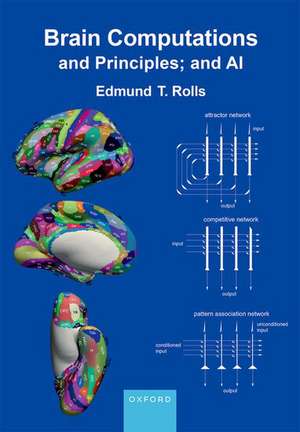
Brain Computations and Principles; and AI
Autor Edmund T. Rollsen Limba Engleză Hardback – 28 aug 2026
Preț: 1088.67 lei
Preț vechi: 1577.05 lei
-31% Nou
Puncte Express: 1633
Carte disponibilă
Livrare economică 12-18 noiembrie
Livrare prin curier în România Termenul estimat este afișat lângă disponibilitate.
Transport gratuit pentru acest produs Plată online sau ramburs, în funcție de opțiunile comenzii.
Retur gratuit în 14 zile Comandă securizată și suport în română.
Specificații
ISBN-13: 9780197920961
ISBN-10: 0197920969
Pagini: 1520
Dimensiuni: 178 x 253 x 60 mm
Greutate: 2.45 kg
Editura: OUP OXFORD
Colecția OUP Oxford
Locul publicării:Oxford, United Kingdom
ISBN-10: 0197920969
Pagini: 1520
Dimensiuni: 178 x 253 x 60 mm
Greutate: 2.45 kg
Editura: OUP OXFORD
Colecția OUP Oxford
Locul publicării:Oxford, United Kingdom
Notă biografică
Professor Edmund T. Rolls performs full-time research at the Oxford Centre for Computational Neuroscience, and at the University of Warwick where he is Professor of Computational Neuroscience, and has performed research and teaching for many years as Professor of Experimental Psychology at the University of Oxford, and as Fellow and Tutor of Corpus Christi College, Oxford. His research links computational neuroscience to neurophysiological, human functional neuroimaging and neuropsychological studies in order to provide a fundamental basis for understanding how the brain operates in health and in disease.
Cuprins
- 1: Introduction
- 2: The ventral visual system
- 3: The dorsal visual system
- 4: The taste and flavor system
- 5: The olfactory system
- 6: The somatosensory system
- 7: The auditory system
- 8: The temporal cortex
- 9: The hippocampus, memory, and spatial function
- 10: The parietal cortex, spatial functions, and navigation
- 11: The orbitofrontal cortex, amygdala, reward value, emotion, and decision-making
- 12: The cingulate cortex
- 13: The prefrontal cortex
- 14: Language and syntax in the brain
- 15: The motor cortical areas
- 16: The basal ganglia
- 17: Cerebellar cortex
- 18: Principles: Hierarchical organization
- 19: Principles: Localization of function
- 20: Principles: Cortical recurrent collateral connections and attractor networks
- 21: Principles: Cortical attractor stochastic dynamics and connectivity, stability, psychiatric disorders, and aging
- 22: Principles: Attention, short-term memory, and biased competition
- 23: Principles: Diluted Connectivity
- 24: Principles: Neural encoding
- 25: Principles: Synaptic modification for learning
- 26: Principles: Synaptic and neuroal adaptation and facilitation
- 27: Principles: Backprojections in the neocortex
- 28: Principles: Limited neurogenesis in the adult cortex
- 29: Principles: Evolutionary trends in cortical design and principles of operation
- 30: Principles: Emotion and motivation in brain design
- 31: Principles: Sleep and Dreaming
- 32: Principles: Genes and self-organization build the cortex
- 33: Principles: Brain, Mind, Causality, and Consciousness
- 34: Differences between Brain Computations and AI computations
- A: Introduction to linear algebra for neural networks
- B: Neuronal network models
- C: Neuronal encoding and information theory
- D: Simulation software for neuronal networks, and information analysis of neuronal encoding
- References
- Index