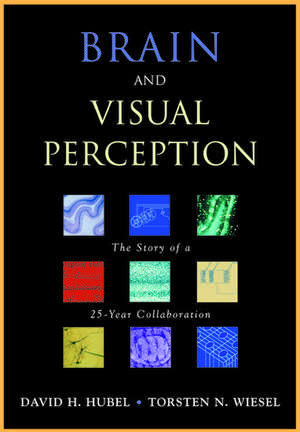
Brain and Visual Perception: The Story of a 25-year Collaboration
Autor David H. Hubel, Torsten N. Wieselen Limba Engleză Hardback – 11 noi 2004
Considerăm Brain and Visual Perception o resursă de nivel referință profesională și studii avansate (master și doctorat), fiind o cronică fundamentală a modului în care neuroștiința modernă a început să descifreze mecanismele vederii. Această ediție publicată de Oxford University Press nu este o simplă antologie de lucrări științifice, ci o analiză retrospectivă a unei colaborări de un sfert de secol care a modelat înțelegerea noastră asupra sistemului vizual.
Elementul distinctiv al volumului constă în prefața și postfața care însoțesc fiecare articol reprinted. Autorii, David H. Hubel și Torsten N. Wiesel, oferă detalii care lipsesc de regulă din jurnalele academice: dificultățile tehnice, momentele de entuziasm sau plictiseala inerentă cercetării de laborator. Cititorii familiarizați cu Science of Vision de K.N. Leibovic vor aprecia în acest volum rigoarea empirică dublată de o perspectivă istorică personală, oferind o imagine completă asupra modului în care conexiunile nervoase sunt fie înnăscute, fie modelate prin experiență timpurie.
Structura narativă urmărește evoluția domeniului de la primele experimente pe retina pisicii, sub îndrumarea lui Stephen W. Kuffler, până la stabilirea departamentului de neurobiologie de la Harvard. Tonul este precis și analitic, însă extrem de onest în descrierea procesului științific, transformând o serie de date tehnice într-o poveste despre curiozitate și rigoare metodologică. Recomandăm acest titlu ca pe un document istoric și științific esențial pentru oricine dorește să înțeleagă bazele biologice ale percepției.
Preț: 624.93 lei
Preț vechi: 787.07 lei
-21%
Carte tipărită la comandă
Livrare economică 17-28 iulie
Specificații
ISBN-10: 0195176189
Pagini: 744
Ilustrații: numerous halftones and line drawings
Dimensiuni: 179 x 262 x 42 mm
Greutate: 1.68 kg
Editura: Oxford University Press
Colecția OUP USA
Locul publicării:New York, United States
V-ar putea interesa
-
 Physical Therapy Case Files: Neurological RehabilitationAnnie Burke-Doe-34%Preț: 277.50 lei418.51 lei
 -
 -24%Preț: 257.06 lei339.77 lei
 -
 -27%Preț: 685.76 lei944.90 lei
 -
 NeurologyMichael Donaghy-23%Preț: 254.87 lei332.58 lei
 -
 -31%Preț: 589.32 lei849.99 lei
 -
 20 Things to Know about Deep Brain StimulationErwin B. Montgomery, Jr.-28%Preț: 518.54 lei716.54 lei
 -
 -29%Preț: 255.19 lei360.20 lei
 -
 A Dictionary of PsychologyAndrew M. Colman-22%Preț: 98.15 lei125.12 lei
 -
 Motor Neuron Disease in AdultsMark B. Bromberg-28%Preț: 1196.60 lei1651.58 lei
 -
 -28%Preț: 741.84 lei1029.45 lei
 -
 Epilepsy: A Century of DiscoveryRamon Bautista-30%Preț: 1624.22 lei2335.30 lei
 -
 Handbook of Parkinson's DiseaseRajesh Pahwa-5%Preț: 1912.11 lei2012.74 lei
De ce să citești această carte
Recomandăm această carte studenților și cercetătorilor în neuroștiințe, psihologie experimentală și biologie. Cititorul câștigă acces direct la mintea a doi laureați Nobel, înțelegând nu doar rezultatele finale, ci și procesul adesea sinuos al descoperirii științifice. Este un instrument fundamental pentru a înțelege cum s-a făcut trecerea de la speculația filosofică despre vedere la biologia celulară și fiziologia modernă.
Despre autor
Autorii, David H. Hubel și Torsten N. Wiesel, au fost recompensați cu Premiul Nobel pentru Fiziologie sau Medicină în 1981 pentru descoperirile lor privind procesarea informației în sistemul vizual. David H. Hubel a fost profesor emerit de neurobiologie la Harvard Medical School, având o contribuție majoră în cartografierea cortexului vizual. Torsten N. Wiesel a ocupat funcții de prestigiu, fiind președinte emerit al Universității Rockefeller și secretar general al Human Frontier Science Program, continuând să fie o figură centrală în cercetarea creierului la nivel internațional.
Descriere
Recenzii
Extremely important
All in all this is an excellent book and helps to set the work of Hubel and Wiesel in the context of real people doing real science. It also helps to connect the papers together in an appropriate set of sequences for those starting in the area - how it would have helped to have it around when I first started trying to teach visual physiology to medical students
The entire book is an inspiration to read. The original papers and the additional chapters are beautifully written - which means that they are stylistically elegant, free from jargon and cliche and, above all, devoid of the current, vulgar, craze for acronyms and abbreviations and of other devices that serve to make science even more inaccessible . . . Neuroscience should rejoice that, during a mere 25 years, its world was enriched not only by a wealth of knowledge but also by new standards of evidence and elegance of methodology which have left a permanent imprint.
The book's glory is that the commentaries sandwiching each paper illuminate the workings of one of the most productive collaborations in the history of biology. Hubel and Wiesel describe the joy of mom-and-pop science where the collaborators do the work and weigh what to do next . . . the book brings their work all together - complete with the authors' retrospective evaluations of their work . . . a gem in the history of the field and a core resource.
. . . The entire book is an inspiration to read. The original papers and the additional chapters are beautifully written . . . Read today, some 50 years after the initial work was published, the papers still retain their freshness and their capacity to arouse wonder, not only at the way in which nature has elaborated such an impressive organ, but also at the tenacity and the powerful conceptual thinking that was behind their collected work . . . Neuroscience should rejoice that, during a mere 25 years, its world was enriched not only by a wealth of knowledge but also by new standards of evidence and elegance of methodology which have left a permanent imprint.
Advance praise for Brain and Visual Perception:
For those who came of age admiring the scientific adventures of Hubel and Wiesel, this book is an opportunity to look back in wonder. For those who came after, it will be an inspiration. This is a marvel of a book, written in David Hubel's disarmingly engaging voice, a must have, a must read.
David Hubel and Torsten Wiesel's book describes the wonderful period in neurophysiology when they worked on the early mammalian visual system. I found it fascinating reading.
A rare opportunity to peek into the minds of two giants of twentieth century science. Each of their classic papers reads like a Sherlock Holmes novel, but the accompanying commentaries and autobiographies, packed with witty, whimsical asides and Hubelisms, bring out the human side of science - reminding us that great science is a judicious blend of intuition, imagination and sheer tenacity rather than a cold rational process of the kind one usually associates with Holmes. It's especially refreshing to see their low-tech approach in an era of high-tech 'big science' dominated by brain imaging and gee whiz neophrenology.
Hubel and Wiesel, as much as any other scientists, are responsible for our current view of the brain, its function, and how it is moulded by the environment. This book will provide students and established scientists alike insight into the roots of modern neuroscience, a view into one of the most productive collaborations in the field, and some of the best examples of scientific writing in the literature.
Beginning around 1960, David Hubel and Torsten Wiesel took the study of the brain and its development from the realm of philosophy to biology. These papers and the commentaries that accompany them put the reader inside the heads of the scientists who gave us our modern understanding of the cerebral cortex, often by asking the next logical question, but always with appreciation for the beauty of the system.