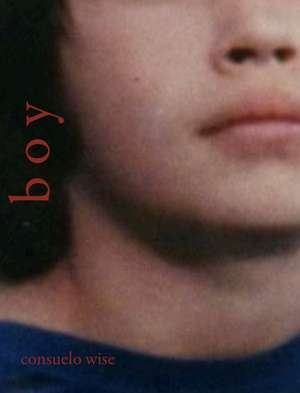
boy
Autor Consuelo Wiseen Limba Engleză Paperback – 18 dec 2024
In this hybrid of lyric poetry and essay, Consuelo Wise utilizes repetition, fragmentation, and syntax to construct a form that repeatedly falls apart. Breaks in lines and fragmented stanzas are followed by accumulative rushes, slashes, brackets, and words pushed together.
Throughout this book-length poem, Wise composes a meditation and an investigation into loss and identity. Moving between sound and image, aggression and subtlety, b o y pries open memories that resist understanding but also refuse to be forgotten. Wise peels back layers of mourning, considering how it can be experienced as a personal, inherited, environmental, social, and historical phenomenon. Throughout, the protagonist in b o y reenvisions ways to process a great loss, listening closely and searching for words while “the earth is shaking and the silence pressing down.”
Preț: 110.98 lei
Puncte Express: 166
Carte disponibilă
Livrare economică 16-30 noiembrie
Livrare prin curier în România Termenul estimat este afișat lângă disponibilitate.
Transport gratuit de la 400.00 lei Plată online sau ramburs, în funcție de opțiunile comenzii.
Retur gratuit în 14 zile Comandă securizată și suport în română.
Specificații
ISBN-13: 9781632431301
ISBN-10: 1632431300
Pagini: 136
Dimensiuni: 184 x 241 x 13 mm
Greutate: 0.27 kg
Editura: Omnidawn Publishing, Inc.
Colecția Omnidawn
ISBN-10: 1632431300
Pagini: 136
Dimensiuni: 184 x 241 x 13 mm
Greutate: 0.27 kg
Editura: Omnidawn Publishing, Inc.
Colecția Omnidawn
Notă biografică
Consuelo Wise is a Guatemalan-American poet, writer, and visiting scholar at Portland State University in Oregon.
Recenzii
"b o y is a deeply moving, undeniably devastating, beautifully constructed poem. Wise has created a text that enacts and embodies the destabilizing saturation of grief. But it also sings through pain and memory like a puncture through the heart, in all its visceral corporeality."
"'O Enkidu, what is this sleep that has seized you, / that has darkened your face and stopped your breath?' In Stephen Mitchell’s rendition, Gilgamesh's ravished incomprehension reaches out across millennia to grab us. Wise's relentless and stunning debut takes up a subject as old as written poetry itself. Or rather, she's taken up by it, yielding a booklength confrontation with grief, grappling with the intolerable loss of her brothers, and grappling just as exhaustedly, as inexhaustibly, with the limits of language to express it. The result is profound enough to make praise beside the point. On one page Wise crafts intimate, uncanny images with the precision of Alejandra Pizarnik or Nelly Sachs—'the leaves fall softly on your not-/cheek,' 'between grass and language, mouth'—on the next, heart-rending plainspokenness—'they weren’t parts but that’s how I remember them.' She conjures a haunting and discordant music from brackets, hyphens, ampersands, slashes. And b o y's questions, like Gilgamesh’s, remain unanswerable—a book of tragic wisdom."
"'See I lost two brothers,' Wise writes, 'but once I begin, the boys—all the boys—begin to merge.'
Wise's debut book, b o y, is a meditation on loss and grief. b o y is two of Wise's own brothers, and it is those boys she grew up with, or who didn't grow up, who were lost to stunted opportunity and youthful recklessness, to speeding cars, alcohol, and the US penal system. . . . In Wise's tracking of sensation, memories return that resist understanding, and form is continually made, continually falls apart. Yet Wise is unflinching in her effort to get at something elusive and necessary. In poems where absence looms, b o y explores the seemingly irreconcilable: how to let the dead go while keeping them close; how to accept that the fragments of memory one is left with are both partial and whole. . . . Wise's stunning syntax, in lines that tumble, undercut, and catch, creates a form that holds grief, while in its fractures extends a singular beauty."
Wise's debut book, b o y, is a meditation on loss and grief. b o y is two of Wise's own brothers, and it is those boys she grew up with, or who didn't grow up, who were lost to stunted opportunity and youthful recklessness, to speeding cars, alcohol, and the US penal system. . . . In Wise's tracking of sensation, memories return that resist understanding, and form is continually made, continually falls apart. Yet Wise is unflinching in her effort to get at something elusive and necessary. In poems where absence looms, b o y explores the seemingly irreconcilable: how to let the dead go while keeping them close; how to accept that the fragments of memory one is left with are both partial and whole. . . . Wise's stunning syntax, in lines that tumble, undercut, and catch, creates a form that holds grief, while in its fractures extends a singular beauty."
"In b o y, Wise creates poetic forms strong enough to hold the staggering weight of grief and supple enough to be remade by its force. Resisting the desire to make loss 'smaller, less opaque,' these poems are stricken with its large and layered presence. Never has a book of poems felt so much a collaboration with silence. These sequences are less scripts or performances than they are a kind of music heard within and against absence. Wise's writing is gorgeous, transfixing. As only the best poets can, she hears 'not hereness.' 'We just want the feeling of coming up from that dark water—I do— / I want that feeling,' she says. Even if these poems can’t provide that particular solace, they make a language that takes us to something close to it."