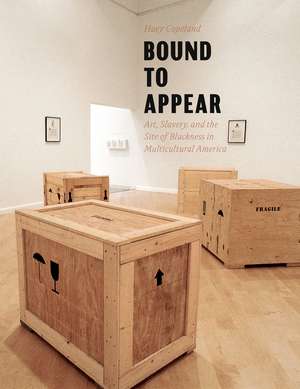
Bound to Appear: Art, Slavery, and the Site of Blackness in Multicultural America
Autor Huey Copelanden Limba Engleză Hardback – 25 noi 2013
At
the
close
of
the
twentieth
century,
black
artists
began
to
figure
prominently
in
the
mainstream
American
art
world
for
the
first
time.
Thanks
to
the
social
advances
of
the
civil
rights
movement
and
the
rise
of
multiculturalism,
African
American
artists
in
the
late
1980s
and
early
’90s
enjoyed
unprecedented
access
to
established
institutions
of
publicity
and
display.
Yet
in
this
moment
of
ostensible
freedom,
black
cultural
practitioners
found
themselves
turning
to
the
history
of
slavery.
Bound
to
Appearfocuses
on
four
of
these
artists—Renée
Green,
Glenn
Ligon,
Lorna
Simpson,
and
Fred
Wilson—who
have
dominated
and
shaped
the
field
of
American
art
over
the
past
two
decades
through
large-scale
installations
that
radically
departed
from
prior
conventions
for
representing
the
enslaved.
Huey
Copeland
shows
that
their
projects
draw
on
strategies
associated
with
minimalism,
conceptualism,
and
institutional
critique
to
position
the
slave
as
a
vexed
figure—both
subject
and
object,
property
and
person.
They
also
engage
the
visual
logic
of
race
in
modernity
and
the
challenges
negotiated
by
black
subjects
in
the
present.
As
such,
Copeland
argues,
their
work
reframes
strategies
of
representation
and
rethinks
how
blackness
might
be
imagined
and
felt
long
after
the
end
of
the
“peculiar
institution.”
The
first
book
to
examine
in
depth
these
artists’
engagements
with
slavery,Bound
to
Appearwill
leave
an
indelible
mark
on
modern
and
contemporary
art.
Preț: 417.93 lei
Puncte Express: 627
Carte disponibilă
Livrare economică 21 septembrie-05 octombrie
Livrare prin curier în România Termenul estimat este afișat lângă disponibilitate.
Transport gratuit pentru acest produs Plată online sau ramburs, în funcție de opțiunile comenzii.
Retur gratuit în 14 zile Comandă securizată și suport în română.
Specificații
ISBN-13: 9780226115702
ISBN-10: 0226115704
Pagini: 280
Ilustrații: 65 color plates, 82 halftones
Dimensiuni: 216 x 279 x 28 mm
Greutate: 1.4 kg
Ediția:New.
Editura: University of Chicago Press
Colecția University of Chicago Press
ISBN-10: 0226115704
Pagini: 280
Ilustrații: 65 color plates, 82 halftones
Dimensiuni: 216 x 279 x 28 mm
Greutate: 1.4 kg
Ediția:New.
Editura: University of Chicago Press
Colecția University of Chicago Press
V-ar putea interesa
-
 The Devil That Danced on the WaterAminatta FornaPreț: 92.49 lei
 -
 The Multiculturalism of FearJacob T. Levy-31%Preț: 742.15 lei1077.20 lei
 -
 Multiculturalism in AsiaWill Kymlicka-28%Preț: 448.31 lei623.76 lei
 -
 -21%Preț: 416.22 lei526.45 lei
 -
 West of Kabul, East of New YorkTamim AnsaryPreț: 119.50 lei
 -
 -18%Preț: 1313.95 lei1602.37 lei
 -
 Xenophobia and Islamophobia in EuropeRaymond Taras-16%Preț: 200.44 lei239.37 lei
 -
 Ethnicity and GlobalizationStephen Castles-15%Preț: 480.60 lei565.41 lei
 -
 Implicit Racial Bias Across the LawJustin D. LevinsonPreț: 197.90 lei
 -
 -27%Preț: 76.01 lei104.42 lei
 -
 -19%Preț: 235.59 lei290.45 lei
 -
 Faith-Based Organisations and Exclusion in European CitiesJustin Beaumont-23%Preț: 689.84 lei895.90 lei
 -
 Benchmarking Muslim Well-Being in Europe: Reducing Disparities and PolarizationsPamela Irving Jackson-23%Preț: 682.73 lei886.66 lei
 -
 The Future Of Multi-Ethnic BritainThe Parekh Report-33%Preț: 86.34 lei128.40 lei
Cuprins
List
of
Illustrations
Acknowledgments
Introduction. The Blackness of Things
1 Fred Wilson and the Rhetoric of Redress
2 Lorna Simpson’s Figurative Transitions
3 Glenn Ligon and the Matter of Fugitivity
4 Renée Green’s Diasporic Imagination
Epilogue. Alternate Routes
NotesBibliography
Acknowledgments
Introduction. The Blackness of Things
1 Fred Wilson and the Rhetoric of Redress
2 Lorna Simpson’s Figurative Transitions
3 Glenn Ligon and the Matter of Fugitivity
4 Renée Green’s Diasporic Imagination
Epilogue. Alternate Routes
NotesBibliography
Recenzii
“[A]
lavishly
illustrated
and
ambitious
book….
Highly
recommended.”
"Taken
together,
this
book’s
theoretical
and
critical
maneuvers
are
consistently
dazzling.
.
.
.Bound
to
Appear’s
combination
of
sensory
description,
sensitive
handling
of
theory,
and
thorough
research
on
featured
artists
and
their
milieu
makes
it
a
substantial
and
fresh
piece
of
art
history."
"Copeland
.
.
.
[has]
done
remarkable
work
bringing
the
lens
of
‘post-slavery’
to
bear
not
only
on
the
objects
of
.
.
.
analysis,
but
on
.
.
.
readers’
senses
of
identity
and
community,
as
well
as
our
notions
of
historical
legacy."
"Bound
to
Appearis
not
about
the
comforts
of
representation.
.
.
.
Instead,
it
leads
us
to
the
limits
of
representational
discourse,
to
something
deeper
and
more
opaque.
.
.
. Bound
to
Appearadjusts
our
vision,
tunes
our
listening
practices,
and
recalibrates
our
haptic
sensibilities
to
see
blackness
everywhere,
in
all
its
pain
and
promises
of
resistance."
“Much
like
Paul
Gilroy’s
seminal
textBlackAtlantic,which
precedes
it
by
two
decades,
the
project’s
greatest
strength
is
its
heterogeneity
derived
from
working
across
previously
unconnected
spaces,
especially
the
site-specific
practices
of
these
four
artists.
Copeland
does
not
make
a
claim
for
mastery
but
instead
plots
the
co-ordinates
and
opens
up
terrain
for
future
mapping
by
readers
and
viewers
of
these
‘spatial
texts.’
Copeland's
phenomenological
investigation
is
equal
parts
mind
and
spirit,
capturing
thegeistof
this
heated
era’s
complex
politics
with
fresh
clarity
and
boundless
sensitivity.”
“Copeland’s
own
elegantly
composed
and
dynamically
well-organized
analysis
fits
comfortably
with
much
of
the
text-laden
works
carried
out
by
the
artists
themselves.”
“A
lavishly
beautiful
book,
this
work
engenders
a
text
that
matches
the
seriousness
and
dignity
of
its
presentation.
A
highly
gifted
writer,
Copeland
navigates
the
discourses
of
his
field
of
study
and
the
accumulated
position-takings
of
contemporary
cultural
critique
in
its
minoritarian
rigor
and
emphases,
as
well
as
a
general
appeal
to
what
Virginia
Woolf
once
called
the
'common
reader,'
with
uncommon
idiomatic
ease,
with
inimitable
grace.
The
benefits
that
accrue
to
the
reader
as
a
result
are
immense.”
“Bound
to
Appearis
bound
to
change
forever
the
ways
we
think
about
blackness,
historical
memory,
and
contemporary
art.
In
combining
close-looking,
theoretical
sophistication,
and
writerly
verve,
Copeland
makes
us
see
the
work
and
world
of
visual
art
differently.
Students
of
contemporary
art
history
and
black
cultural
studies
will
welcome
this
book
with
appropriate
admiration
and
wild
abandon.”
“The
archival
turn
among
Black
Atlantic
artists
gets
the
depth
of
attention
it
has
long
deserved
inBound
to
Appear.
Asking
why
the
subject
of
slavery
is
so
resistant
to
representation,
Huey
Copeland
builds
upon
studies
of
race
and
visuality
inaugurated
by
Ralph
Ellison
and
Frantz
Fanon,
adding
far-reaching
insights
into
the
politics
of
form
in
post-medium
art.
Introducing
a
bold
voice
whose
eloquence
delivers
conceptual
acuity
with
ethical
urgency,
this
field-turning
book
will
be
eagerly
embraced
across
the
arts
and
humanities
for
the
future
horizons
of
intellectual
adventure
it
opens
up.”
“With
its
rigorous
and
nuanced
theoretical
engagement
as
well
as
its
meticulous
description
and
analysis
of
artworks, Bound
to
Appear brings
together
the
literature
of
black
radical
thought
and
modernist
formalism
not
only
to
enhance
our
understanding
of
the
complex
range
of
issues
and
materials
engaged
by
the
artists
under
scrutiny
but
also
to
insist
that
their
practices
are
central
to
the
larger
histories
of
modernism
and
contemporary
art.
Throughout,
Huey
Copeland’s
prose
is
simply
stunning,
punctuated
with
moving
rhetorical
flourishes
and
crescendos.
This
is
an
incredibly
imaginative
and
compelling
book.”
“Art
history
of
the
sort
that
Huey
Copeland
produces,
in
its
capacity
to
make
us
see
works
of
art
anew,
makes
us
see
the
world
anew
as
well.
Such
vision
is
often
discomfiting
and,
as
such,
unwanted
precisely
insofar
as
it
refuses
to
allow
any
simple
separation
of
beauty
and
ugliness,
enjoyment
and
terror.
But
this
is
exactly
what
makes
such
vision
necessary.
This
is
all
extraordinarily
clear
in
the
work
Copeland
has
done
inBound
to
Appear,
a
brilliantly
accomplished
and
vivid
examination
of
the
legacies
of
slavery
that
continue
to
haunt
American
art.”