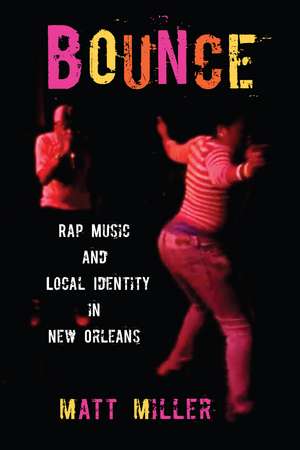
Bounce: Rap Music and Local Identity in New Orleans: American Popular Music
Autor Matt Milleren Limba Engleză Paperback – 18 mai 2012
Hip-hop has been the latest conduit for a “New Orleans sound” that lies at the heart of many of the city's best-known contributions to earlier popular music genres. Bounce, while globally connected and constantly evolving, reflects an enduring cultural continuity that reaches back and builds on the city's rich musical and cultural traditions.
In this book, the popular music scholar and filmmaker Matt Miller explores the ways in which participants in New Orleans's hip-hop scene have collectively established, contested, and revised a distinctive style of rap that exists at the intersection of deeply rooted vernacular music traditions and the modern, globalized economy of commercial popular music. Like other forms of grassroots expressive culture in the city, New Orleans rap is a site of intense aesthetic and economic competition that reflects the creativity and resilience of the city's poor and working-class African Americans.
Din seria American Popular Music
-
 Preț: 355.33 lei
 -
 Preț: 237.64 lei
 -
 Preț: 304.15 lei
 -
 Preț: 292.71 lei
 -
 Preț: 255.98 lei
 - 7%
 Preț: 191.56 lei
 -
 Preț: 214.56 lei
 -
 Preț: 215.20 lei
Preț: 213.26 lei
Puncte Express: 320
Carte indisponibilă temporar
Doresc să fiu notificat când acest titlu va fi disponibil:
Se trimite...
Specificații
ISBN-13: 9781558499362
ISBN-10: 1558499369
Pagini: 232
Ilustrații: 8 b&w illus.
Dimensiuni: 152 x 229 x 18 mm
Greutate: 0.4 kg
Ediția:First Edition
Editura: University of Massachusetts Press
Colecția University of Massachusetts Press
Seria American Popular Music
ISBN-10: 1558499369
Pagini: 232
Ilustrații: 8 b&w illus.
Dimensiuni: 152 x 229 x 18 mm
Greutate: 0.4 kg
Ediția:First Edition
Editura: University of Massachusetts Press
Colecția University of Massachusetts Press
Seria American Popular Music
Notă biografică
MATT MILLER completed his PhD at Emory University, where he continues to teach American Studies. He was codirector of the documentary film Ya Heard Me (2008), presenting the history of bounce music and bounce artists. Matt Miller has a blog http://mattmillerbounce.blogspot.com with music tracks for each of the chapters in his book.
Cuprins
List of Illustrations
Acknowledgments
Introduction
1. African American Life and Culture in New Orleans: From Congo Square to Katrina and Beyond
2. “The City That Is Overlooked”: Rap Beginnings, 1980–1991
3. “Where They At”: Bounce, 1992–1994
4. “Bout It”: New Orleans Breaking Through, 1995–2000
5. “Lights Out”: Stagnation, Decline, and the Resurgence of the Local, 2001–2005
6. Bouncing Back: After Katrina, Toward an Uncertain Future
Notes
New Orleans Rap: A Selected Discography
Index
Acknowledgments
Introduction
1. African American Life and Culture in New Orleans: From Congo Square to Katrina and Beyond
2. “The City That Is Overlooked”: Rap Beginnings, 1980–1991
3. “Where They At”: Bounce, 1992–1994
4. “Bout It”: New Orleans Breaking Through, 1995–2000
5. “Lights Out”: Stagnation, Decline, and the Resurgence of the Local, 2001–2005
6. Bouncing Back: After Katrina, Toward an Uncertain Future
Notes
New Orleans Rap: A Selected Discography
Index
Recenzii
“Miller leaves no stone unturned, focusing on every conceivable way bounce has affected New Orleans. . . . Bounce is a comprehensive history and should stand as the go-to document for anyone looking to read up on one of the most important music genres in the country.”—Off Beat
“Miller's research is more than thorough. He convincingly establishes bounce as yet another offshoot of New Orleans's unique musical culture.”—PopMatters
“While Bounce: Rap Music and Local Identity in New Orleans is indeed the first book of its kind on the subject, its importance lies not so much in this distinction as it does in the thoughtful perspectives that inform its methodology. Careful not to approach bounce music in either musical or cultural isolation, Miller considers the realities of New Orleans's geographic and socio-spatial history, the city's long tradition of public street performance, the central role of the housing projects, the stark materialities of racialized poverty and violence, and the effects of Hurricane Katrina, displacement, and the right to return, largely without falling into the trap of romanticization and/or morbid glorification that so many others writing on the subject do. subject do. . . . Miller provides readers with a solid resource that can and will be used by writers, journalists, music critics, culture workers, and enthusiasts alike as a point of departure for further exploration and reflection.”—Southern Spaces
“Miller's book is important, if for no other reason than its placement of Sissy Bounce within the realm of contemporary subaltern cultural production.”—Journal of African American History
“Bounce uses the tools of the historian, the musicologist, and the sociologist as it works to create a portrait of rap music in New Orleans that at once places bounce in a legible history of African American cultural life while also paying careful attention to the particularities of New Orleans's unique musical cultures.”—Jeffrey Melnick, author of 9/11 Culture and coeditor of American Popular Music: New Approaches to the Twentieth Century
“Miller's research is more than thorough. He convincingly establishes bounce as yet another offshoot of New Orleans's unique musical culture.”—PopMatters
“While Bounce: Rap Music and Local Identity in New Orleans is indeed the first book of its kind on the subject, its importance lies not so much in this distinction as it does in the thoughtful perspectives that inform its methodology. Careful not to approach bounce music in either musical or cultural isolation, Miller considers the realities of New Orleans's geographic and socio-spatial history, the city's long tradition of public street performance, the central role of the housing projects, the stark materialities of racialized poverty and violence, and the effects of Hurricane Katrina, displacement, and the right to return, largely without falling into the trap of romanticization and/or morbid glorification that so many others writing on the subject do. subject do. . . . Miller provides readers with a solid resource that can and will be used by writers, journalists, music critics, culture workers, and enthusiasts alike as a point of departure for further exploration and reflection.”—Southern Spaces
“Miller's book is important, if for no other reason than its placement of Sissy Bounce within the realm of contemporary subaltern cultural production.”—Journal of African American History
“Bounce uses the tools of the historian, the musicologist, and the sociologist as it works to create a portrait of rap music in New Orleans that at once places bounce in a legible history of African American cultural life while also paying careful attention to the particularities of New Orleans's unique musical cultures.”—Jeffrey Melnick, author of 9/11 Culture and coeditor of American Popular Music: New Approaches to the Twentieth Century