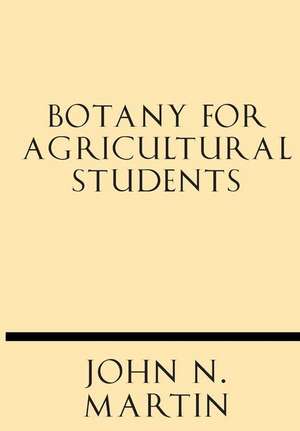
Botany for Agricultural Students
Autor John N. Martinen Limba Engleză Paperback
Considerăm că înțelegerea profundă a pământului începe cu stăpânirea mecanismelor invizibile care guvernează viața vegetală. Botany for Agricultural Students propune o incursiune academică și totodată practică în universul botanicii, structurată în 24 de capitole ce disecă viața plantelor de la nivel celular până la dinamica ecosistemelor. Spre deosebire de manualele moderne, această ediție de la Windham Press păstrează farmecul și rigoarea perioadei clasice, fiind o reproducere fidelă ce evită erorile de scanare digitală și onorează munca tipografilor de odinioară.
Fanii lucrării Botany de D. Thoday vor recunoaște aceeași atenție la clasificarea sistematică și la relația plantelor cu mediul, însă John N. Martin extinde perspectiva către aplicații agricole directe, precum analiza purității semințelor și fiziologia tăierilor. Partea a doua a volumului face tranziția de la structură la ereditate și evoluție, oferind o bază teoretică solidă pentru ceea ce numim astăzi ameliorarea plantelor. Putem afirma că stilul autorului este unul analitic, reflectând rigoarea pe care acesta o aplică și în alte lucrări ale sale, precum cele dedicate logicii carteziene sau neoplatonice, transformând un subiect tehnic într-o expunere logică și coerentă.
Deși este un volum dens de aproape 600 de pagini, ritmul lecturii este susținut de ilustrațiile originale care facilitează înțelegerea proceselor complexe precum osmoza sau diviziunea celulară. Este o resursă care nu doar informează, ci conectează cititorul la o tradiție a cunoașterii în care știința agricolă era privită ca o artă a observației minuțioase.
Preț: 183.36 lei
Carte disponibilă
Livrare economică 25 mai-08 iunie
Specificații
ISBN-10: 1628452404
Pagini: 598
Dimensiuni: 170 x 244 x 31 mm
Greutate: 0.94 kg
Editura: Windham Press
V-ar putea interesa
-
 Preț: 150.92 lei
 -
 Preț: 127.58 lei
 -
 -15%Preț: 423.30 lei498.00 lei
 -
 The Reason for FlowersStephen BuchmannPreț: 105.39 lei
 -
 Preț: 86.17 lei
 -
 Basic Illustrated Edible and Medicinal MushroomsJim MeuninckPreț: 78.09 lei
 -
 Posthuman PlantsJohn Charles RyanPreț: 293.54 lei
 -
 Chainsaw LumbermakingWill MalloffPreț: 191.51 lei
 -
 Planner JournalSpeedy Publishing LLCPreț: 79.03 lei
 -
 Plant JournalSpeedy Publishing LLCPreț: 79.03 lei
 -
 -31%Preț: 129.38 lei188.26 lei
 -
 The Scout's Guide to Wild EdiblesMike KrebillPreț: 98.19 lei
 -
 Commercial OrchidsLakshman Chandra De-18%Preț: 818.68 lei998.39 lei
De ce să citești această carte
Recomandăm această carte studenților la agronomie și grădinarilor pasionați care doresc să depășească nivelul sfaturilor empirice. Veți câștiga o înțelegere științifică asupra modului în care nutriția, germinația și genetica influențează sănătatea culturilor. Este un instrument esențial pentru oricine dorește să stăpânească biologia plantelor prin intermediul unei lucrări de referință, prezentată într-un format clasic, de colecție.
Descriere scurtă
By John N. Martin
Contents
Introduction
--I--The Nature and Subdivisions of Botany
--II--A General View of Plants
Part I: Plants (Chiefly Seed Plants), as to Structures and Functions
--III--Flowers General characteristics and structure of flowers; Some particular forms of flowers; Arrangement of flowers or inflorescence]
--IV--Pistils and Stamens Structure and function of pistils and stamens; Pollination]
--V--Seeds and Fruits Nature and structure of seeds; Resting period, vitality, and longevity of seeds; Purity and analysis of seeds; Nature and types of fruits of Flowering Plants; dissemination of seeds and fruits]
--VI--Germination of Seeds; Seedlings Nature of germination and factors upon which it depends; Germinative processes; Testing the germinative capacity of seeds; Seedlings]
--VII--Cells and Tissues Structure and function of cells; Respiration; Cell multiplication; General view of tissues]
--VIII--Roots General features of roots; Root structure; Factors influencing the direction of growth in roots; The soil as the home of roots; Water, air, and parasitic roots; Propagation by roots]
--IX--Stems Characteristic features and types of stems; General structure of stems; Structure of monocotyledonous stems; Structure of herbaceous dicotyledonous stems; Structure of woody stems]
--X--Buds: Growth of Stems; Pruning; Propagation by Stems Buds; Growth of stems; Pruning; Propagation by means of stems]
--XI--Leaves Characteristic features of leaves; Primary and secondary leaves; General structure of leaves; Cellular structure of leaves; The manufacture of food by leaves; Factors influencing photosynthesis; Transpiration from plants; Respiration; Special forms of leaves; Uses of the photosynthetic food]
Part II: Plants as to Kinds, Relationships, Evolution, and Heredity
--XII--Introduction
--XIII--Thallophytes Algae]
--XIV--Thallophytes Myxomycetes]
--XV--Thallophytes Fungi]
--XVI--Bryophytes Liverworts and Mosses]
--XVII--Pteridophytes Filicales; Horsetails; Club Mosses; Ferns]
--XVIII--Spermatophytes Gymnosperms; Cycads; Pines]
--XIX--Spermatophytes Angiosperms]
--XX--Classification of Angiosperms and some of Their Families of Most Economic Importance Dicotyledons; Monocotyledons]
--XXI--Ecological classification of plants
--XXII--Evolution
--XXIII--Heredity
--XXIV--Plant Breeding
------------------------------------------------------------------------------------------------------------------------------------------
Windham Press is committed to bringing the lost cultural heritage of ages past into the 21st century through high-quality reproductions of original, classic printed works at affordable prices.
This book has been carefully crafted to utilize the original images of antique books rather than error-prone OCR text. This also preserves the work of the original typesetters of these classics, unknown craftsmen who laid out the text, often by hand, of each and every page you will read. Their subtle art involving judgment and interaction with the text is in many ways superior and more human than the mechanical methods utilized today, and gave each book a unique, hand-crafted feel in its text that connected the reader organically to the art of bindery and book-making.
We think these benefits are worth the occasional imperfection resulting from the age of these books at the time of scanning, and their vintage feel provides a connection to the past that goes beyond the mere words of the text.