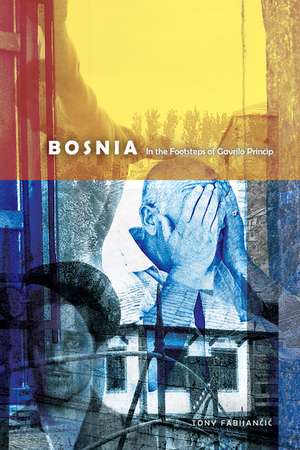
Bosnia: In the Footsteps of Gavrilo Princip
Autor Tony Fabijančićen Limba Engleză Paperback – 25 feb 2010
Preț: 171.51 lei
Preț vechi: 223.67 lei
-23%
Puncte Express: 257
Carte disponibilă
Livrare economică 09-23 noiembrie
Livrare prin curier în România Termenul estimat este afișat lângă disponibilitate.
Transport gratuit de la 400.00 lei Plată online sau ramburs, în funcție de opțiunile comenzii.
Retur gratuit în 14 zile Comandă securizată și suport în română.
Specificații
ISBN-13: 9780888645197
ISBN-10: 0888645198
Pagini: 264
Ilustrații: b/w photos
Dimensiuni: 152 x 229 x 13 mm
Greutate: 0.3 kg
Editura: University of Alberta Press
Colecția University of Alberta Press
Locul publicării:Edmonton, Canada
ISBN-10: 0888645198
Pagini: 264
Ilustrații: b/w photos
Dimensiuni: 152 x 229 x 13 mm
Greutate: 0.3 kg
Editura: University of Alberta Press
Colecția University of Alberta Press
Locul publicării:Edmonton, Canada
Recenzii
Behind one of the twentieth century's most infamous events lies the forgotten story of Gavrilo Princip, Archduke Franz Ferdinand's assassin and unlikely catalyst of the Great War. Inspired by the idealism of the young Princip, Tony Fabijancic sets off on an unprecedented journey, shadowing the ghost of the assassin from the peasant village of his birth, across the rugged breadth of Bosnia-Herzegovina, to his fateful meeting in Sarajevo with the heir apparent to the Austro-Hungarian Empire. A human portrait of Princip emerges as Fabijancic, accompanied by his father, plunges us into the roiling heart of Bosnia then and now. Two parallel journeys flow into one compelling story that takes readers interested in Balkan nationalism, political terrorism, and literary travel writing on a unique journey through a complex land. The son of a Croatian immigrant who escaped Yugoslavia in 1964, Tony Fabijancic was born in Edmonton, Alberta. He is an Associate Professor of English at Memorial University in Corner Brook, Newfoundland, and the author of Croatia: Travels in Undiscovered Country.
"The past century has been filled with tumultuous times for the nation of Bosnia. Bosnia: In the Footsteps of Gavrilo Princip looks at the history of Bosnia, using the model of the assassin of Archduke Franz Ferdinand, Gavrilo Princip. What drove him to start a war that claimed countless lives and how his actions are still felt to this day as Bosnia struggles to find its own national identity and place in the world. Bosnia is a riveting and educational read, not to be missed." Midwest Book Review, July 2010
"Fabijancic combines travelogue and history through biographically and physically retracing the life journey of Gavrilo Princip, the Bosnian Serb who assassinated Archduke Franz Ferdinand in 1914, thereby setting off the chain of events that would lead to the First World War. The history and the travelogue together reflect on the history and current realities of the contentious ethnic relations of the former Yugoslavia." Reference and Research Book News, August 2010
"From the perspective of a road trip, with anecdotes and photographs that make the journey more personal, a reader learns the history of the region from Austria-Hungary¹s occupation through the Baltic Wars, the breakup of Yugoslavia, and the Balkan Wars in the 1990s, as well as the religious differences (Muslim, Catholic, and Orthodox) and the racial divide that still fuels pride and conflict.... This is not a dry readSit¹s sobering but still amusing at times--it reads like a novel. It reminded me a bit of Andrzej Stasuik¹s Fado although exploring a different region. This is the way history should be read-through lively narration and not dry data and charts. I am terribly enthusiastic about this book because it feels valuable-it doesn¹t solve the problems there but by neutral observation it helps an outsider understand them, as well as the bigger picture of the brutality of mankind¹s yearning for domination. The photography should be noted: the black and white images are stark and bring out the humanity in the faces shown." http://www.theblacksheepdances.com
"Fabijancic and his Croatian-born father follow Princip's path as he joins a river of progress that leads him to university, involvement with the Serbian national movement and, ultimately, to murder. Along the way they travel through thee borderlands of the modern states of Serbia, Croatia, and Bosnia-Herzegovina, juxtaposing the ethnic cleansing of the 1990s with the earlier nationalist frenzy in the Balkans.. Princip was assisted by a band of young men much like himself..and one gets the impression that they, like modern-day terrorists, were more interested in achieving greatness than in achieving any specific aim. The same can't be said of the perpetrators of the 1990s massacres.. Fabijancic's travels in search of Princip are also travels through the sites of some of the most infamous atrocities of the 1990s, and he comes face-to-face with the rivalries and resentments that both stem from and predate that bloody time. It's a sad journey, with only the smallest glimpses of hope." Alex Rettie, Alberta Views, March 2011
"The past century has been filled with tumultuous times for the nation of Bosnia. Bosnia: In the Footsteps of Gavrilo Princip looks at the history of Bosnia, using the model of the assassin of Archduke Franz Ferdinand, Gavrilo Princip. What drove him to start a war that claimed countless lives and how his actions are still felt to this day as Bosnia struggles to find its own national identity and place in the world. Bosnia is a riveting and educational read, not to be missed." Midwest Book Review, July 2010
"Fabijancic combines travelogue and history through biographically and physically retracing the life journey of Gavrilo Princip, the Bosnian Serb who assassinated Archduke Franz Ferdinand in 1914, thereby setting off the chain of events that would lead to the First World War. The history and the travelogue together reflect on the history and current realities of the contentious ethnic relations of the former Yugoslavia." Reference and Research Book News, August 2010
"From the perspective of a road trip, with anecdotes and photographs that make the journey more personal, a reader learns the history of the region from Austria-Hungary¹s occupation through the Baltic Wars, the breakup of Yugoslavia, and the Balkan Wars in the 1990s, as well as the religious differences (Muslim, Catholic, and Orthodox) and the racial divide that still fuels pride and conflict.... This is not a dry readSit¹s sobering but still amusing at times--it reads like a novel. It reminded me a bit of Andrzej Stasuik¹s Fado although exploring a different region. This is the way history should be read-through lively narration and not dry data and charts. I am terribly enthusiastic about this book because it feels valuable-it doesn¹t solve the problems there but by neutral observation it helps an outsider understand them, as well as the bigger picture of the brutality of mankind¹s yearning for domination. The photography should be noted: the black and white images are stark and bring out the humanity in the faces shown." http://www.theblacksheepdances.com
"Fabijancic and his Croatian-born father follow Princip's path as he joins a river of progress that leads him to university, involvement with the Serbian national movement and, ultimately, to murder. Along the way they travel through thee borderlands of the modern states of Serbia, Croatia, and Bosnia-Herzegovina, juxtaposing the ethnic cleansing of the 1990s with the earlier nationalist frenzy in the Balkans.. Princip was assisted by a band of young men much like himself..and one gets the impression that they, like modern-day terrorists, were more interested in achieving greatness than in achieving any specific aim. The same can't be said of the perpetrators of the 1990s massacres.. Fabijancic's travels in search of Princip are also travels through the sites of some of the most infamous atrocities of the 1990s, and he comes face-to-face with the rivalries and resentments that both stem from and predate that bloody time. It's a sad journey, with only the smallest glimpses of hope." Alex Rettie, Alberta Views, March 2011