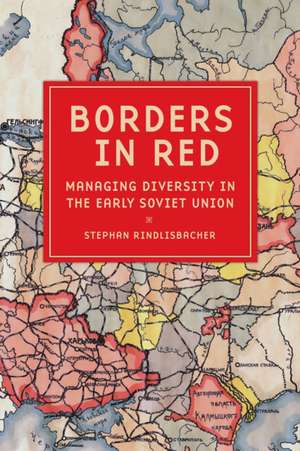
Borders in Red: NIU Series in Slavic, East European, and Eurasian Studies
Autor Stephan Rindlisbacheren Limba Engleză Hardback – 15 apr 2025
President Putin has condemned Lenin's nationality policy to be a historical mistake, and with its war against Ukraine, Russia has tried to revise borders that date back to the early days of the Soviet state. However, Borders in Red shows that the Soviet Republics were not arbitrarily divided by leaders like Stalin or Khrushchev. They were the result of long-lasting debates involving politicians, experts, and people from the border regions. The developing Soviet order was a product of trial and error.
Din seria NIU Series in Slavic, East European, and Eurasian Studies
-
 Preț: 186.14 lei
 -
 Preț: 410.01 lei
 -
 Preț: 372.87 lei
 -
 Preț: 254.30 lei
 -
 Preț: 286.30 lei
 -
 Preț: 438.71 lei
 -
 Preț: 315.40 lei
 -
 Preț: 258.47 lei
 -
 Preț: 219.46 lei
 -
 Preț: 250.25 lei
 -
 Preț: 381.96 lei
 -
 Preț: 183.01 lei
 -
 Preț: 261.08 lei
 -
 Preț: 209.26 lei
 - 27%
 Preț: 808.38 lei
 -
 Preț: 440.59 lei
 -
 Preț: 281.19 lei
 -
 Preț: 199.19 lei
 -
 Preț: 229.74 lei
 -
 Preț: 438.38 lei
 -
 Preț: 240.81 lei
 -
 Preț: 472.07 lei
 -
 Preț: 412.23 lei
 - 27%
 Preț: 768.33 lei
 -
 Preț: 459.93 lei
 -
 Preț: 369.53 lei
 - 27%
 Preț: 770.90 lei
 -
 Preț: 224.30 lei
 -
 Preț: 192.72 lei
 -
 Preț: 218.64 lei
 -
 Preț: 422.81 lei
 - 27%
 Preț: 775.08 lei
 -
 Preț: 495.25 lei
 -
 Preț: 476.40 lei
 -
 Preț: 255.64 lei
 -
 Preț: 471.17 lei
 - 27%
 Preț: 804.15 lei
 -
 Preț: 469.66 lei
 - 27%
 Preț: 788.59 lei
 -
 Preț: 295.57 lei
 -
 Preț: 281.23 lei
 -
 Preț: 442.26 lei
 -
 Preț: 173.34 lei
 -
 Preț: 453.21 lei
 -
 Preț: 241.71 lei
 -
 Preț: 434.42 lei
 -
 Preț: 445.95 lei
Preț: 794.45 lei
Preț vechi: 1031.75 lei
-23%
Puncte Express: 1192
Carte indisponibilă temporar
Doresc să fiu notificat când acest titlu va fi disponibil:
Se trimite...
Specificații
ISBN-13: 9781501780530
ISBN-10: 1501780530
Pagini: 294
Dimensiuni: 152 x 229 mm
Greutate: 0.91 kg
Editura: Cornell University Press
Seria NIU Series in Slavic, East European, and Eurasian Studies
ISBN-10: 1501780530
Pagini: 294
Dimensiuni: 152 x 229 mm
Greutate: 0.91 kg
Editura: Cornell University Press
Seria NIU Series in Slavic, East European, and Eurasian Studies
V-ar putea interesa
-
 Fulfilling the PledgeRoger C. HartleyPreț: 354.36 lei
 -
 Their Accomplices Wore RobesBrando Simeo StarkeyPreț: 237.00 lei
 -
 Private Finance, Public Power - A History of Bank Supervision in AmericaPeter Conti-BrownPreț: 307.44 lei
 -
 The Bailout State - Why governments rescue banks, not peopleMartijn KoningsPreț: 140.33 lei
 -
 The Hidden GlobeAtossa Araxia Abrahamian-38%Preț: 98.61 lei159.73 lei
 -
 The Handy Law Answer BookDavid L. HudsonPreț: 170.67 lei
 -
 In Our Future We Are FreeNell BernsteinPreț: 169.89 lei
 -
 As Public as PossibleDavid I BackerPreț: 170.74 lei
 -
 ScannedNick Corbishley-19%Preț: 74.59 lei92.43 lei
 -
 Our Land: The MaritimesG.P. Gould-10%Preț: 140.07 lei155.04 lei
 -
 KaputWolfgang MunchauPreț: 79.03 lei
 -
 Accounts for Solicitors 2025/26KemptonPreț: 355.50 lei
 -
 Preț: 363.87 lei
 -
 With the Law on Our SideLady HalePreț: 191.77 lei
 -
 AffrilachiaChris Aluka BerryPreț: 409.90 lei
 -
 -24%Preț: 907.38 lei1193.93 lei
 -
 Preț: 139.12 lei
 -
 Pakistan Insights 2021-22Tilak DevasherPreț: 312.00 lei
Notă biografică
Stephan Rindlisbacher is a postdoctoral researcher at the European University Viadrina Frankfurt (Oder).
Cuprins
Introduction
1. The Leninian Moment: Making the Soviet State
2. Gosplan: How to Achieve SpatialHomogeneity
3. Ukraine and the RSFSR: Howto Find a Common Border
4. Central Asia: How to Discuss aCommon Border
5. Armenia and Azerbaijan: Howto Search for a Common Border
6. How to Contextualize"Khrushchev'sGift"?
Conclusion
1. The Leninian Moment: Making the Soviet State
2. Gosplan: How to Achieve SpatialHomogeneity
3. Ukraine and the RSFSR: Howto Find a Common Border
4. Central Asia: How to Discuss aCommon Border
5. Armenia and Azerbaijan: Howto Search for a Common Border
6. How to Contextualize"Khrushchev'sGift"?
Conclusion