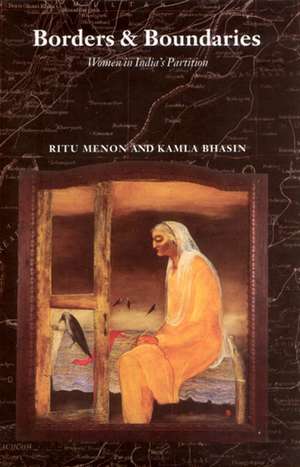
Borders and Boundaries: How Women Experienced the Partition of India
Autor Ritu Menonen Limba Engleză Paperback – mai 1998
As an event of shattering consequence, the Partition of India remains significant today. While Partition sounds smooth on paper, the reality was horrific. More than eight million people migrated and one million died in the process. The forced migration, violence between Hindus and Muslims, and mass widowhood were unprecedented and well-documented. What was less obvious but equally real was that millions of people had to realign their identities, uncertain about who they thought they were. The rending of the social and emotional fabric that took place in 1947 is still far from mended.
While there are plenty of official accounts of Partition, there are few social histories and no feminist histories. Borders and Boundaries changes that, providing first-hand accounts and memoirs, juxtaposed alongside official government accounts. The authors make women not only visible but central. They explore what country, nation, and religious identity meant for women, and they address the question of the nation-state and the gendering of citizenship.
In the largest ever peace-time mass migration of people, violence against women became the norm. Thousands of women committed suicide or were done to death by their own kinsmen. Nearly 100,000 women were "abducted" during the migration. A young woman might have been separated from her family when a convoy was ambushed, abducted by people of another religion, forced to convert, and forced into marriage or cohabitation. After bearing a child, she would be offered the opportunity to return only if she left her child behind and if she could face shame in her natal community. These stories do not paint their subjects as victims. Theirs are the stories of battles over gender, the body, sexuality, and nationalism-stories of women fighting for identity.
While there are plenty of official accounts of Partition, there are few social histories and no feminist histories. Borders and Boundaries changes that, providing first-hand accounts and memoirs, juxtaposed alongside official government accounts. The authors make women not only visible but central. They explore what country, nation, and religious identity meant for women, and they address the question of the nation-state and the gendering of citizenship.
In the largest ever peace-time mass migration of people, violence against women became the norm. Thousands of women committed suicide or were done to death by their own kinsmen. Nearly 100,000 women were "abducted" during the migration. A young woman might have been separated from her family when a convoy was ambushed, abducted by people of another religion, forced to convert, and forced into marriage or cohabitation. After bearing a child, she would be offered the opportunity to return only if she left her child behind and if she could face shame in her natal community. These stories do not paint their subjects as victims. Theirs are the stories of battles over gender, the body, sexuality, and nationalism-stories of women fighting for identity.
Preț: 295.20 lei
Puncte Express: 443
Preț estimativ în valută:
52.25€ • 60.70$ • 45.27£
52.25€ • 60.70$ • 45.27£
Carte tipărită la comandă
Livrare economică 02-16 martie
Preluare comenzi: 021 569.72.76
Specificații
ISBN-13: 9780813525525
ISBN-10: 0813525527
Pagini: 288
Dimensiuni: 140 x 216 x 20 mm
Greutate: 0.34 kg
Ediția:None
Editura: Rutgers University Press
Colecția Rutgers University Press
ISBN-10: 0813525527
Pagini: 288
Dimensiuni: 140 x 216 x 20 mm
Greutate: 0.34 kg
Ediția:None
Editura: Rutgers University Press
Colecția Rutgers University Press
V-ar putea interesa
-
 Women and the New Business LeadershipP. ThomsonPreț: 375.57 lei
 -
 Exile Through a Gendered LensG. ZinnPreț: 371.77 lei
 -
 Preț: 372.15 lei
 -
 Preț: 375.07 lei
 -
 Incomplete RevolutionGosta Esping-AndersenPreț: 151.49 lei
 -
 Women and Poverty in 21st Century AmericaPaula vW DailPreț: 192.55 lei
 -
 I Am an Emotional CreatureEve Ensler-22%Preț: 73.93 lei94.47 lei
 -
 A Jewish Feminine Mystique?Hasia DinerPreț: 305.07 lei
 -
 Women and the Animal Rights MovementEmily GaarderPreț: 275.02 lei
 -
 Bad Shoes: And the Women Who Love ThemLeora Tanenbaum-43%Preț: 49.30 lei86.18 lei
 -
 -27%Preț: 76.50 lei104.17 lei
 -
 Passing Through Missing PagesFrances Welwood-5%Preț: 104.57 lei110.38 lei
 -
 StrippedJennifer Hayashi DannsPreț: 62.16 lei
Notă biografică
RITU MENON is an independent scholar and co-publisher of Kali. She is co-editor of Against All Odds: Essays on Women, Religion, and Development from India and Pakistan. KAMLA BHASIN has written extensively on participatory training for women and on sustainable development.
Descriere
As an event of shattering consequence, the Partition of India remains significant. While Partition sounds smooth on paper, the reality was horrific. While there are many official accounts of Partition, there are few social histories and no feminist histories. Borders and Boundaries changes that, providing first-hand accounts and memoirs, juxtaposed alongside official government accounts.