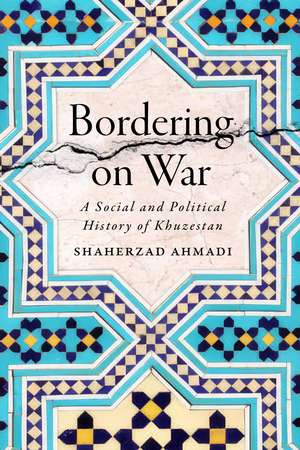
Bordering on War: A Social and Political History of Khuzestan: Connected Histories of the Middle East and the Global South
Autor Shaherzad Ahmadien Limba Engleză Hardback – 3 dec 2024
Observăm în Bordering on War o abordare interdisciplinară riguroasă, situată la intersecția dintre istoria politică, sociologia migrației și studiile de frontieră. Lucrarea propune o perspectivă inedită asupra provinciei Khuzestan, una dintre cele mai vechi și bogate regiuni ale Iranului, transformând-o dintr-un simplu teatru de război într-un spațiu vibrant al negocierii identitare. Ne-a atras atenția modul în care Shaherzad Ahmadi reușește să destabilizeze narațiunile naționaliste rigide, demonstrând cum locuitorii de la graniță au cultivat loialități non-naționale care au sfidat presiunile birocratice ale Teheranului și Bagdadului.
Descoperim aici o structură cronologică bine definită, care ghidează cititorul prin deceniile critice de dinaintea conflictului din 1980. De la impactul anilor Arif (1963–1968) până la tensiunile provocate de politicile Partidului Ba'ath, cuprinsul indică o progresie de la micro-istoria comunităților locale către analiza macro-politică a Revoluției și a războiului. Un element distinctiv al acestei ediții este utilizarea unor surse primare în limbile persană și arabă, adesea inaccesibile cercetătorilor occidentali, ceea ce oferă o profunzime documentară rară.
Ca alternativă la The Boundaries of Modern Iran de Keith Mclachlan pentru cursurile de istorie a Orientului Mijlociu, lucrarea lui Ahmadi aduce avantajul unei „istorii de jos”, concentrată pe agenția umană și pe viața cotidiană a migranților și liderilor provinciali. În timp ce studiile anterioare se axau pe delimitări teritoriale și tratate diplomatice, Bordering on War pune accent pe modul în care educația, comerțul și religia au creat un mediu transnațional complex, oferind o înțelegere nuanțată a ceea ce înseamnă apartenența națională într-o zonă de contact etnic.


Preț: 429.19 lei
Carte disponibilă
Livrare economică 09-23 noiembrie
Specificații
ISBN-10: 1477329935
Pagini: 280
Ilustrații: 1 map
Dimensiuni: 152 x 229 x 28 mm
Greutate: 0.54 kg
Editura: University of Texas Press
Colecția University of Texas Press
Seria Connected Histories of the Middle East and the Global South
De ce să citești această carte
Această monografie este esențială pentru cercetătorii și studenții interesați de istoria Iranului modern și de dinamica conflictelor transfrontaliere. Cititorul câștigă o înțelegere profundă a modului în care identitățile etnice și regionale pot influența geopolitica globală. Este o recomandare solidă pentru cei care doresc să depășească clișeele despre războiul Iran-Irak, descoperind rolul activ al comunităților arabe din Khuzestan în modelarea istoriei ambelor state.
Despre autor
Shaherzad Ahmadi este o specialistă în istoria Orientului Mijlociu, recunoscută pentru capacitatea sa de a lucra cu arhive multilingve complexe. Cercetarea sa se concentrează pe regiunile de frontieră, migrație și construcția identității naționale în contextul Iranului și Irakului. Prin volumul de față, publicat în prestigioasa serie a University of Texas Press, Ahmadi aduce o contribuție semnificativă la istoriografia modernă, fiind unul dintre puținii academicieni care integrează perspectivele ambelor părți ale graniței prin utilizarea fluidă a surselor în arabă și persană.
Descriere scurtă
In 1980, Saddam Hussein’s Ba‘athist forces invaded Khuzestan, one of the oldest and richest provinces in Iran, triggering the Iran-Iraq War. Shaherzad Ahmadi’s Bordering on War examines the social history of Khuzestan and sheds light on how border dwellers, provincial leaders, and migrants in the region shaped Iran and Iraq's history before, during, and after the war.
Drawing from a rich collection of Persian- and Arabic-language archival sources—rarely used by western scholars due to restrictions in Iran—Ahmadi’s research focuses on Arab Iranians and argues that Iranian border dwellers and migrants formed local, non-national loyalties, thereby eschewing bureaucratic pressures to confine loyalties to a single nation-state. The transnational character and ethnically diverse composition of Khuzestan, especially in the oil-rich towns on the southwestern border, led many, including Iraq’s Ba‘ath Party, to question the national belonging of Arab Iranians. Bordering on War contributes to a wider discussion about the ability of individuals and communities to exert agency through migration, trade, education, and other activities.
Notă biografică
Cuprins
- Acknowledgments
- Note on Transliteration
- Introduction. Khuzestan, a Borderland--Writing a Connected History
- 1. Leveraging Loyalty in the Borderland
- 2. Luring and Repelling Iranians: Abd al-Karim Qasim, 1958–1963
- 3. An Ambiguous Borderland Milieu: The Impact of the Arif Years, 1963–1968
- 4. Arab Iranians and Arabized Iranians: The Baath Party, 1968–1975
- 5. Nationality and Loyalty: The Baath and Iraqis of Iranian Descent
- 6. A National Narrative of Revolution: Subsuming the Local, 1978–1979
- 7. Khorramshahr and Abadan, May–July 1979
- 8. The Iran–Iraq War: A Denouement
- Conclusion
- Notes
- Index
Recenzii
Ahmadi utilizes both Persian and Arab primary sources to approach Khuzestan’s history with nuance...Her narrative is clear and careful, and her writing detailed...Ahmadi breaks new ground, highlighting aspects of cross-frontier interplay...At a time when too many scholars substitute polemic for fact and theory for research, Ahmadi’s careful scholarship contributes substantially to Iranian studies.
Ahmadi creatively draws on a diverse array of sources to showcase regional perspectives and nonstate actors...Few scholars based in western institutions have sufficient proficiency in both Arabic and Persian to produce scholarship based on both Iranian and Iraqi sources, which is a real strength of this book...The premise and methodology of Ahmadi’s book is tremendously valuable for demonstrating a promising approach to studying liminal border regions.