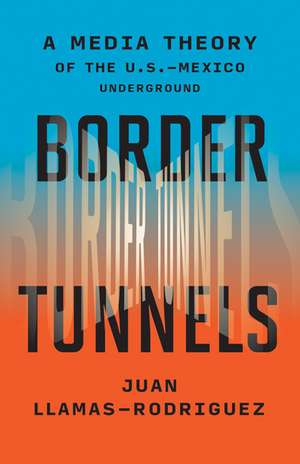
Border Tunnels: A Media Theory of the U.S.-Mexico Underground
Autor Juan Llamas-Rodriguezen Limba Engleză Paperback – 17 oct 2023
Border tunnels at the U.S.–Mexico border are ubiquitous in news, movies, and television, yet, because they remain hidden and inaccessible, the public can encounter them only through media. Analyzing the technologies, institutional politics, narrative tropes, and aesthetic decisions that go into showing border tunnels across multiple forms of media, Juan Llamas-Rodriguez argues that we cannot properly address border issues without attending to—and fully understanding—the fraught relationship between their representation and reality.
Llamas-Rodriguez reveals that every media text about border tunnels, whether meant for entertainment, cable news, video games, or speculative design, implicitly takes a position on the politics of the border. The examples laid out in Border Tunnels will teach readers how to look differently at the border as it is commonly presented in various forms of media, from ABC’s Nightline and CNN’s Anderson Cooper 360º to reality TV, propaganda videos, and even digital effects in Hollywood action films. Llamas-Rodriguez examines how creative decisions in the production, promotion, and distribution of these media texts either emphasize or downplay issues such as border security, racial dynamics of migration, and sustainability of the borderlands.
Focusing on tunnels to show how media representations can influence all kinds of audiences—even those physically near the border—Border Tunnels helps us make sense of this pressing social issue, ultimately advancing understanding of the U.S.–Mexico border in all of its complexity and precariousness.
Preț: 126.24 lei
Puncte Express: 189
Carte disponibilă
Livrare economică 02-16 noiembrie
Livrare express 17-23 octombrie pentru 25.65 lei
Livrare prin curier în România Termenul estimat este afișat lângă disponibilitate.
Transport gratuit de la 400.00 lei Plată online sau ramburs, în funcție de opțiunile comenzii.
Retur gratuit în 14 zile Comandă securizată și suport în română.
Specificații
ISBN-13: 9781517914295
ISBN-10: 1517914299
Pagini: 272
Ilustrații: 80 black and white illustrations
Dimensiuni: 140 x 216 x 18 mm
Greutate: 0.34 kg
Editura: University of Minnesota Press
Colecția Univ Of Minnesota Press
ISBN-10: 1517914299
Pagini: 272
Ilustrații: 80 black and white illustrations
Dimensiuni: 140 x 216 x 18 mm
Greutate: 0.34 kg
Editura: University of Minnesota Press
Colecția Univ Of Minnesota Press
Notă biografică
Juan Llamas-Rodriguez is assistant professor of global media in the Annenberg School for Communication and affiliated faculty with the Center for Latin American and Latinx Studies at the University of Pennsylvania.
Cuprins
Contents
Introduction: A Media Theory of the Border Tunnel
1. TV News and Spectacle
2. Reality TV and Performativity
3. Digital Animation and Plasticity
4. First-Person Shooters and Racialization
5. Speculative Design and Sustainability
Conclusion: Media Theory from the Border Tunnel
Acknowledgments
Notes
Index
Introduction: A Media Theory of the Border Tunnel
1. TV News and Spectacle
2. Reality TV and Performativity
3. Digital Animation and Plasticity
4. First-Person Shooters and Racialization
5. Speculative Design and Sustainability
Conclusion: Media Theory from the Border Tunnel
Acknowledgments
Notes
Index
Recenzii
"Don’t miss this provocative and impressive study of the mediated imaginings and construction of the U.S.–Mexico border. Juan Llamas-Rodriguez’s Border Tunnels provides an original and illuminating investigation of the complex and intertwined subjects of U.S.–Mexico relations, media narratives and video games that focus on border security, and the political rhetoric of marginalization." —Mary Beltrán, author of Latino TV: A History
"Juan Llamas-Rodriguez pushes the limits of media theory to help us think about borders, tunnels, and the complex social and material interrelations that define the U.S.–Mexico border. Subtle, creative, and theoretically sophisticated, Border Tunnels compels us to look at these material structures as media, as social organizers crafted by popular culture, policy, myth, engineering, and surveillance technologies." —Hector Amaya, author of Trafficking: Narcoculture in Mexico and the United States
" The conceptual dilation between such infrastructural thinking and the “tunnelicity” in the chapters’ case studies position Border Tunnels as an exemplary text for film and media studies syllabi. Llamas-Rodriguez’s methodology demonstrates the sociotechnical and political applications of theoretically rich close readings. Beyond scholars of film, media, and borders, the book will strongly appeal to scholars invested in critical ethnic studies, Latinx studies, infrastructure studies, and environmental humanities."—Film Quarterly
"The reading of the book by Llamas-Rodriguez leads us to understand the connections that influence the media, the social imaginaries, and the re-appropriation of spaces within the margins of legality and the clandestine."—Journal of Borderlands Studies
"This clearly written, thoroughly researched interdisciplinary study offers an outstanding contribution to the scholarship, while breaking new ground by examining the mediated image of the border tunnel, which has become a prominent symbol of the US-Mexico border in recent years."—Journal of Cinema and Media Studies
"Llamas- Rodriguez’s informative work convincingly appeals to media makers and consumers to imagine alternatives to hegemonic, racist, and state- sponsored narratives, particularly alternatives that advocate and enact resistance to current border thinking."—Journal of Film and Video
"Juan Llamas-Rodriguez pushes the limits of media theory to help us think about borders, tunnels, and the complex social and material interrelations that define the U.S.–Mexico border. Subtle, creative, and theoretically sophisticated, Border Tunnels compels us to look at these material structures as media, as social organizers crafted by popular culture, policy, myth, engineering, and surveillance technologies." —Hector Amaya, author of Trafficking: Narcoculture in Mexico and the United States
" The conceptual dilation between such infrastructural thinking and the “tunnelicity” in the chapters’ case studies position Border Tunnels as an exemplary text for film and media studies syllabi. Llamas-Rodriguez’s methodology demonstrates the sociotechnical and political applications of theoretically rich close readings. Beyond scholars of film, media, and borders, the book will strongly appeal to scholars invested in critical ethnic studies, Latinx studies, infrastructure studies, and environmental humanities."—Film Quarterly
"The reading of the book by Llamas-Rodriguez leads us to understand the connections that influence the media, the social imaginaries, and the re-appropriation of spaces within the margins of legality and the clandestine."—Journal of Borderlands Studies
"This clearly written, thoroughly researched interdisciplinary study offers an outstanding contribution to the scholarship, while breaking new ground by examining the mediated image of the border tunnel, which has become a prominent symbol of the US-Mexico border in recent years."—Journal of Cinema and Media Studies
"Llamas- Rodriguez’s informative work convincingly appeals to media makers and consumers to imagine alternatives to hegemonic, racist, and state- sponsored narratives, particularly alternatives that advocate and enact resistance to current border thinking."—Journal of Film and Video