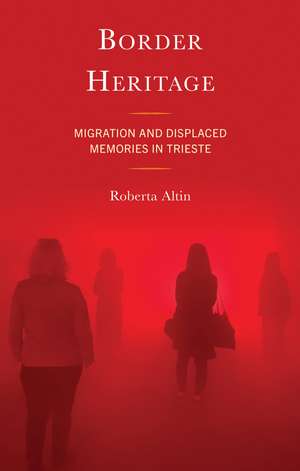
Border Heritage: Migration and Displaced Memories in Trieste: Crossing Borders in a Global World: Applying Anthropology to Migration, Displacement, and Social Change
Autor Roberta Altinen Limba Engleză Hardback – 17 iul 2024
Critically rethinking the heritage of a borderland means rethinking cognitive categories and being able to perceive the different nuances of those on the margins, without necessarily wanting to merge them into a generic "social inclusion" and instead giving them the right to a different voice. This book reverses the monochrome historical perspective to instead adopt the migrants' perspective and make them the subject of study in a set of historical migrations.





Preț: 525.39 lei
Preț vechi: 791.30 lei
-34%
Puncte Express: 788
Carte tipărită la comandă
Livrare economică 24 noiembrie-08 decembrie
Livrare prin curier în România Termenul estimat este afișat lângă disponibilitate.
Transport gratuit pentru acest produs Plată online sau ramburs, în funcție de opțiunile comenzii.
Retur gratuit în 14 zile Comandă securizată și suport în română.
Specificații
ISBN-13: 9781666949490
ISBN-10: 1666949493
Pagini: 226
Ilustrații: 37 BW Illustrations
Dimensiuni: 156 x 232 x 22 mm
Greutate: 0.5 kg
Editura: Bloomsbury Publishing
Colecția Lexington Books
Seria Crossing Borders in a Global World: Applying Anthropology to Migration, Displacement, and Social Change
Locul publicării:New York, United States
ISBN-10: 1666949493
Pagini: 226
Ilustrații: 37 BW Illustrations
Dimensiuni: 156 x 232 x 22 mm
Greutate: 0.5 kg
Editura: Bloomsbury Publishing
Colecția Lexington Books
Seria Crossing Borders in a Global World: Applying Anthropology to Migration, Displacement, and Social Change
Locul publicării:New York, United States
Cuprins
Table of Contents
List of Figures
Acknowledgments
Introduction
Trieste, a Border Area
Chapter 1: Refugees Welcome, Preferably Women: Migrants from Ukraine (2022-)
Story of Tatiana
Open Borders
Gender Issues
True and Bogus Refugees
Migrant Women between East and West
Chapter 2: Game Over? Asylum Seekers via the Balkan Route (2015-)
Story of Abdul
Arriving in Europe
The Balkan Circuit and Network
Different Scales of Solidarity
Changes in "Borderism"
Minors, The Only Way In
Chapter 3: Yugoslavian Assemblage: Refugees from the Former Yugoslavia (1990s-early 2000s)
Story of Arbnore
The Fall of the Federal Republic of Yugoslavia
Grassroots Hospitality
Humanitarianism
Changing Regime
Old and New Europe-Bound Assemblages
Chapter 4: The "Exodus". Displaced Italians from Istria and Dalmatia (1945-1965)
Story of Rita
New Borders and Refugee Relocation
From Exiles to Refugees
In-between Nostalg(Istr)ia
Chapter 5: Borderscape
Refugee Spaces
The Great Human Hub
The Silos and Other Past Refugee Centers
Then and Now: An (im)possible Comparison?
Public Spaces and Emplacement
Chapter 6: Abandoned Things
No Stuff, No Name
Warehouse 18, The Cemetery of Things
Border Archive
Chapter 7: Bordering to Remember: A Critical Approach
Resurfacing Memories
The Past is a Foreign Country
From a Displaced Memory to a Memory of Displacement
Memories United by Humanitarian Reason
Towards some Conclusions
Fuzzy Heritage
References
About the Author
List of Figures
Acknowledgments
Introduction
Trieste, a Border Area
Chapter 1: Refugees Welcome, Preferably Women: Migrants from Ukraine (2022-)
Story of Tatiana
Open Borders
Gender Issues
True and Bogus Refugees
Migrant Women between East and West
Chapter 2: Game Over? Asylum Seekers via the Balkan Route (2015-)
Story of Abdul
Arriving in Europe
The Balkan Circuit and Network
Different Scales of Solidarity
Changes in "Borderism"
Minors, The Only Way In
Chapter 3: Yugoslavian Assemblage: Refugees from the Former Yugoslavia (1990s-early 2000s)
Story of Arbnore
The Fall of the Federal Republic of Yugoslavia
Grassroots Hospitality
Humanitarianism
Changing Regime
Old and New Europe-Bound Assemblages
Chapter 4: The "Exodus". Displaced Italians from Istria and Dalmatia (1945-1965)
Story of Rita
New Borders and Refugee Relocation
From Exiles to Refugees
In-between Nostalg(Istr)ia
Chapter 5: Borderscape
Refugee Spaces
The Great Human Hub
The Silos and Other Past Refugee Centers
Then and Now: An (im)possible Comparison?
Public Spaces and Emplacement
Chapter 6: Abandoned Things
No Stuff, No Name
Warehouse 18, The Cemetery of Things
Border Archive
Chapter 7: Bordering to Remember: A Critical Approach
Resurfacing Memories
The Past is a Foreign Country
From a Displaced Memory to a Memory of Displacement
Memories United by Humanitarian Reason
Towards some Conclusions
Fuzzy Heritage
References
About the Author
Recenzii
Border Heritage is a masterful book that engages in a debate with methodological nationalism. It takes the city of Trieste as an entry point to think in grounded and at the same time comparative terms about migration, border regimes and memories of displacement. It compellingly brings together first-hand empirical research, historical inquiry and intellectual critique.
This study embodies state-of-the art thinking on forced migration, refugees, and borderlands. In her timely and poignant ethnography, Altin traces out the multiple displacements and migrations that have shaped the port city of Trieste and its surrounding region in the modern era. Altin powerfully demonstrates the value and, indeed, the necessity of historicizing Europe's contemporary migration "crises." In doing so, she demonstrates how today's migrants travel paths and inhabit spaces traversed by previous generations on the move. Drawing upon her own childhood experiences in a refugee camp on the outskirts of Trieste, Altin courageously rejects a predominant narrative that disavows identification with today's migrants and that casts them as different and "undeserving" from the European displaced persons generated by the conflicts of the 20th century. With a bold new vision for conceiving of a "border heritage" comprised by migrations and crossings, this study provides a way forward for scholars, policymakers and humanitarian organizations alike. Avoiding the impasses of an abstract humanitarianism that rests on compassion but ultimately denies its recipients both dignity and agency, Altin's proposal for "memory-as-process" in this quintessential European borderland offers indispensable and broader lessons for establishing common ground.
This study embodies state-of-the art thinking on forced migration, refugees, and borderlands. In her timely and poignant ethnography, Altin traces out the multiple displacements and migrations that have shaped the port city of Trieste and its surrounding region in the modern era. Altin powerfully demonstrates the value and, indeed, the necessity of historicizing Europe's contemporary migration "crises." In doing so, she demonstrates how today's migrants travel paths and inhabit spaces traversed by previous generations on the move. Drawing upon her own childhood experiences in a refugee camp on the outskirts of Trieste, Altin courageously rejects a predominant narrative that disavows identification with today's migrants and that casts them as different and "undeserving" from the European displaced persons generated by the conflicts of the 20th century. With a bold new vision for conceiving of a "border heritage" comprised by migrations and crossings, this study provides a way forward for scholars, policymakers and humanitarian organizations alike. Avoiding the impasses of an abstract humanitarianism that rests on compassion but ultimately denies its recipients both dignity and agency, Altin's proposal for "memory-as-process" in this quintessential European borderland offers indispensable and broader lessons for establishing common ground.