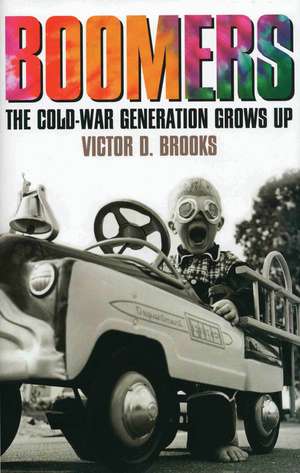
Boomers
Autor Victor D Brooksen Limba Engleză Hardback – 16 mai 2009
Preț: 140.12 lei
Preț vechi: 166.18 lei
-16%
Puncte Express: 210
Carte tipărită la comandă
Livrare economică 16-30 noiembrie
Livrare prin curier în România Termenul estimat este afișat lângă disponibilitate.
Transport gratuit de la 400.00 lei Plată online sau ramburs, în funcție de opțiunile comenzii.
Retur gratuit în 14 zile Comandă securizată și suport în română.
Specificații
ISBN-13: 9781566637244
ISBN-10: 1566637244
Pagini: 208
Dimensiuni: 145 x 222 x 16 mm
Greutate: 0.44 kg
Editura: Bloomsbury Publishing
Locul publicării:New York, United States
ISBN-10: 1566637244
Pagini: 208
Dimensiuni: 145 x 222 x 16 mm
Greutate: 0.44 kg
Editura: Bloomsbury Publishing
Locul publicării:New York, United States
V-ar putea interesa
-
 The Long LifeHelen Small-14%Preț: 302.06 lei349.28 lei
 -
 -5%Preț: 500.98 lei527.34 lei
 -
 An Introduction to GerontologyIan Stuart-HamiltonPreț: 462.18 lei
 -
 The Senior Cohousing Handbook - 2nd EditionCharles DurrettPreț: 281.97 lei
 -
 Nasty, Brutish, and LongIra RosofskyPreț: 130.97 lei
 -
 -19%Preț: 62.95 lei77.47 lei
 -
 Middle AgeChristopher HamiltonPreț: 378.83 lei
 -
 Preț: 275.29 lei
 -
 Preț: 344.01 lei
 -
 Managing the ageing experienceDenise TannerPreț: 292.77 lei
 -
 Preț: 277.39 lei
Cuprins
Preface
Prologue
Chapter 1: Genesis of the Baby Boom
Chapter 2: Home and Family in Early Postwar America
Chapter 3: School Daze: From Split Shifts to Sputnik
Chapter 4: Leisure World
Chapter 5: Sibling Rivalry
Chapter 6: Camelot Kids
Chapter 7: Boomers in Transition: High School to College
Chapter 8: Growing Up in the Great Society
Chapter 9: Challenging the Establishment
Chapter 10: The Summer of '69 and Beyond
Chapter 11: A Good Time to Grow Up
Prologue
Chapter 1: Genesis of the Baby Boom
Chapter 2: Home and Family in Early Postwar America
Chapter 3: School Daze: From Split Shifts to Sputnik
Chapter 4: Leisure World
Chapter 5: Sibling Rivalry
Chapter 6: Camelot Kids
Chapter 7: Boomers in Transition: High School to College
Chapter 8: Growing Up in the Great Society
Chapter 9: Challenging the Establishment
Chapter 10: The Summer of '69 and Beyond
Chapter 11: A Good Time to Grow Up
Recenzii
An intriguing survey, this is recommended for . . . popular history and social issues.
[Boomers] is packed with historical, demographic and cultural insights about the 'largest generation,' if not 'The Greatest.'
For many older readers, the book offers a highly evocative stroll through memory lane, with captivating references to fads, movies, music, television shows, and toys. Boomers identifies several distinctive features of a postwar childhood, such as the importance of neighborhood-based peer groups; the significance of negotiation and bargaining in large families; the Cold War tensions that colored childhood; and the sense of a common generational identity fostered in schools and by television, movies, and music. . . . Brooks's book is one of a number of new or forthcoming books which will help us move beyond myth, caricature, nostalgic memories, and gross overgeneralization and better understand the lasting imprint of an age cohorts' upbringing and formative experiences.
[Boomers] is packed with historical, demographic and cultural insights about the 'largest generation,' if not 'The Greatest.'
For many older readers, the book offers a highly evocative stroll through memory lane, with captivating references to fads, movies, music, television shows, and toys. Boomers identifies several distinctive features of a postwar childhood, such as the importance of neighborhood-based peer groups; the significance of negotiation and bargaining in large families; the Cold War tensions that colored childhood; and the sense of a common generational identity fostered in schools and by television, movies, and music. . . . Brooks's book is one of a number of new or forthcoming books which will help us move beyond myth, caricature, nostalgic memories, and gross overgeneralization and better understand the lasting imprint of an age cohorts' upbringing and formative experiences.