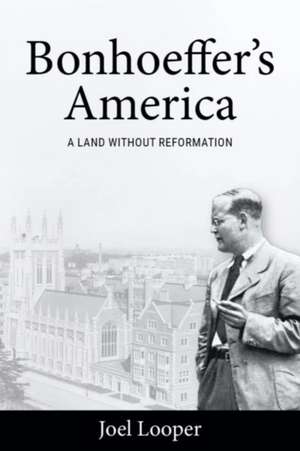
Bonhoeffer's America
Autor Joel Looperen Limba Engleză Hardback – 29 aug 2021
În cadrul studiilor de teologie sistematică și istoria bisericii, analiza lui Dietrich Bonhoeffer asupra peisajului religios american rămâne un punct de referință provocator. Găsim în această lucrare, Bonhoeffer's America, o explorare detaliată a perioadei petrecute de teologul german la Union Theological Seminary în anii 1930, moment în care acesta a diagnosticat ceea ce el numea un „protestantism fără Reformă”. Autorul Joel Looper reconstruiește meticulos contextul în care Bonhoeffer a observat o biserică americană care predica despre orice, mai puțin despre Evanghelia lui Iisus Hristos, cruce sau păcat.
Descoperim aici o perspectivă critică asupra modului în care moștenirea disidentă a bisericilor din SUA a condus la o formă de secularizare internă, făcându-le impermeabile la auto-reflexie teologică. Joel Looper pune în lumină angajamentele barthiene ale lui Bonhoeffer, oferind o lectură academică riguroasă a modului în care acesta a funcționat ca un echivalent teologic al lui Alexis de Tocqueville pentru noul continent. Cititorii familiarizați cu The Theology of Dietrich Bonhoeffer de John D. Godsey vor aprecia modul în care volumul de față aduce un suflu nou cercetării, concentrându-se specific pe interacțiunea dintre teologia continentală și praxisul american, depășind simpla prezentare biografică.
Spre deosebire de alte studii care se concentrează pe viziunea ecleziologică generală, cum este For the Life of the World de Robert J. Dean, lucrarea lui Looper este mult mai ancorată în specificul cultural american, analizând dacă verdictul lui Bonhoeffer rămâne valid în fața provocărilor secolului XXI. Stilul este unul academic, precis, evitând generalizările și oferind o analiză critică a surselor primare, inclusiv a perioadei de detenție a lui Bonhoeffer.
Preț: 435.58 lei
Carte disponibilă
Livrare economică 02-16 noiembrie
Specificații
ISBN-10: 1481314513
Pagini: 278
Dimensiuni: 152 x 229 x 30 mm
Greutate: 0.54 kg
Editura: Baylor University Press
De ce să citești această carte
Această carte este esențială pentru cercetătorii și studenții la teologie care doresc să înțeleagă rădăcinile crizei identitare a protestantismului contemporan. Cititorul câștigă o perspectivă clară asupra distincției dintre teologia reformatorie europeană și evoluția bisericilor americane. Este o recomandare solidă pentru cei interesați de intersecția dintre sociologia religiei și dogmatică, oferind argumente factuale despre secularizarea spațiului eclezial.
Descriere scurtă
In the 1930s, Dietrich Bonhoeffer came to Union Theological Seminary looking for a cloud of witnesses. What he found instead disturbed, angered, and perplexed him. There is no theology here, he wrote to a German colleague. The New York churches, if possible, were even worse: They preach about virtually everything; only one thing is not addressed... namely, the gospel of Jesus Christ, the cross, sin and forgiveness, death and life. Bonhoeffer acts for American Protestantism as an Alexis de Tocqueville, whose Democracy in America, a cultural and political analysis of the new republic, appeared a century prior. But what the Berlin theologian found was, if possible, more significant than the observations of the French aristocrat: Protestantism in America was a Protestantism without Reformation.
Bonhoeffer's America explicates these criticisms, then turns to consider what they tell us about Bonhoeffer's own theological commitments and whether, in fact, his judgments about America were accurate. Joel Looper first brings Bonhoeffer's reformational and Barthian commitments into relief against the work of several Union theologians and the broader American theological milieu. He then turns to Bonhoeffer's own genealogy of American Protestantism to explore why it developed as it did: steeped in dissenting influences, the American church became one that resisted critique by the word of God. American Protestantism is not Protestant, Bonhoeffer shows us, not like the churches that emerged from the Continental Reformation. This difference gave rise to the secularization of the American church.
Bonhoeffer's claims against the church in the United States, Looper contends, hold strong, even after considering objections to this narrative--Bonhoeffer's experience with Abyssinian Baptist Church in Harlem, and the possibility that Bonhoeffer, during his time in Tegel Prison, abandoned the theological commitments that undergirded his critique. Bonhoeffer's America concludes that what Bonhoeffer saw in America, the twenty-first-century American church should strive to see for itself.